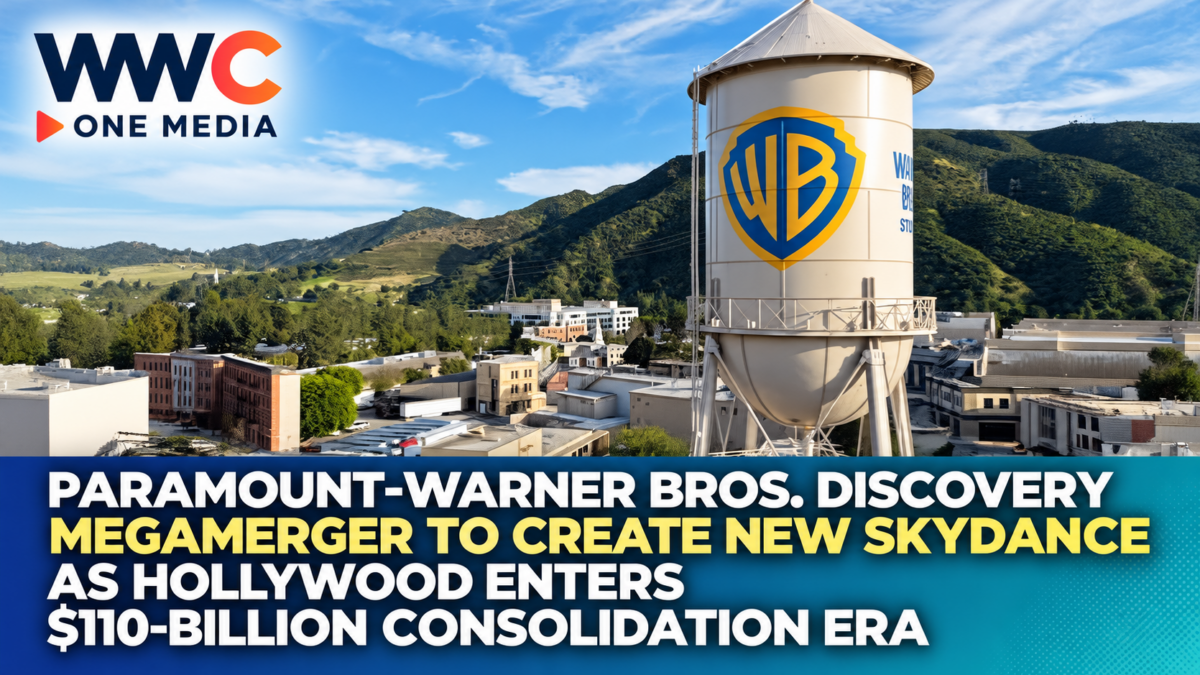
LOS ANGELES — One of the biggest mergers in Hollywood history is now days away from completion, with Paramount Skydance preparing to absorb Warner Bros. Discovery in a roughly $110 billion deal that will combine two century-old studios, HBO Max and Paramount+, CBS and CNN, and some of the most valuable entertainment franchises in the world under a new corporate name: Skydance.
Paramount Skydance CEO David Ellison said the combined company will officially become Skydance once the transaction closes, currently expected on October 6, 2026.
The new group will sit above the existing Paramount and Warner Bros. studio brands rather than replacing those names.
Ellison said the strategy is intended to preserve the identities of the two historic Hollywood studios while giving the enlarged company a separate corporate identity.
The deal is not simply another media acquisition.
It will place under one corporate roof businesses and franchises including:
Warner Bros.
Paramount Pictures
HBO and HBO Max
Paramount+
CBS
CNN
MTV
Comedy Central
Nickelodeon
TBS
Food Network
and major franchises including:
Harry Potter
The Lord of the Rings
DC
Game of Thrones
Mission: Impossible
Top Gun
and
Yellowstone.
A U.S. JUDGE JUST CLEARED THE FINAL BIG LEGAL HURDLE
The merger moved much closer to completion on September 30 when U.S. District Judge Araceli Martínez-Olguín approved a settlement between Paramount and a coalition of 12 states that had sued to block the acquisition on antitrust grounds.
That ruling removed what Variety described as the final remaining barrier to the transaction.
The states had argued that combining Paramount and Warner Bros. Discovery could reduce competition in:
Theatrical film distribution
Cable television
and
News and entertainment markets.
They also warned that the merger could give the combined company greater power over workers, theaters, cable distributors and consumers.
Paramount maintained that the merger would create a stronger competitor in a media industry increasingly dominated by global streaming and technology companies.
THE DEAL COMES WITH MAJOR CONDITIONS
The settlement did not give Paramount a completely free hand.
Among the conditions, the company agreed to release at least 30 films annually in U.S. theaters for five years.
That requirement is designed partly to prevent the merged company from dramatically shrinking theatrical output.
Paramount also committed to approximately $300 million in additional annual domestic production spending.
The company must also maintain separate cable negotiations for certain networks under the settlement terms.
That is intended to reduce concerns that a combined Paramount-Warner operation could use its increased market power to force distributors into less competitive agreements.
CNN AND CBS NEWS WILL ALSO GET SPECIAL OVERSIGHT
News operations became one of the most politically and legally sensitive aspects of the merger.
The settlement requires an independent News Editorial Independence Board designed to protect editorial standards at both CNN and CBS News.
That condition follows months of debate over what a combined company could mean for two of the most prominent U.S. news organizations.
Ellison has separately asked CNN CEO Mark Thompson to remain in his position after the deal closes, according to Reuters.
No final agreement with Thompson had been reached as of October 1.
Reuters reported that Thompson is seeking guarantees covering editorial independence and wider control over CNN’s journalism.
PARAMOUNT WILL NOT SIMPLY SWALLOW THE WARNER BROS. NAME
Ellison’s decision to use Skydance as the new corporate name is strategically important.
Warner Bros. and Paramount are two of the oldest and most recognizable film-studio brands in Hollywood.
Rather than combining them into an awkward hybrid name, Ellison is creating a separate parent identity while allowing both studios to retain their historic labels.
That approach mirrors structures used by some other entertainment conglomerates where the corporate parent differs from the consumer-facing brands underneath it.
For audiences, the Warner Bros. shield and Paramount mountain will remain far more recognizable than the Skydance corporate name.
For Wall Street, however, Skydance will become the identity investors track.
THE NEW COMPANY WILL TRADE UNDER “SKYD”
The combined company is expected to move its Class B shares from Nasdaq to the New York Stock Exchange, where they will trade under the ticker:
SKYD.
That symbolic change marks the completion of a remarkable transformation for Skydance.
What began as David Ellison’s relatively small film-production company will soon become the parent of two of Hollywood’s largest studios and several of America’s biggest television and streaming businesses.
THE PRICE TAG: ABOUT $110 BILLION
The transaction is valued at approximately $110 billion, making it one of the largest media acquisitions ever attempted.
That valuation includes the enormous amount of debt involved in the combined business.
Reuters Breakingviews estimates the new Skydance could carry around $80 billion in debt.
That is one of the biggest risks facing Ellison.
The merged company may own world-famous brands, but it will also have to generate enough cash to service that debt while funding:
Movies
Television productions
Streaming platforms
Sports rights
News organizations
and
Technology investments.
SKydance IS TARGETING MORE THAN $6 BILLION IN SAVINGS
Paramount has said the combination could eventually generate more than $6 billion in cost savings and synergies.
Those savings could come from overlapping areas such as:
Corporate functions
Technology infrastructure
Advertising operations
Distribution
Marketing
and potentially some content-production spending.
But achieving billions of dollars in savings almost always comes with difficult decisions.
Mergers of this size frequently result in:
Job cuts
Management restructuring
Office consolidation
and
Changes in investment priorities.
Hollywood workers will therefore be watching closely to see where those savings actually come from.
MATTEL CEO YNON KREIZ IS JOINING AS CO-CEO
Ellison will not manage the enlarged business alone.
Current Mattel CEO Ynon Kreiz is joining the company on October 5 and will become co-CEO alongside Ellison after the Warner Bros. transaction closes.
Kreiz is one of the more experienced media executives in the industry.
Before Mattel, he led several entertainment companies and later helped reposition Mattel from primarily a toy manufacturer into a broader intellectual-property company.
The success of the Barbie movie demonstrated that strategy dramatically.
Ironically, Barbie itself was distributed by Warner Bros.
Kreiz will now help manage the company that owns that studio.
TWO CEOs COULD HELP — OR COMPLICATE EVERYTHING
The co-CEO structure gives Skydance two experienced leaders.
Ellison is expected to focus heavily on creative strategy and long-term direction.
Kreiz is expected to play a major role in operations and integration.
But shared leadership can also create problems.
Reuters Breakingviews noted that co-CEO arrangements often struggle because major decisions can take longer and authority can become blurred.
That risk becomes even bigger when integrating companies as large and culturally different as Paramount and Warner Bros. Discovery.
THE STREAMING WAR IS ONE OF THE BIGGEST REASONS FOR THE MERGER
The most obvious strategic logic is streaming.
The combined company will own:
Paramount+
and
HBO Max.
Netflix remains the global streaming leader.
Amazon Prime Video, Disney+, Apple TV and other platforms are also competing aggressively for audiences and premium content.
By combining two major streaming businesses, Skydance could potentially reduce duplicated spending and create a larger global content library.
But there is still a major unanswered question:
Will Paramount+ and HBO Max remain separate?
The companies have not yet announced a final long-term platform strategy.
That decision could eventually become one of the most important parts of the entire merger.
NETFLIX ISN’T CONVINCED BIGGER AUTOMATICALLY MEANS BETTER
Netflix co-CEO Ted Sarandos publicly downplayed the idea that combining Paramount and Warner Bros. Discovery automatically creates a stronger streaming competitor.
Speaking this week, Sarandos said the result could be greater than the sum of its parts—or potentially less efficient than expected.
His comments underline a central truth about media consolidation:
combining two content libraries is easy on paper.
Successfully integrating technology, pricing, marketing and corporate cultures is much harder.
WARNER BROS. BRINGS SOME OF HOLLYWOOD’S BIGGEST FRANCHISES
For Ellison, Warner Bros. Discovery offers something extremely difficult to build from scratch:
decades of global intellectual property.
Warner Bros. owns or controls major franchises and brands including:
Harry Potter
DC Comics
Batman
Superman
Game of Thrones
and large portions of the Lord of the Rings film universe.
The company also owns HBO, one of the most prestigious television brands in the world.
These properties can be monetized through:
Movies
Streaming
Television
Video games
Licensing
Consumer products
and
Theme-park partnerships.
That makes intellectual property one of the most valuable assets inside the merger.
PARAMOUNT BRINGS ITS OWN GLOBAL FRANCHISES
Paramount contributes its own major properties.
Its portfolio includes:
Mission: Impossible
Top Gun
Star Trek
Transformers
Sonic the Hedgehog
Yellowstone
and
Nickelodeon brands.
The combined company will therefore control a library spanning generations of film and television audiences.
That gives Skydance enormous potential leverage in streaming and licensing.
But large libraries are expensive to maintain if they do not consistently generate new hits.
CABLE TELEVISION REMAINS A MAJOR PROBLEM
Both companies also own large portfolios of traditional cable networks.
These include:
CNN
TBS
TNT
MTV
Comedy Central
Nickelodeon
and others.
Cable television has been declining for years as consumers cancel pay-TV subscriptions and move toward streaming.
That means the new Skydance will inherit businesses generating substantial cash today but facing structural long-term decline.
Managing that transition could become one of the hardest parts of the merger.
THE DEAL ALMOST ENDED UP IN A FULL ANTITRUST TRIAL
The transaction faced serious legal uncertainty only months ago.
In July, California and 11 other states sued to stop the acquisition, arguing it could unlawfully reduce competition.
Paramount later agreed to pause closing the deal while the lawsuit progressed.
A trial had been scheduled for March 2027.
Instead, both sides reached a settlement in September.
That allowed Paramount to avoid a potentially lengthy courtroom fight that could have delayed the transaction by many additional months.
PARAMOUNT WAS FACING A $7-MILLION-A-DAY CLOCK
The timing of the settlement mattered financially.
Paramount was approaching a deadline after which it could have been required to pay approximately $7 million per day in additional deal costs if closing continued to slip.
That created enormous pressure to resolve the legal dispute quickly.
The settlement arrived just before those ticking fees became a much larger financial problem.
CALIFORNIA SECURED MAJOR CONCESSIONS
California Attorney General Rob Bonta, who led the state challenge, pushed for commitments aimed at protecting production, competition and employment.
Negotiations reportedly included discussions of roughly $1.5 billion in additional California production investment.
The final agreement included production and theatrical-release commitments intended to limit the risk that the merged company would simply cut output.
That is especially significant for California because film and television production supports thousands of jobs throughout the state.
THE MERGER WILL ALSO CHANGE WALL STREET INDEXES
Warner Bros. Discovery’s disappearance as a standalone public company is already affecting the market.
Nasdaq said Moderna will replace Warner Bros. Discovery in the Nasdaq-100 index effective October 9.
That reflects the end of WBD as an independent listed company.
Its assets will instead become part of the new Skydance structure.
HOLLYWOOD IS CONSOLIDATING BECAUSE STREAMING CHANGED THE ECONOMICS
The merger is another example of how streaming has transformed the entertainment business.
For decades, major studios depended heavily on:
Movie tickets
Cable subscriptions
TV advertising
and
DVD sales.
Streaming disrupted all four.
Consumers now expect enormous libraries for relatively low monthly subscription prices.
That forces media companies to spend billions of dollars every year on content while competing with technology companies that have much larger balance sheets.
Consolidation has become one response.
Companies hope that getting bigger allows them to:
Spread content costs across more subscribers
Reduce duplicated spending
Increase advertising scale
and
Gain stronger negotiating power.
BUT BIGGER DOES NOT GUARANTEE SUCCESS
Hollywood history is filled with giant media mergers that looked attractive on spreadsheets but struggled afterward.
The Warner Bros. assets themselves have passed through multiple corporate structures over the years.
Recent Reuters historical analysis highlighted Warner’s long sequence of combinations involving Time, AOL, AT&T and Discovery.
Each deal promised synergies.
Not all delivered them.
The new Skydance therefore inherits not only famous intellectual property but also a long history of media consolidation that frequently produced disappointing financial results.
$80 BILLION IN DEBT CHANGES EVERYTHING
That is why debt may ultimately matter more than studio logos.
A company carrying around $80 billion in debt cannot operate exactly like a lightly leveraged creative studio.
Management will face constant pressure to generate cash.
That could influence decisions involving:
Film budgets
Streaming investment
Layoffs
Asset sales
and
Content spending.
The new company may own Batman, Harry Potter, Star Trek and Mission: Impossible.
But those franchises still need to produce enough financial returns to support the balance sheet behind them.
THE BIGGER STORY: SKydance IS ABOUT TO BECOME A HOLLYWOOD SUPERPOWER
David Ellison began Skydance as a production company.
Now, that name is about to sit above one of the largest collections of media assets ever assembled.
When the merger closes, Skydance will control:
two major Hollywood studios,
two major streaming platforms,
two major U.S. news organizations,
dozens of television networks,
and some of the most commercially valuable franchises in global entertainment.
That scale gives Ellison enormous opportunity.
It also gives him an equally enormous integration problem.
The company is promising more than $6 billion in savings while carrying roughly $80 billion of debt and managing businesses undergoing dramatic structural change.
So the real story is not whether Paramount and Warner Bros. can become bigger together.
They clearly can.
The question is whether the new Skydance can turn that size into something Hollywood megamergers have often failed to deliver:
a company that is both creatively powerful and financially stronger after the deal than before it.