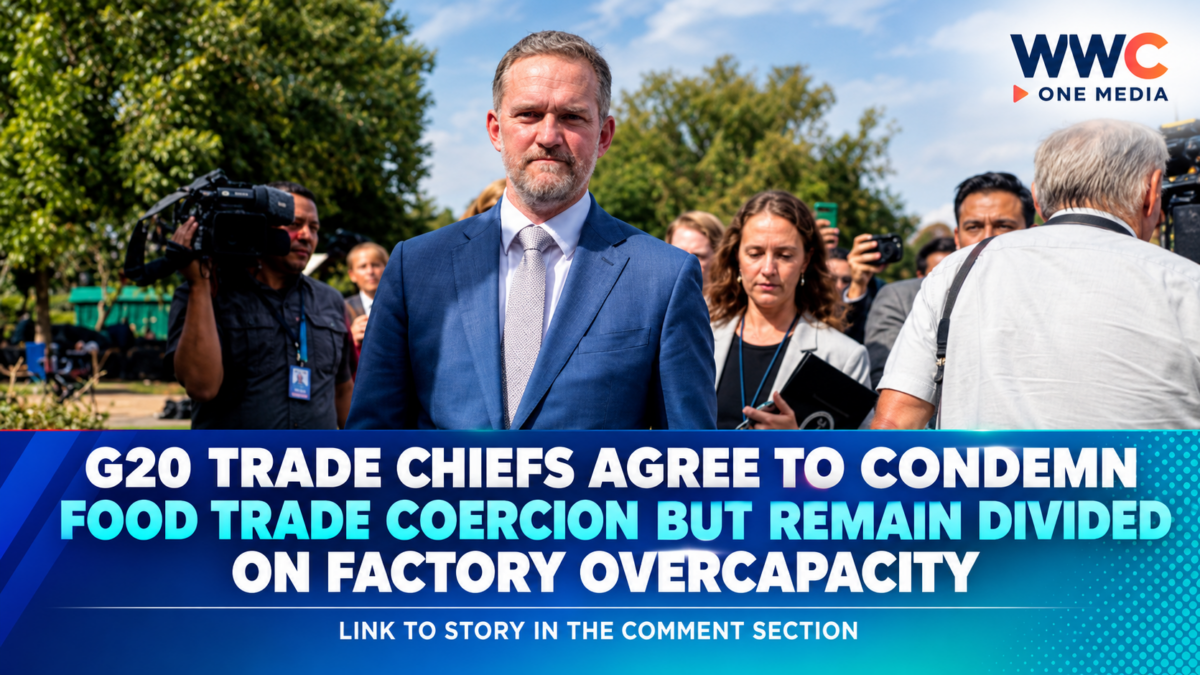
Trade ministers from the Group of 20 major economies agreed to condemn the use of food and agricultural trade as a tool of coercion but failed to reach consensus on how to address excess industrial capacity and forced labor in global supply chains.
The discussions took place during a two-day G20 Trade Ministers’ Meeting in Milwaukee, Wisconsin, where trade officials examined several contentious issues affecting the global trading system. US Trade Representative Jamieson Greer said the ministers were able to find common ground on food trade coercion but remained divided on other major trade concerns.
Food security was one of the areas where the ministers reached agreement. The G20 is expected to issue a statement opposing the use of food, agricultural products and agricultural inputs as instruments of economic pressure, reflecting concerns that disruptions to food trade can have broader consequences for economies and consumers.
India’s Trade Minister Piyush Goyal said countries should distinguish between coercive actions involving food supplies and legitimate government measures designed to protect domestic food security. He argued that food should remain a source of security and cooperation rather than becoming a tool of economic pressure.
The ministers were less successful in reaching a common position on structural excess industrial capacity. Greer said many participating countries expressed concerns about surplus production, particularly in China, and the effect of large volumes of exports on industries in other markets.
Greer said nearly all countries represented at the meeting viewed excess capacity as an issue requiring action, but governments differed over how it should be addressed. He also argued that existing trade-remedy mechanisms are insufficient to deal with the scale of the problem.
European Trade Commissioner Maros Sefcovic separately said the issue had become increasingly important for European industries, particularly steel and automobiles. He called for coordinated action as rising exports and production surpluses put pressure on manufacturers in major markets.
China has rejected accusations that its industrial policies are responsible for excess capacity. Chinese officials have argued that criticism of its production levels is being used by other countries to justify protectionist trade measures and restrictions on Chinese exports.
The disagreement over industrial capacity reflects a wider debate about the role of subsidies, domestic demand, exports and government intervention in global manufacturing. Countries that rely heavily on manufacturing are concerned about downward pressure on prices and the effect of imported goods on domestic producers, while exporters have pushed back against measures they view as protectionist.
Forced labor in global supply chains was another issue where the G20 failed to produce a unified position. Greer said the United States would continue discussions with a smaller group of countries on measures addressing goods linked to forced labor after the broader G20 grouping could not agree on a joint statement.
The ministers also discussed the World Trade Organization’s Most-Favored-Nation, or MFN, system. Greer said Washington believes the system should be reconsidered because unconditional tariff treatment can limit governments’ ability to respond to what they consider unfair or distortive trade practices.
The United States did not seek a joint G20 statement on MFN reform, with Greer describing the issue as a longer-term discussion that Washington wanted to begin with other major trading economies. The proposal reflects broader US efforts to reconsider long-standing assumptions governing international trade and tariff policy.
The meeting also included discussions on energy supplies. Greer said US and European officials had discussed possible cooperation involving strategic diesel reserves as governments deal with elevated fuel prices and supply constraints. He said the discussions included France and Germany, although he did not provide details on any final agreement.
The G20 trade meeting therefore produced agreement on one area while leaving several of the most difficult issues unresolved. Food trade coercion received collective attention, but excess industrial capacity, forced labor and broader reforms to the international tariff system remain subjects of disagreement among major economies.
The discussions come as governments around the world reassess trade policies amid rising use of tariffs, industrial subsidies and measures aimed at protecting domestic industries. The lack of consensus at the G20 meeting highlights the difficulty of coordinating trade policy among economies with competing industrial and geopolitical interests.