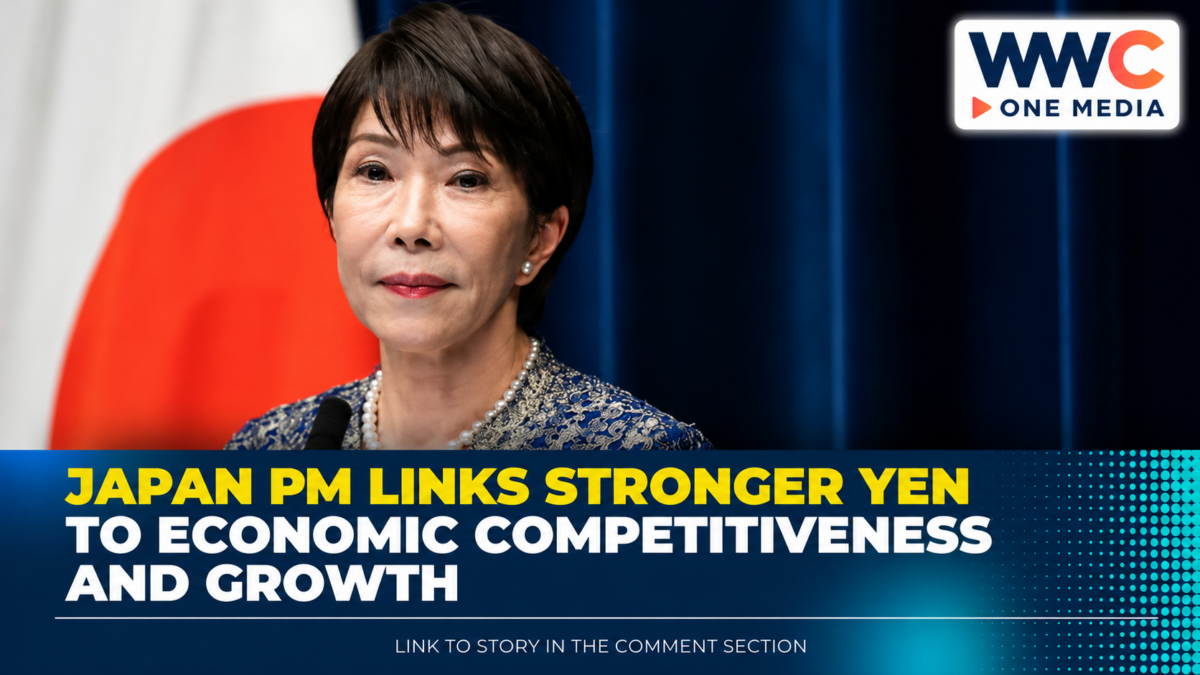
Japanese Prime Minister Sanae Takaichi has pledged to strengthen Japan’s economic competitiveness as part of efforts to restore market confidence in the yen, while insisting that her government’s economic policies are not aimed at manipulating the currency.
In a recorded interview aired on Oct. 1, Takaichi said her administration intends to raise Japan’s growth potential by expanding the economy’s supply capacity through investment in crisis management and sectors considered important for future growth.
She said stronger competitiveness would help support confidence in the yen, which has remained weak despite recent interest-rate increases by the Bank of Japan.
Takaichi also said she had raised the issue of the yen’s undervaluation with US President Donald Trump when the two leaders met in September.
However, she stressed that Japan’s economic strategy was not designed to directly influence exchange rates.
“Our economic policy is not aimed at manipulating exchange rates,” Takaichi said, while outlining her administration’s focus on investment and improving Japan’s productive capacity.
The yen’s weakness has become a growing concern for Japanese policymakers because a weaker currency increases the cost of imported goods and energy, adding to inflationary pressures for households and businesses.
The Bank of Japan has raised interest rates, including a hike in September, but the increases have not prevented the yen from remaining under pressure. Market participants have also been closely watching the government’s spending plans and their potential impact on Japan’s fiscal position.
Takaichi said US Treasury Secretary Scott Bessent had also expressed support for Japan’s economic policy during talks with Finance Minister Satsuki Katayama on Aug. 31. According to Takaichi, the US side did not make specific demands during the meeting.
She said Japan remained committed to pursuing both economic strength and sustainable fiscal policy.
The government is facing increased scrutiny over the size of its upcoming budget. Requests from ministries and agencies for the next fiscal year have reached about 143 trillion yen, equivalent to roughly US$903 billion, bringing them close to levels seen during the pandemic.
The figure could rise further because some spending requests, including defence-related expenditures, had not yet been assigned specific amounts.
The scale of the requests has raised questions in financial markets about how the government will fund its planned measures without increasing pressure on Japan’s already high debt burden.
Among the proposals is a temporary suspension of a levy on food items, while defence spending is also expected to increase. The lack of detailed funding plans for some of these measures has contributed to uncertainty in the bond market.
Takaichi said the 143 trillion yen in requests should not be interpreted as the final size of next year’s national budget. Her administration will review the proposals before deciding which programmes should receive funding.
She said the government would establish clear priorities and examine both spending and revenue while monitoring tax collections and the broader economic outlook.
The prime minister also said Japan would maintain its goal of steadily reducing its debt-to-GDP ratio and would manage the amount of government bonds issued in a way that supports fiscal sustainability.
Takaichi did not repeat an earlier statement that her government would seek to limit new bond issuance to 40 trillion yen for the next fiscal year. Instead, she said the government would secure the funding needed to respond to fiscal requirements while reviewing its overall budget priorities.
The debate over fiscal policy has become particularly important for financial markets because higher government spending can raise concerns about additional borrowing, potentially putting upward pressure on government bond yields and weighing on the yen.
Japan’s currency has therefore been caught between several competing forces: efforts by the central bank to raise interest rates, expectations surrounding government spending, inflation pressures and concerns about the country’s long-term fiscal position.
Takaichi’s latest comments indicate that her administration intends to address the yen’s weakness primarily by strengthening the underlying economy rather than targeting the exchange rate directly.
The government’s ability to balance investment, economic growth, inflation control and fiscal discipline will remain closely watched by financial markets as Japan prepares its next budget and determines the pace of future economic measures.