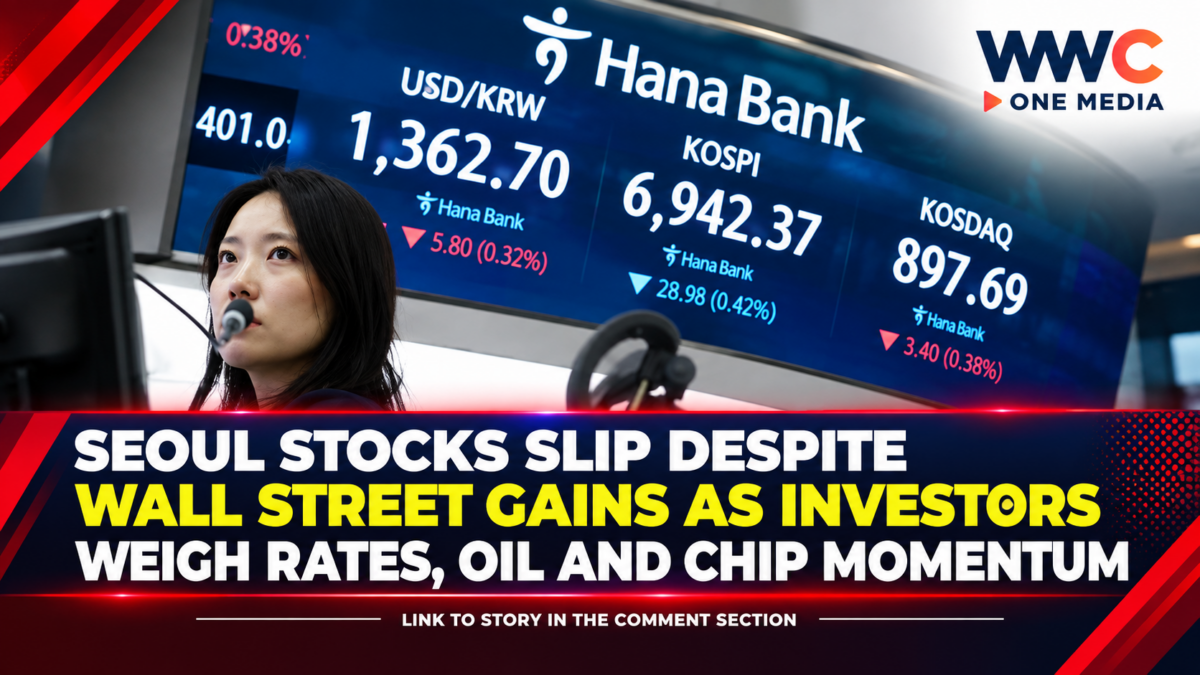
South Korean stocks opened lower Friday despite gains on Wall Street, as investors remained cautious over elevated U.S. Treasury yields and other pressures facing global markets.
The benchmark Korea Composite Stock Price Index (KOSPI) opened 0.47% lower and stood at 6,961.18, down 10.17 points, or 0.15%, at 9:15 a.m., according to the Korea Times report citing Yonhap.
The subdued opening came despite overnight gains in major U.S. markets, highlighting the different factors currently influencing Seoul’s trading session.
Wall Street Gains Fail to Lift Seoul
U.S. stocks advanced in the previous session, but investors in South Korea continued to monitor interest rates, oil prices and the outlook for technology shares.
The divergence is particularly notable because South Korea’s stock market has recently been strongly influenced by semiconductor shares. On Oct. 1, the KOSPI had surged nearly 2% as institutional investors bought major chip stocks, ending a three-session losing streak.
That rally came after South Korea reported record September exports, with semiconductor shipments benefiting from strong global demand linked to artificial intelligence.
Chip Stocks Remain in Focus
Semiconductors remain one of the biggest factors for Seoul’s market direction.
Samsung Electronics and SK hynix were among the companies closely watched by investors after recent trading sessions showed how quickly chip stocks can influence the broader KOSPI.
The previous day’s rally was supported by semiconductor gains, with Samsung Electronics climbing 2.79% and SK hynix gaining 3.21%, according to Reuters.
However, the broader market continues to face pressure from elevated borrowing costs. Recent trading in Seoul has shown that strong technology-sector earnings and demand can coexist with concerns about interest rates and rising energy prices.
A Market Caught Between Strong Chips and Higher Rates
The latest opening illustrates the competing forces facing South Korean equities.
On one side, record semiconductor exports and strong demand for AI-related technology are providing support for major Korean chipmakers. On the other, elevated U.S. Treasury yields and higher oil prices have continued to weigh on investor sentiment.
That tension could keep market participants focused on whether earnings strength can continue to offset higher financing costs and global economic uncertainty.
For now, Seoul’s latest session begins with investors balancing two very different signals: Wall Street’s gains and Korea’s powerful semiconductor momentum on one side, and persistent macroeconomic pressure on the other.
And with the KOSPI already moving sharply in recent sessions, the question is how investors will respond as trading develops beyond the opening bell.
WWC ONE MEDIA G,A