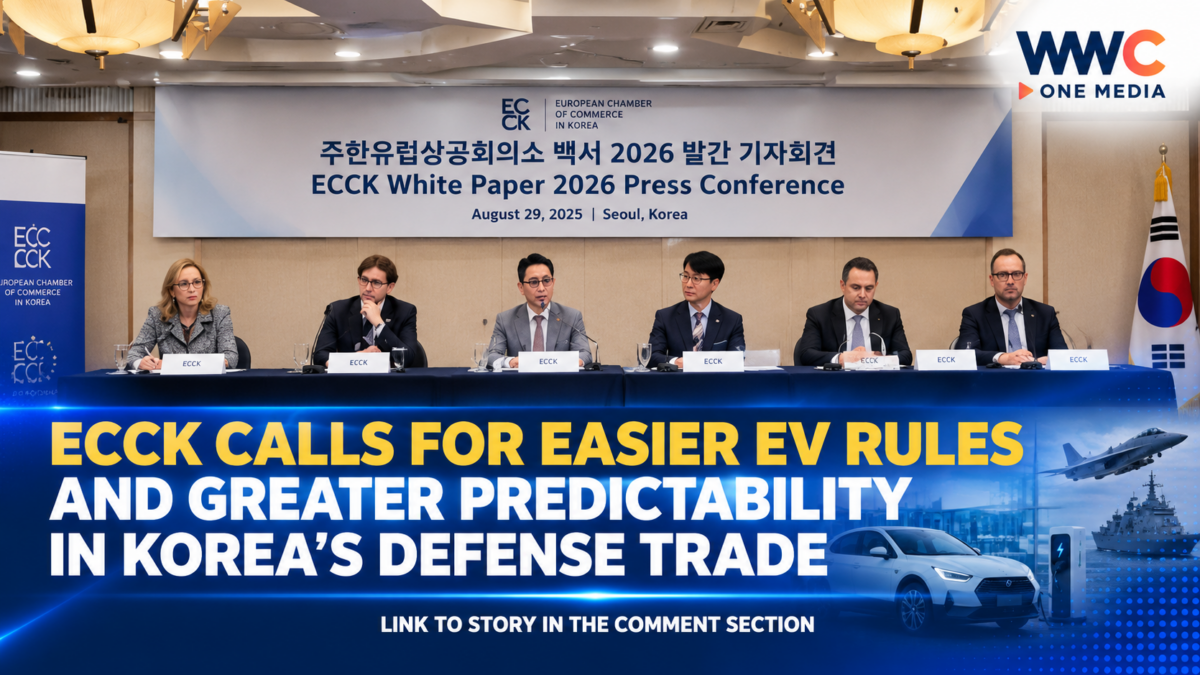
SEOUL, South Korea — European businesses are calling for changes to several South Korean regulations, with the European Chamber of Commerce in Korea (ECCK) urging Seoul to make electric-vehicle rules more compatible with international standards and provide greater predictability in defense trade.
The recommendations were included in the ECCK’s 2026 White Paper, unveiled Wednesday. The document contains 82 recommendations from 15 committees and three forums, covering industries ranging from automobiles and defense to health care, energy, food and alcoholic beverages.
ECCK wants Korea’s EV rules aligned with global standards
The ECCK’s Passenger Vehicle Committee called for improvements to Korea’s electric-vehicle certification and assessment procedures.
Committee Chair Kim Hong-joong said greater harmonization and mutual recognition of international standards could reduce regulatory differences between Korea and Europe, particularly as advanced automotive technologies develop.
The chamber said closer alignment could help companies introduce new EV technologies into the Korean market more efficiently and support wider EV adoption.
The recommendation comes as automakers face increasingly complex certification and regulatory requirements across international markets.
For European companies operating in Korea, reducing differences between Korean and international standards could potentially make it easier to introduce vehicles and technologies already approved elsewhere.
Defense trade rules also come under scrutiny
The ECCK’s recommendations extend well beyond the automotive industry.
Its Aerospace & Defense Committee called for greater predictability and transparency in Korea’s defense offset system.
Defense offsets are arrangements in which foreign suppliers provide economic or industrial benefits to the purchasing country as part of an arms-sale agreement.
The ECCK specifically called for clearer evaluation criteria for advanced technology projects involving artificial intelligence, cybersecurity and quantum technology.
Committee Chair Francois Piolet said European companies see potential to expand their participation in Korea’s defense supply chain, including areas ranging from subsystems to lifecycle support.
The white paper covers much more than EVs
The ECCK’s 2026 recommendations span several major industries.
In health care, the chamber called for faster reimbursement listings for innovative medicines and mutual recognition of Good Manufacturing Practice (GMP) standards between Korea and the European Union.
The food committee recommended greater digitalization of health certificates and more English-language guidance for packaging regulations.
Meanwhile, the energy and environment committee called for greater regulatory predictability for offshore wind projects.
The alcoholic beverages committee also proposed changes involving e-commerce delivery restrictions, a comprehensive specific tax system and mandatory RFID tagging requirements for whisky.
What happens to the recommendations next?
The ECCK’s white paper does not itself change Korean regulations.
Following its publication, the document is submitted through the Korea Trade-Investment Promotion Agency’s Foreign Investment Ombudsman for review by relevant Korean government ministries and institutions.
It is also shared with European stakeholders, including the European Commission, the European Free Trade Association and the U.K. government.
That means the recommendations now enter a review process rather than automatically becoming government policy.
For European companies operating in Korea, however, the message is clear: the ECCK wants greater regulatory alignment, transparency and predictability across several sectors.
From EV certification and advanced automotive technology to AI, cybersecurity, quantum projects and defense offsets, the chamber’s proposals highlight areas where it says regulatory differences could affect business activity.
The recommendations are now on Seoul’s table — and what happens next could shape how easily European companies introduce new technologies and expand their operations in Korea.
WWC ONE MEDIA G,A