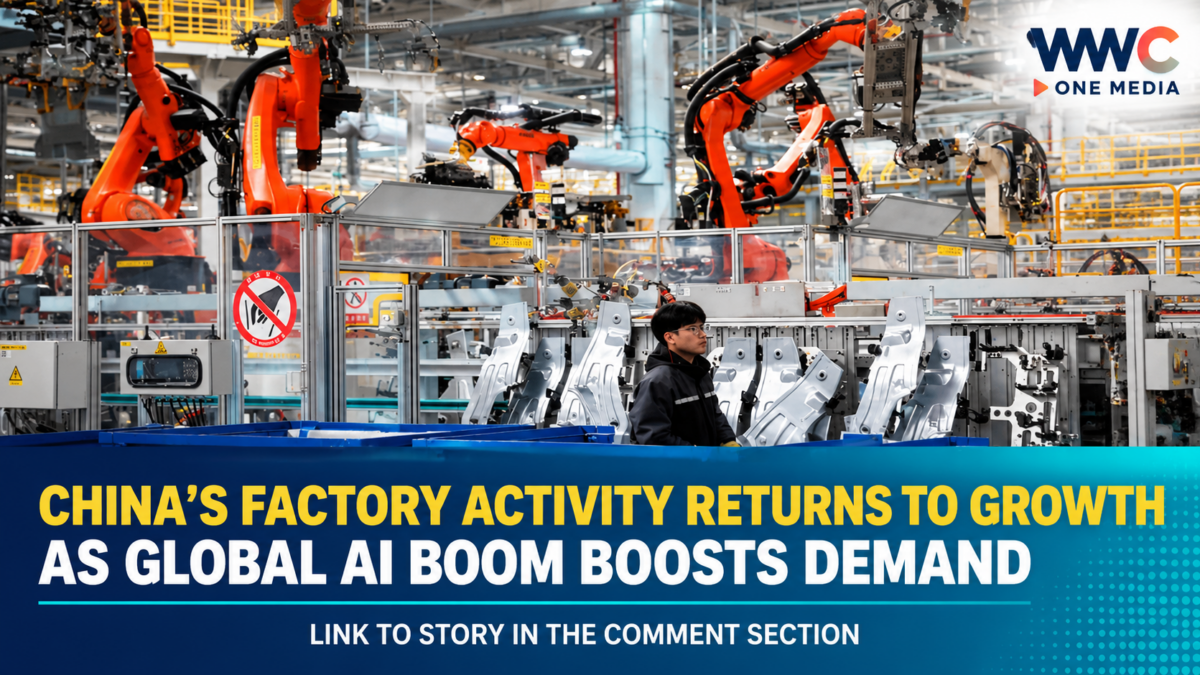
China’s factory activity returned to growth in September, ending two consecutive months of contraction as easing weather disruptions and strong global demand for artificial intelligence-related products helped support the manufacturing sector.
The official manufacturing purchasing managers’ index rose to 50.1 in September from 49.8 in August, according to data from China’s National Bureau of Statistics. A reading above 50 indicates expansion, while a figure below 50 signals contraction.
The September reading matched the median forecast of economists and marked the first time the official manufacturing PMI moved above the 50-point threshold since June.
Factory production showed a stronger improvement, with the production sub-index rising to 51.7 from 50.4 in August. New orders also remained in expansion territory at 50.5, while new export orders were at 50.0.
A separate private survey provided a stronger indication of momentum. The RatingDog manufacturing PMI, compiled by S&P Global, climbed to 52.1 in September from 51.5 in August, reaching its highest level in five months. The survey also pointed to continued growth in new orders and overseas demand.
The improvement has been partly linked to the global AI investment boom, which has increased demand for semiconductors, data-center equipment, computers and other advanced technology products. Chinese manufacturers have benefited from the country’s strong position in producing a wide range of industrial and technology goods.
Easing weather disruptions also allowed factories to resume more normal operations after earlier interruptions. At the same time, China’s non-manufacturing PMI, which covers services and construction, recovered to 50.2 in September from 49.0 in August.
Despite the improvement, China’s broader economy continues to face challenges. Weak domestic demand, a prolonged property downturn and pressure on employment remain concerns, while rising raw-material and energy costs are putting pressure on manufacturers’ profit margins.
The stronger factory readings could provide some support for China’s growth target of 4.5% to 5% this year, but policymakers are still facing pressure to strengthen domestic demand and provide additional economic support.
China has already announced measures aimed at directing cheaper credit toward infrastructure and technology while expanding support for home buyers. The latest manufacturing data could give policymakers some additional room to assess whether those measures are gaining traction.
For now, the September figures point to an industrial sector benefiting from global technology investment even as China continues to deal with weaker domestic demand and structural pressures at home. The sustainability of the recovery will depend on whether stronger exports and AI-related demand can be matched by broader improvements across the Chinese economy.