
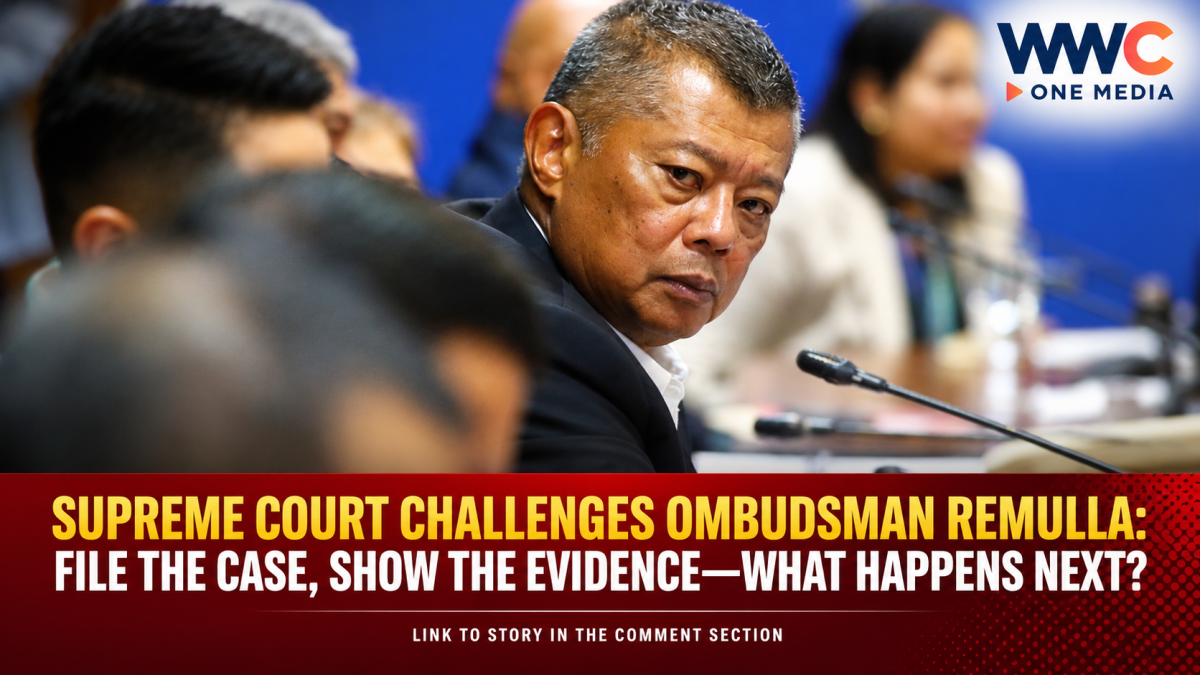
MANILA, Philippines — The Supreme Court has challenged Ombudsman Jesus Crispin Remulla and other concerned parties to take allegations of judicial bias, misconduct and corruption out of the public arena and into the proper legal process: file a formal complaint and present evidence.
The High Court’s position came after Remulla publicly called for a closer examination of the judiciary, citing what he described as a troubling pattern in which decisions of the Office of the Ombudsman and, previously, the Department of Justice were overturned by the Court of Appeals.
In a statement issued Thursday night, Supreme Court spokesperson Camille Sue Mae Ting said the Court agrees with the principle that judicial proceedings at every level must remain accountable to the Filipino people.
But accountability, the Court stressed, must also operate within constitutional and procedural safeguards.
The Supreme Court said it takes allegations of judicial bias, misconduct and corruption seriously. However, it cannot act on broad accusations against an entire appellate court when those claims are made publicly without supporting evidence or a formal complaint.
The message was direct: If there is evidence of wrongdoing, bring it forward through the proper process.
“We therefore extend a formal invitation to the Ombudsman, and to all concerned parties, to file the appropriate complaint and submit supporting evidence.”
The process would give the judges or justices involved an opportunity to answer the allegations and allow the Supreme Court to determine the facts before deciding whether disciplinary action is warranted.
Remulla raises concerns over reversed cases
The controversy intensified after Remulla raised concerns during Senate deliberations on the Ombudsman’s proposed P7.2-billion 2027 budget.
Remulla told senators that the judiciary needs to undergo what he called a period of “soul-searching,” particularly over cases in which decisions or disciplinary actions taken by the Ombudsman were subsequently reversed by the Court of Appeals.
He cited an example from his previous tenure as Justice secretary involving an individual dismissed by the Ombudsman from the National Bureau of Investigation who was later reinstated following a Court of Appeals ruling.
Remulla described the repeated reversals as discouraging and said the issue had become difficult to ignore within the country’s justice system.
His remarks triggered a response from the Supreme Court, which emphasized that criticism of the judiciary is not prohibited—but serious allegations should be supported by evidence and raised through established procedures.
Supreme Court: Criticism is allowed
The High Court also pointed to a recent unanimous ruling involving Richard Heydarian, Percival Cendaña and Larry Gadon as an example of its approach to criticism.
According to the Supreme Court, despite strong statements directed at the Court over one of its rulings, it upheld the respondents’ constitutional right to freedom of expression and declined to hold them in contempt.
The Court said the decision demonstrated its willingness to tolerate fair criticism while maintaining that accusations of serious misconduct must be subjected to proper investigation.
That distinction is crucial.
The current dispute is not simply about whether the judiciary can be criticized. The larger question is whether allegations involving particular judges, justices or judicial decisions can be formally substantiated and investigated under the mechanisms provided by law.
Ombudsman says complaints could follow
On Saturday, Remulla indicated that his office was already gathering cases involving decisions and temporary restraining orders that had been reversed or issued in administrative matters.
He said the Ombudsman was compiling the material and could publish information about those cases.
Remulla also pointed to a complaint filed in 2025 by former Ombudsman Samuel Martires against seven Court of Appeals justices over a temporary restraining order involving the preventive suspension of eight members of the Sangguniang Panlalawigan of Antique.
According to GMA News, Remulla said there appeared to be no public record showing that the Judicial Integrity Board or Supreme Court had acted on or resolved that complaint.
That development adds another layer to the confrontation: the debate is no longer limited to general criticism of the judiciary but is moving toward the question of whether specific complaints should be formally investigated.
DOJ backs examination of the justice system
The issue has also drawn attention from the Department of Justice.
Justice Secretary Fredderick Vida said Friday that he welcomed Remulla’s call to examine the judiciary, saying the process could ultimately help improve the country’s legal system.
Vida emphasized, however, that the objective should be reached through discussion and the proper legal procedures.
He said the DOJ, Supreme Court and Ombudsman ultimately share an interest in improving the justice system.
What happens next?
The Supreme Court’s response effectively puts the next move in the hands of Remulla and anyone else who believes they have evidence of judicial wrongdoing.
Instead of relying solely on public statements, the Court has asked that allegations be converted into formal complaints backed by evidence.
That could potentially trigger an official process in which the allegations are examined, the judges or justices concerned are given the opportunity to respond, and the appropriate authority determines whether misconduct actually occurred.
For now, there is no established finding by the Supreme Court that the Court of Appeals or its justices committed corruption or misconduct based merely on Remulla’s public allegations.
The dispute therefore enters a potentially more consequential phase: Will the allegations remain a political and institutional debate—or will they become formal cases backed by evidence?
That answer could determine how far the growing confrontation between the Ombudsman and the judiciary goes.
WWC ONE MEDIA J.M.D




Leave a Reply