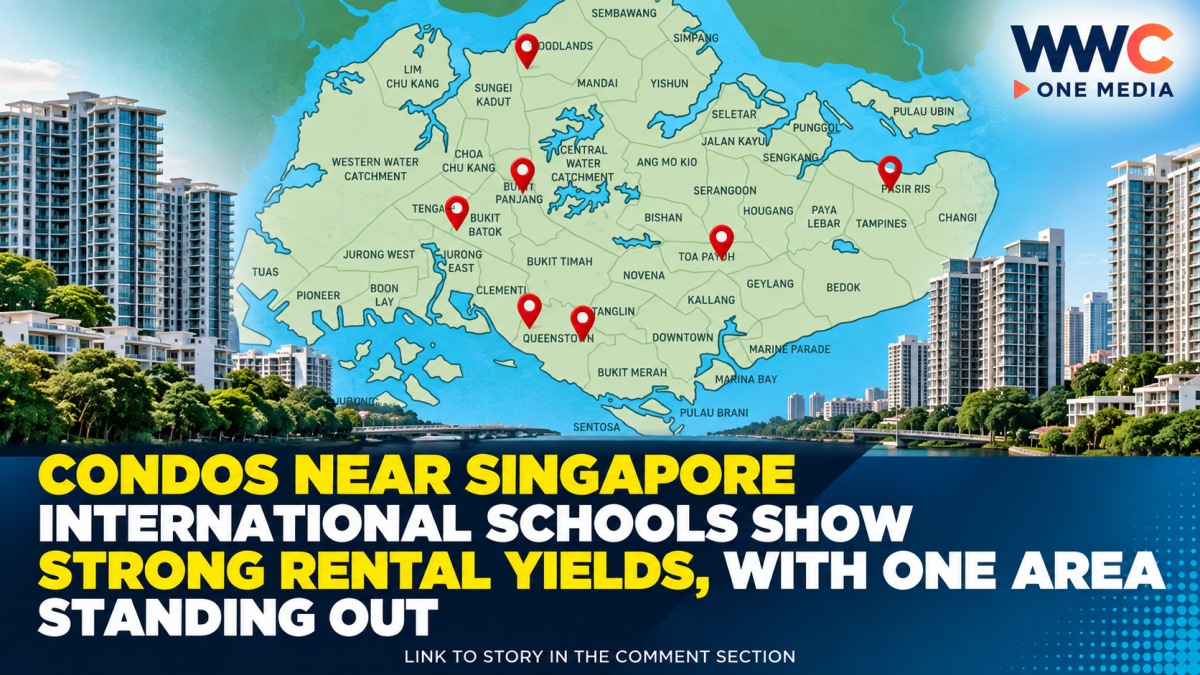
Singapore condominiums located near international schools are showing relatively strong rental yields, highlighting how access to education continues to shape rental demand in parts of the city-state.
A recent analysis compared median resale prices and rents for condominiums located within 1km and between 1km and 2km of five major international schools. The findings showed that properties closer to the schools generally recorded slightly higher rental yields, although the difference was not large across every location.
The relationship is partly linked to Singapore’s expatriate population. International-school families often prefer homes close to their children’s schools to reduce commuting times, creating concentrated rental demand around certain education clusters.
One of the areas examined was the Dover and one-north corridor, where United World College of Southeast Asia’s Dover campus and Tanglin Trust School are located relatively close to each other. The area also has a large concentration of businesses and professional workers, creating another potential pool of tenants.
Among the developments examined, The Rochester Residences recorded a median resale price of about S$2.87 million. Two-bedroom units had median monthly rents of around S$6,500, while three-bedroom units reached about S$9,000. Units within 1km of the relevant schools recorded net rental yields of about 4.84% for two-bedroom units and 4.86% for three-bedroom units.
The Woodgrove area near Singapore American School also produced notable figures. Two-bedroom units at The Woodgrove recorded a median resale price of about S$861,444 and median rent of S$3,775 a month, translating into a net yield of 4.84%. Three-bedroom units recorded a median resale price of about S$1.24 million, median rent of S$5,550 and a net yield of 4.86%.
However, proximity alone did not guarantee the highest rental returns. Around Dulwich College, for example, some developments located more than 1km from the school recorded higher yields than properties immediately nearby. Two-bedroom units at Westmere and Regent Heights posted net yields of about 3.86% and 3.84%, respectively.
The analysis also found that condos near international schools generally had healthy leasing demand, suggesting that the tenant base created by expatriate families can support occupancy. But the researchers cautioned that the available transaction data varied significantly between areas, meaning some comparisons were based on a relatively small number of developments.
Location is only one factor affecting Singapore rental yields. Purchase price, unit size, age, tenure, rental rates, property taxes and the type of tenants attracted by each development can all influence the eventual return. Rental yield calculations also do not account for every ownership expense or financing cost.
The analysis comes as Singapore’s private-property market remains highly segmented. International-school locations can attract a specific tenant demographic, but investors still have to account for broader property-market conditions and changes in rental demand.
There is also a longer-term consideration around Dover. The existing UWC Southeast Asia campus is scheduled to relocate to Tengah in 2032, after which the current Dover site will be returned to the Singapore Land Authority. That could alter the area’s education-driven rental dynamics over time.
The findings underline a broader feature of Singapore’s property market: an international school can become an important source of rental demand, but the relationship between distance, property prices and rental returns is not always straightforward.
For prospective landlords, the numbers suggest that looking beyond simple proximity to a school may reveal significant differences in rental performance from one condominium development to another.