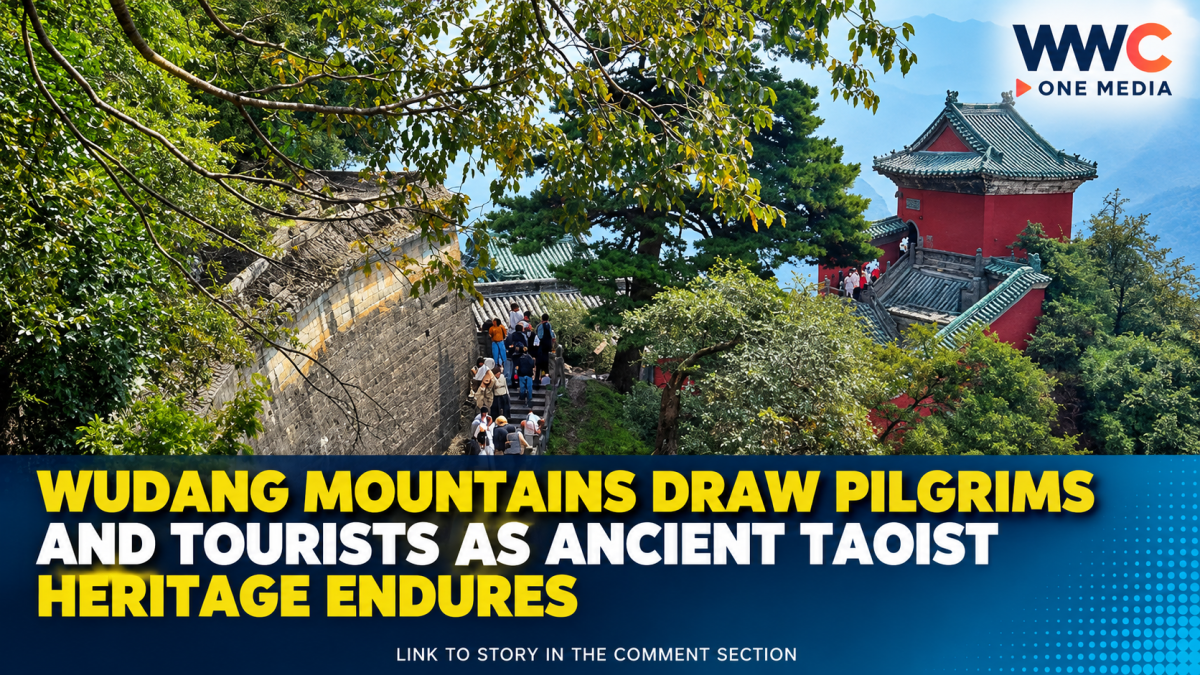
The Wudang Mountains in central China continue to attract a steady flow of pilgrims, tourists and martial arts enthusiasts, bringing together spiritual traditions, dramatic landscapes and centuries of Chinese history.
Located in Hubei province, Wudang has long been regarded as a sacred center of Taoism. Its mountains contain ancient temples, palaces and religious sites, with some structures dating back to the seventh century. Government figures show the area received about 14 million visits in 2025.
For many visitors, the journey is more than sightseeing. Pilgrims travel to the mountain to pray to Zhenwu, a Taoist deity associated with the Wudang tradition, while others seek blessings for their families, health, studies and future.
At the summit of Tianzhu Peak stands the Golden Hall, a bronze structure located about 1,610 metres above sea level. Visitors gather there to pray, leave offerings and attach written wishes near the temple complex.
Wudang’s landscape is also deeply connected to traditional Chinese philosophy. The mountain range contains 72 peaks, which are traditionally understood to converge toward Tianzhu. The area’s religious architecture incorporates symbolism associated with the Five Elements and ideas about harmony between humanity and nature.
The Golden Hall itself reflects this symbolism. Museum officials explain that its bronze construction is connected to traditional beliefs surrounding metal and water, while the temple’s religious meaning includes prayers for favorable weather, abundant harvests, peace and prosperity.
Wudang’s religious character has also shaped generations of local residents. Taoist priests continue to maintain temples and religious sites, while families living around the mountain have historically developed livelihoods connected to visitors, heritage preservation, medicinal plants and traditional crafts.
For local residents who grew up around the temples, Wudang is not simply a tourist destination. Its religious sites and surrounding forests, trails and communities form part of their personal and family history.
The mountain’s present-day appearance was heavily influenced by the Ming dynasty. Emperor Zhu Di sponsored an extensive building programme at Wudang as part of his efforts to associate his imperial rule with Taoism. More than 60 historic sites survive in the mountain complex today.
The development of Wudang during the Ming period coincided with the construction of the Forbidden City in Beijing. The two sites are now both recognized as UNESCO World Heritage sites and represent major examples of China’s imperial and religious architectural heritage.
Beyond its temples, Wudang has become closely associated with traditional Chinese martial arts. Visitors can encounter sites connected with martial arts practice alongside religious buildings, pilgrimage routes and scenic viewpoints.
The combination has helped give the mountains a broad appeal. Some visitors arrive because of their religious beliefs, others because of the history, architecture, scenery or martial arts traditions, while some come simply to experience a landscape long associated with Taoist cultivation and spirituality.
That mixture of faith, history and tourism continues to shape Wudang today. As millions of visitors make their way through its ancient temples and mountain paths, the site remains a place where China’s religious heritage and modern tourism meet.
Wudang’s enduring appeal ultimately lies in that unusual combination — a sacred landscape where centuries-old Taoist traditions remain part of everyday life while breathtaking scenery and cultural heritage continue to draw visitors from across China and beyond.