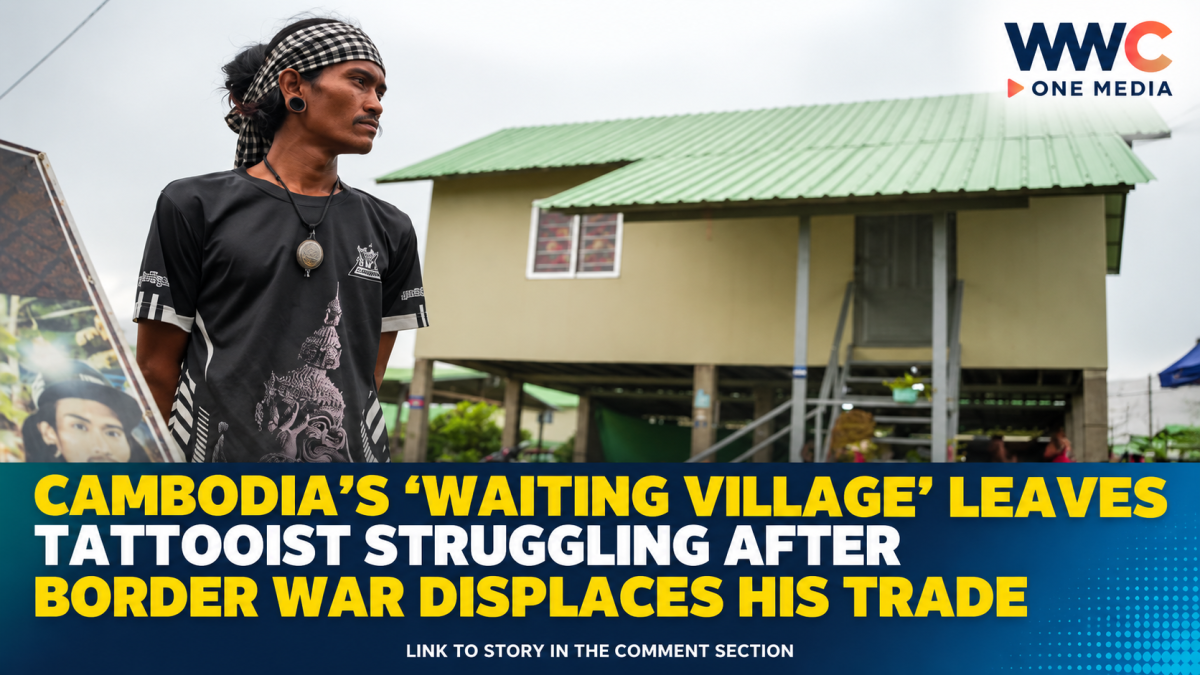
In Cambodia’s “Waiting Village,” thousands of families are living in newly built homes while waiting for a chance to return to communities they fled during fighting along the Cambodia-Thailand border.
Among them is Cheng Bora, known locally as Sam, a tattoo artist whose once-thriving business was left behind when the conflict forced his family from their home in Banteay Meanchey province. He now works from a small house in Rong Cham, but says customers are far fewer than before.
Rong Cham is a 400-hectare resettlement site containing more than 3,000 houses. Residents have nicknamed it the “Waiting Village” because many families there remain displaced and uncertain about when they can return home, months after a ceasefire ended the latest fighting.
Sam previously operated his tattoo shop in Boeung Trakuon, a busy trading area near the Thai border. The location provided him with a steady stream of customers, but the fighting changed the area dramatically and left his former home inaccessible.
Today, he tattoos customers from his temporary residence, using the same skills that once supported his family. The difference is the number of people coming through his door. With business sharply reduced, he has taken on additional work as a plumber, electrician and construction worker to make ends meet.
The conflict also separated members of Sam’s family. His nine-year-old daughter has returned to live with him, while his adult son remains in Thailand with other relatives.
The family recently traveled toward the border, stopping about 20 kilometres from Rong Cham at a metal barricade marking the area they cannot access. From there, Sam could only look toward the community where he once lived and worked.
The border fighting erupted in July 2025 over a long-disputed stretch of the Cambodia-Thailand frontier, which extends for more than 800 kilometres. Fighting flared again later in the year before a ceasefire took hold, leaving communities on both sides dealing with displacement and disrupted livelihoods.
Cambodian authorities say more than 20,000 people remain unable to return home. Thailand has rejected accusations that it is illegally occupying Cambodian territory, saying its military presence follows the bilateral ceasefire arrangement. Border crossings between the two countries remain closed.
For displaced workers like Sam, the consequences extend well beyond the loss of a house. Businesses, customers, family networks and sources of income have all been disrupted, forcing people to rebuild their livelihoods in unfamiliar surroundings.
Sam said the two issues weighing most heavily on him are whether he will be able to return to his old home and whether renewed fighting could occur.
For now, his tattoo business continues on a much smaller scale in the resettlement village, while the future of his former shop remains uncertain.
The story of Sam and the families in Rong Cham shows how a ceasefire does not immediately restore normal life. Even after the fighting stops, displaced communities can remain suspended between temporary homes and places they still hope to call home again.