
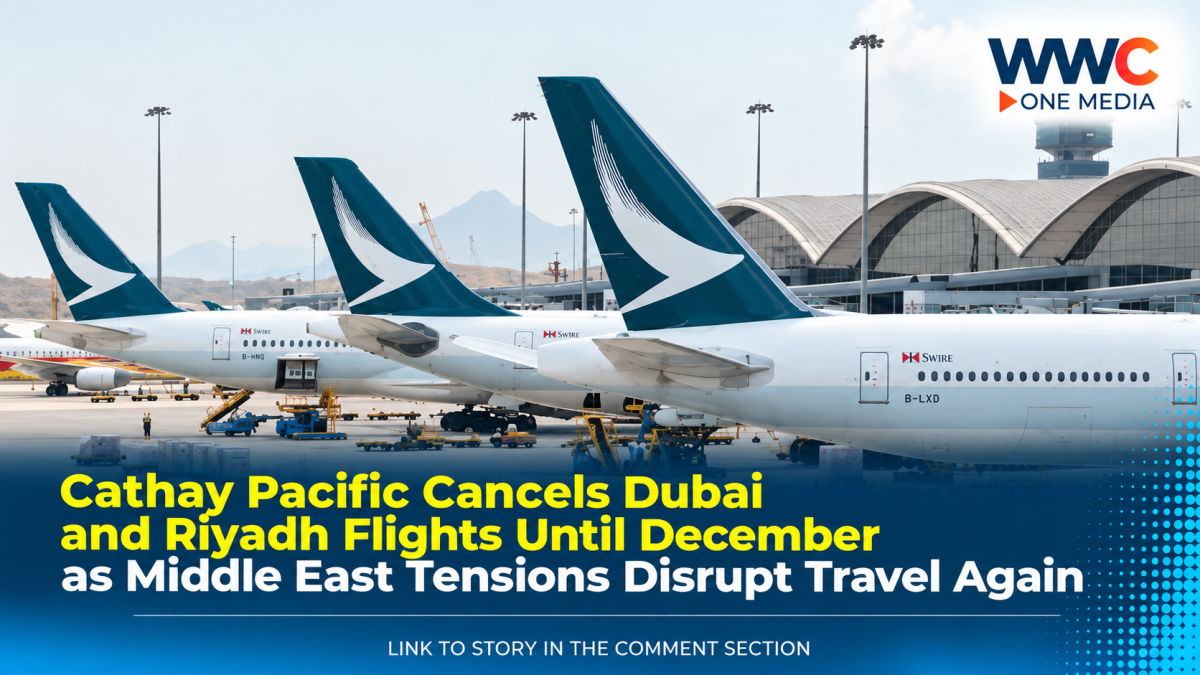
HONG KONG — Cathay Pacific has extended the cancellation of its passenger flights to Dubai and Riyadh until the end of November, dealing another blow to travellers as renewed tensions in the Middle East continue to disrupt international aviation.
Hong Kong’s flagship carrier said its passenger services to the two major Middle Eastern destinations have been cancelled up to and including Nov. 30, 2026.
The announcement means affected flights will remain suspended until at least Dec. 1, unless the airline announces further changes.
For passengers who had been waiting for Cathay’s Middle East network to return, the latest announcement represents another major setback.
Cathay says Middle East situation remains under review
Cathay Pacific said the decision was made in view of the latest developments in the Middle East.
The airline said it would continue to closely monitor the evolving situation before deciding when regular services could safely resume.
Passengers affected by the cancellations are being offered flexibility to rebook, reroute or request a refund, according to Cathay’s official travel advisory.
However, passengers making entirely new bookings should note that fare and tax differences may still apply under the airline’s booking conditions.
This is not the first delay
The latest cancellation is part of a series of disruptions to Cathay Pacific’s Middle East operations this year.
Cathay had initially planned to restart its daily Hong Kong-Dubai passenger service and its four-times-weekly Riyadh service from Sept. 1 after earlier suspensions caused by the regional conflict.
But the airline subsequently pushed those plans back, postponing the expected restart of Dubai flights to Oct. 25 and Riyadh flights to Oct. 26 as tensions again intensified.
Now, those restart plans have been pushed back even further.
The latest announcement effectively wipes out Cathay’s previously planned October return and extends the suspension through the end of November.
Renewed US-Iran tensions are hitting aviation
Cathay’s decision comes as airlines continue to navigate rapidly changing security conditions and airspace restrictions across the Middle East.
Recent fighting and renewed tensions involving the United States and Iran have once again raised concerns about the safety of air routes through the region.
The European Union Aviation Safety Agency recently updated its aviation guidance for the Persian Gulf region, warning airlines about elevated risks in several areas and maintaining restrictions involving Iranian, Iraqi and Lebanese airspace.
Those security concerns can have consequences far beyond the countries directly involved in a conflict.
Airlines may have to cancel flights, alter routes or take longer detours to avoid potentially dangerous airspace.
That can increase operating costs, lengthen travel times and create major disruptions for passengers.
Dubai and Riyadh are key regional destinations
The extended suspension affects two of the Middle East’s most important aviation and business hubs.
Dubai is a major global centre for tourism, finance and international transit, while Riyadh has become increasingly important as Saudi Arabia expands its business, tourism and investment sectors.
For Cathay Pacific, the suspension means Hong Kong travellers and international passengers connecting through the carrier will need to consider alternative routes or airlines.
The impact could also be felt by business travellers whose schedules depend on direct services between Hong Kong and the Gulf.
Airlines across the region remain under pressure
Cathay Pacific is far from the only airline facing difficult decisions over Middle East routes.
Airlines worldwide have repeatedly adjusted schedules since the regional conflict began, with some carriers restoring services only to suspend or alter them again when security conditions deteriorated.
Reuters reported that airlines have been gradually rebuilding Middle East networks following earlier disruption, but flight schedules remain vulnerable to sudden changes in the security environment.
The aviation industry faces a difficult balancing act.
Carriers must respond quickly to security risks while also managing aircraft schedules, crew rotations, passenger bookings and airport operations.
A single airspace closure can affect flights far beyond the immediate region.
What affected passengers should do
Cathay Pacific passengers holding bookings to Dubai or Riyadh should check their flight status directly with the airline before travelling to the airport.
Under Cathay’s latest advisory, affected travellers can generally choose from options including:
- Rebooking their journey
- Rerouting to an alternative itinerary
- Requesting a refund
The exact options available may depend on the booking, ticket conditions and itinerary. Cathay has published flexible arrangements for customers affected by the latest cancellations.
Travellers with hotel reservations, connecting flights or visa arrangements may also need to review those bookings separately.
Could the suspension be extended again?
That remains uncertain.
Cathay Pacific has not guaranteed that flights will resume immediately on Dec. 1.
The airline has said it will continue monitoring developments in the Middle East, meaning another extension remains possible if security or operational conditions do not improve.
That uncertainty is likely to be frustrating for travellers planning trips months in advance.
But it also reflects the unpredictable nature of the current aviation environment.
A growing problem for international travellers
The Cathay cancellations are another reminder that the impact of Middle East tensions is extending well beyond the battlefield.
For travellers, the consequences can include:
- Cancelled flights
- Longer routes
- Missed connections
- Higher operating costs for airlines
- Schedule changes with little warning
For airlines, the uncertainty makes it difficult to restore normal operations.
And for major hubs such as Dubai and Riyadh, every prolonged suspension means fewer direct connections and more disruption to international travel patterns.
Cathay Pacific had hoped to bring back its Dubai and Riyadh flights this autumn. Instead, passengers are now facing a suspension stretching into December — with the airline making clear that the next decision will depend on what happens in the Middle East.
Editorial accuracy note
Cathay Pacific’s official advisory states that Dubai and Riyadh passenger flights are cancelled up to and including Nov. 30, 2026. It is therefore most accurate to say flights are cancelled through Nov. 30 or that services are suspended until at least Dec. 1, rather than claiming the airline has permanently cancelled the routes.
The cancellations should also be attributed to Cathay’s reference to the “latest developments in the Middle East.” While wider US-Iran tensions and regional airspace restrictions provide important context, Cathay’s public notice does not attribute the suspension to a single incident.
WWC ONE MEDIA J.M.D




Leave a Reply