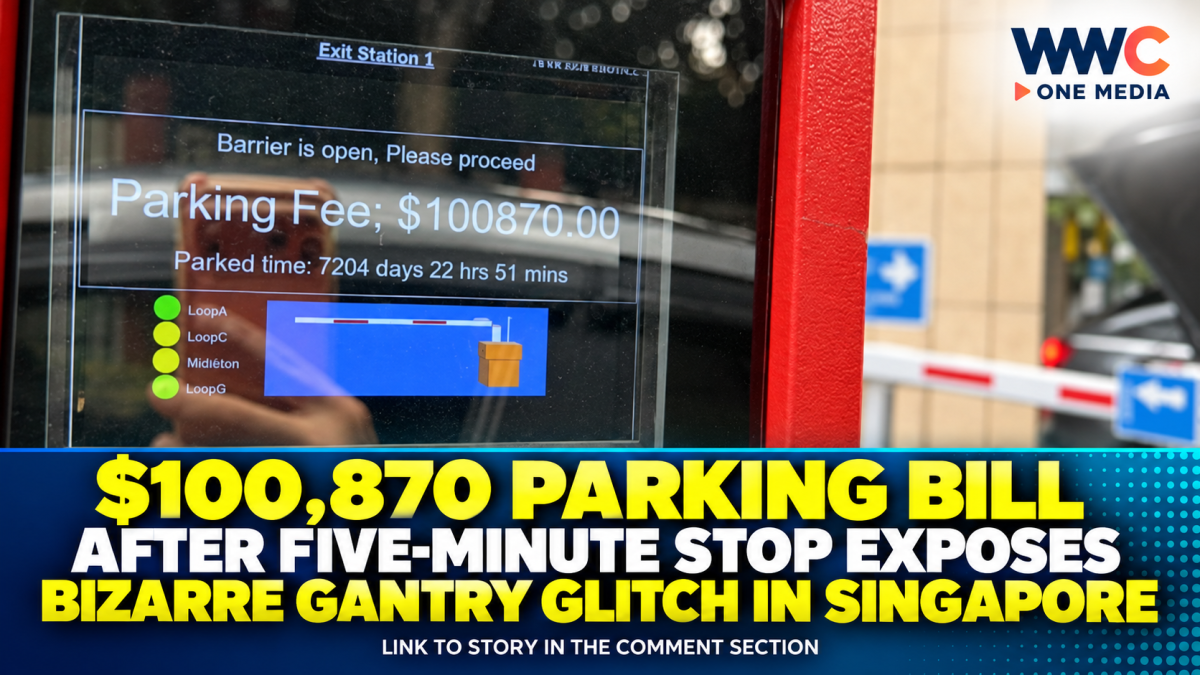
A routine five-minute stop in Singapore’s River Valley turned into an extraordinary parking bill of $100,870 after a gantry system apparently recorded a driver as having remained in the car park for almost 20 years.
The driver, who shared a photo of the bill online on Sept. 25, said he had stopped for only about five minutes and was still within the car park’s grace period. However, the system showed the vehicle as having been parked for 7,204 days, 22 hours and 51 minutes — an amount of time equivalent to nearly two decades.
According to the driver’s account, the gantry barrier opened when he entered, but the system apparently failed to register the vehicle’s entry. When he later exited, that missing entry record appears to have resulted in the system calculating an extraordinarily long parking duration.
The driver contacted the parking operator’s hotline after seeing the charge and was reportedly told that the system had not detected his vehicle entering the car park, despite the barrier having opened. Fortunately, the amount was not deducted from his CashCard, according to his account.
The incident quickly attracted attention online, with users joking about the supposed 20-year parking session and the massive bill. Others focused on the technical explanation, with some speculating that the unusual duration could be connected to how the electronic parking system handles dates and time records. Those explanations remain unconfirmed.
The episode highlights how heavily automated parking systems depend on accurate entry and exit records. If an entry is missed but an exit is later detected, the system can potentially interpret the vehicle as having remained inside for an abnormally long period.
Singapore’s electronic parking infrastructure has evolved over the years, with motorists now also able to use digital parking services. The Urban Redevelopment Authority says its Parking.sg system calculates charges on a per-minute basis, while newer electronic parking functions are being developed as part of the wider transition toward the ERP 2.0 system.
In this particular case, however, the eye-catching $100,870 figure appears to have been the result of a system-recording problem rather than an actual charge for two decades of parking. The parking operator has been contacted for clarification.
For motorists, the bizarre incident serves as a reminder that even automated systems can produce unexpected records when a gantry fails to properly register a vehicle.
A five-minute stop was all it took to produce a bill equivalent to nearly 20 years of parking — leaving the real issue not the amount itself, but what caused the system to lose track of when the vehicle entered in the first place.