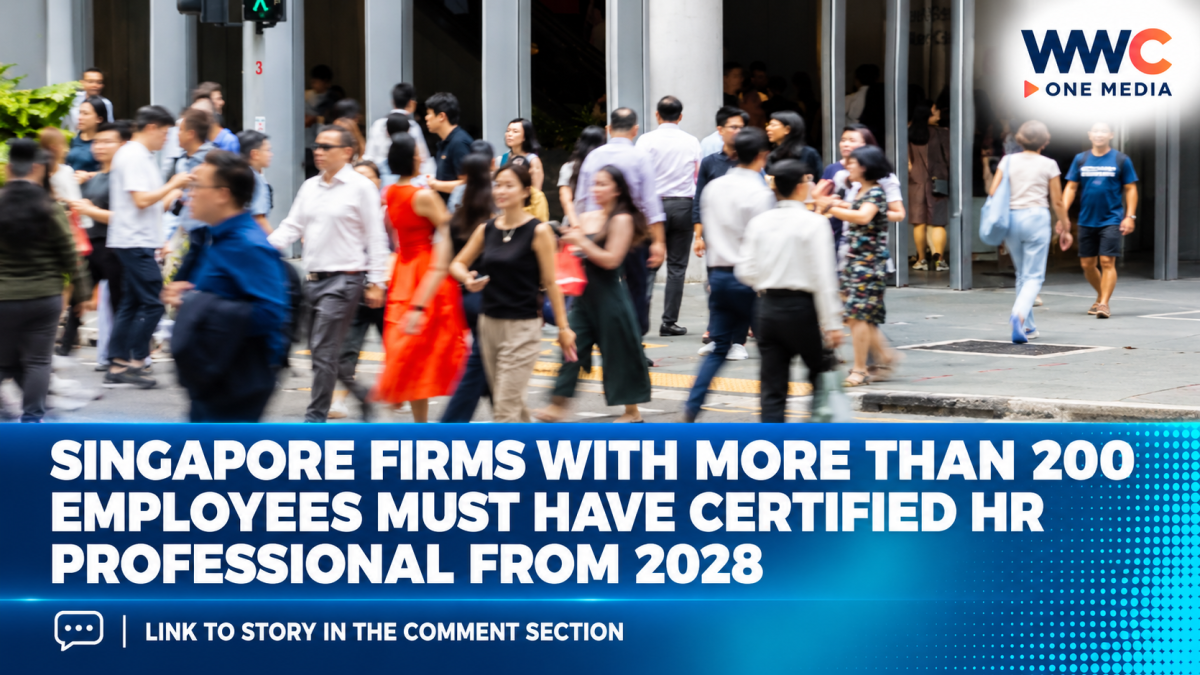
Singapore companies with more than 200 employees will be required to have at least one certified human resources professional from July 1, 2028, under a new government-backed effort to strengthen HR standards and prepare workplaces for rapid changes driven by artificial intelligence.
The requirement was announced on September 24 after the Government accepted recommendations from the Tripartite Workgroup on Human Capital Capability Development, which was formed by the Ministry of Manpower, NTUC and the Singapore National Employers Federation.
Under the new rule, affected organisations must have at least one HR professional certified at the Institute for Human Resource Professionals Certified Professional (IHRP-CP) level or higher. Equivalent certifications from international HR professional bodies may also qualify if they are recognised by IHRP and meet any required bridging conditions.
The measure is designed to establish a baseline for professional HR practice as companies deal with increasingly complex decisions involving hiring, promotions, redeployment, skills development and workforce restructuring.
Minister of State for Manpower Foo Cexiang said workers and employers need confidence that important employment decisions are handled professionally, fairly and with sound judgement. The Government’s broader objective is to ensure economic growth translates into better career opportunities rather than productivity gains accompanied by fewer pathways for workers.
Singapore has about 2,000 companies with more than 200 employees, and these firms employ more than 45% of the country’s workforce. More than 900 of those companies already have at least one IHRP-certified HR professional, meaning a substantial number will already meet the future requirement.
The certification requirement comes as Singapore prepares for further changes to workplace regulation, including the planned implementation of the Workplace Fairness Act and amendments to the Employment Act. The Government says stronger HR capabilities will help companies navigate these changes while improving workplace practices.
The policy will also come with financial support aimed at encouraging companies and HR professionals to prepare before the 2028 deadline.
From October 1, 2026 to June 30, 2028, Singapore residents will receive an additional S$100 subsidy for IHRP certification on top of existing support. The Government said this will bring the certification fees to S$163.50 for IHRP-CP and S$272.50 for IHRP Senior Professional certification. Companies can also use SkillsFuture Enterprise Credits to offset remaining eligible costs.
The Government wants the number of certified HR professionals to roughly double from about 9,000 currently to around 18,000 by 2030, equivalent to about 40% of Singapore’s HR workforce.
But certification is only one part of the wider workforce strategy.
The tripartite workgroup has also recommended stronger support for AI adoption in HR, including an AI playbook for HR professionals expected in the first quarter of 2027 and an updated HR Jobs Transformation Map examining how AI is changing HR roles and required skills.
The Government also plans initiatives aimed at helping workers identify workplaces where they can develop and progress, while strengthening the pipeline of people leaders capable of managing workforce transformation.
The push comes as AI increasingly changes how jobs are designed and how companies make decisions about their workforce. Officials have stressed that business transformation and people transformation should be addressed together rather than treated as separate issues.
For smaller companies with 200 or fewer employees, the certification requirement will not apply. However, the Government says it will still support these organisations in getting their HR professionals certified.
The policy therefore marks a significant shift toward formalising HR standards in Singapore, while giving businesses nearly two years to prepare before the requirement takes effect.
The bigger question now is whether the new certification baseline will translate into stronger workplace decisions and better career opportunities as Singaporean companies navigate AI, job redesign and a rapidly changing labour market.