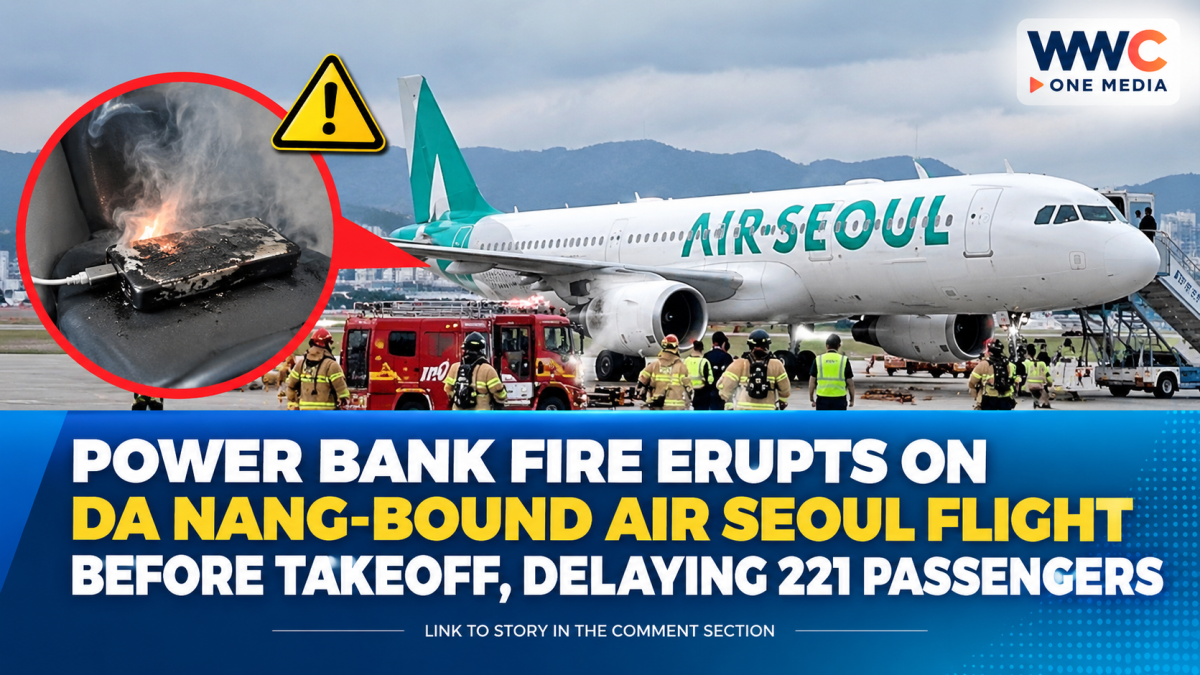
INCHEON, SOUTH KOREA — A suspected power bank fire broke out inside a passenger’s bag aboard an Air Seoul flight bound for Da Nang, Vietnam, shortly before takeoff from Incheon International Airport, forcing the aircraft to be evacuated and delaying the journey by nearly three hours.
The incident occurred at around 9 p.m. Thursday aboard Air Seoul flight RS511, as the aircraft was preparing to depart during the Chuseok holiday period, according to industry sources cited by Yonhap.
The fire reportedly started inside a passenger’s bag stored beneath a seat. A portable power bank was found inside a pouch in the bag.
Cabin crew quickly extinguished the fire, while firefighters arrived to inspect the aircraft and check passengers.
The plane was carrying 221 passengers and seven crew members when the incident occurred. No deaths or serious injuries were reported.
Flight Replaced After Fire
Air Seoul evacuated passengers from the aircraft and deployed a replacement plane while safety inspections were carried out.
The replacement flight eventually departed approximately 2 hours and 50 minutes behind schedule. Korea JoongAng Daily reported that 219 passengers ultimately continued the journey after two passengers chose not to fly.
Some passengers reportedly experienced respiratory discomfort following the incident, although none required hospitalization, according to Korea JoongAng Daily.
The exact cause of the fire remains under investigation.
Why Power Banks Are Drawing Fresh Attention
The incident comes as South Korea and the international aviation industry have tightened rules surrounding portable batteries because of fire risks associated with lithium-ion batteries.
South Korea introduced stricter restrictions in April 2026. Passengers are limited to carrying up to two portable chargers with a maximum capacity of 160 watt-hours, while charging power banks or using them to charge other devices during flights is prohibited under the strengthened rules. Portable chargers must also be carried onboard rather than placed in checked baggage.
The latest incident is therefore likely to renew attention on how passengers store and handle portable batteries while traveling.
Importantly, authorities have not yet established that the power bank itself definitively caused the fire. The device was found in the bag where the fire originated, but investigators are still determining the precise cause.
A Holiday Flight Turns Into a Safety Investigation
For hundreds of passengers traveling to Da Nang for the Chuseok holiday, what should have been the start of a vacation instead became an unexpected airport emergency.
The crew’s rapid response prevented the incident from developing further, while the replacement aircraft allowed most passengers to continue their trip later that night.
But the episode highlights a continuing challenge for airlines: small rechargeable batteries can create significant aviation-safety concerns when something goes wrong.
As investigators examine what triggered the fire aboard RS511, the incident could further intensify scrutiny of portable battery safety on passenger aircraft.
And with millions of travelers carrying power banks in their bags, one question is now getting harder to ignore: how much battery risk can an aircraft safely tolerate?
WWC ONE MEDIA G,A