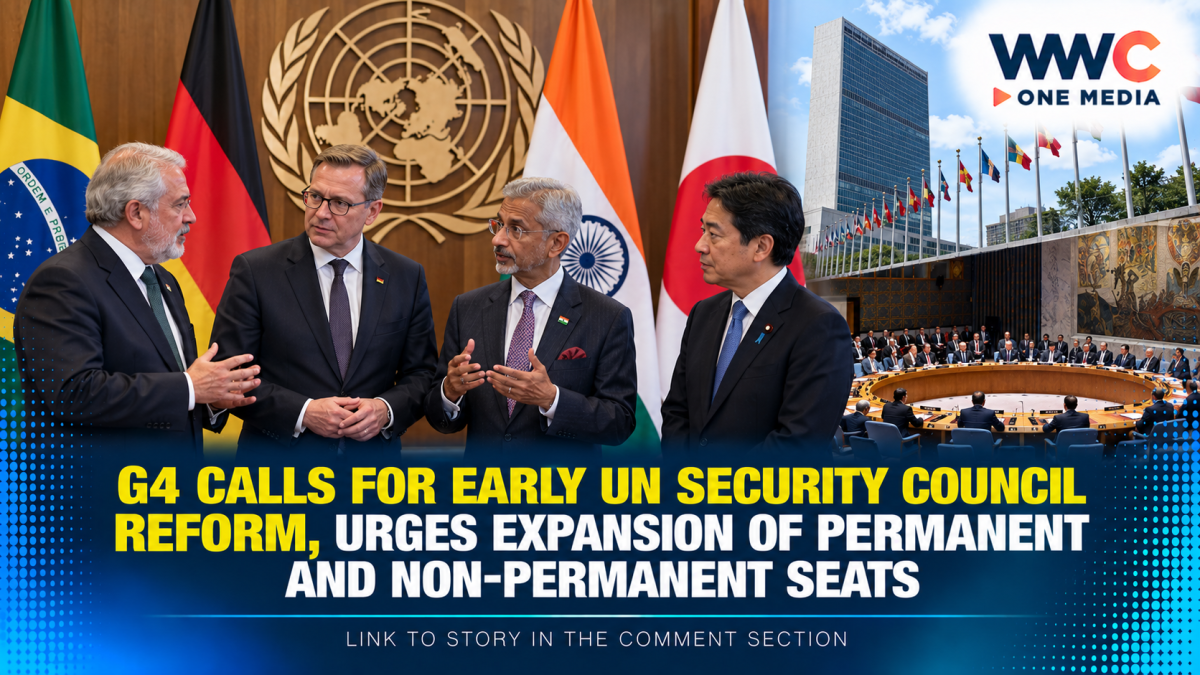
NEW YORK — Japan, Germany, India and Brazil are pressing for faster reform of the United Nations Security Council, arguing that the powerful UN body needs a broader membership to better reflect the international community.
Foreign ministers from the four countries — collectively known as the Group of Four (G4) — issued a joint statement after meeting in New York on Sept. 22, calling for the reform process to move forward as soon as possible.
The G4 specifically supports increasing the number of both permanent and non-permanent members of the Security Council, according to the statement reported by the Philippine News Agency.
The countries said it is crucial to implement Security Council reform at the earliest opportunity, renewing a long-running campaign to change the structure of the UN’s most powerful decision-making body.
Why the G4 Wants Change
The Security Council currently has 15 members: five permanent members — China, France, Russia, the United Kingdom and the United States — and 10 non-permanent members elected for two-year terms.
The permanent five also hold veto power over substantive Security Council decisions.
The G4 — made up of four major countries from Asia, Europe and Latin America — has for years advocated expanding the Council to give greater representation to regions and countries that are not permanently represented.
Their latest statement places renewed emphasis on moving the reform process forward rather than allowing negotiations to remain stalled.
A Long-Running UN Debate
Reforming the Security Council has been discussed for decades, with member states divided over questions including how many additional seats should be created, which countries or regions should receive permanent representation, and whether new permanent members should have veto rights.
The G4 countries have traditionally supported each other’s bids for permanent seats as part of their broader campaign for Security Council reform.
Their latest meeting therefore represents another coordinated push for negotiations at a time when the UN is confronting conflicts and geopolitical disputes across several regions.
Nuclear-Test-Ban Treaty Also on Agenda
Japanese Foreign Minister Toshimitsu Motegi also attended a meeting of the Friends of the Comprehensive Nuclear-Test-Ban Treaty (CTBT), according to the PNA report.
The group adopted a statement noting that 188 countries have signed the CTBT and 177 have ratified it. The treaty, however, has not yet entered into force because several required ratifications remain outstanding.
The statement called for the remaining countries whose ratification is necessary for the treaty to take effect — including the United States, China, Russia and North Korea — to complete the process.
What Happens Next?
The G4’s latest call does not itself change the composition of the Security Council. Any reform would require negotiations among UN member states and agreement through the UN’s established procedures.
For now, Japan, Germany, India and Brazil are continuing to push their case for a Security Council that includes more permanent and non-permanent members.
Their renewed call puts one of the UN’s longest-running institutional debates back in the spotlight — with the question of who gets a permanent seat at the world’s top security table still unresolved.
WWC ONE MEDIA G,A