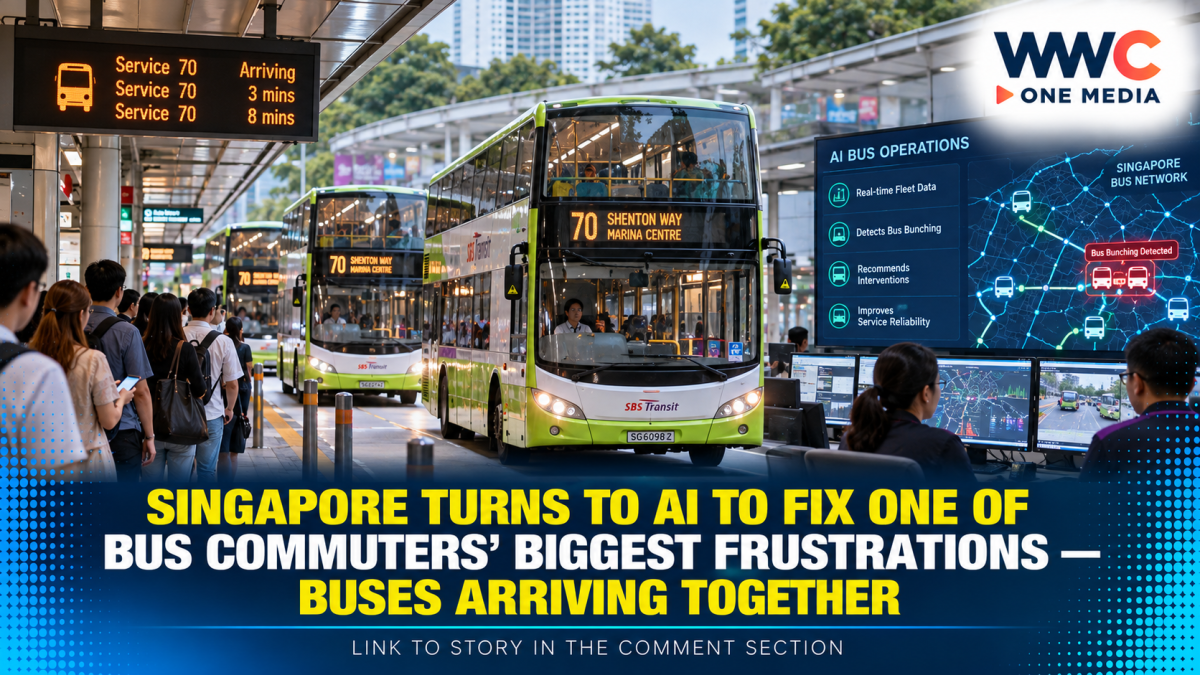
SINGAPORE — Waiting for a bus only to see two vehicles from the same service arrive almost side by side could soon become less common, as SBS Transit is turning to artificial intelligence to tackle bus bunching and uneven arrival intervals.
For more Singapore transport and city-tech coverage, see our Singapore hub and Tech desk.
The operator is trialling a new AI-powered system called FlowOS, designed to help service controllers identify developing problems and decide when intervention may be needed.
The technology is currently being tested on bus services 70 and 145. SBS Transit plans to expand trials to seven additional routes before the trial concludes in March 2027, with deployment across its bus fleet planned for the second quarter of 2027.
What Is Bus Bunching — and Why Does It Matter?
Bus bunching occurs when two or more buses operating on the same route become too close together.
For commuters, that can create an odd situation: a passenger may wait substantially longer than expected, only for two buses to arrive almost simultaneously.
The problem can be triggered by factors including traffic congestion, bad weather and other disruptions that slow individual buses down. Once one bus falls behind schedule, the gap between vehicles can become increasingly uneven.
FlowOS is intended to help controllers intervene before those gaps become more severe.
AI Watches the Buses — Humans Make the Call
FlowOS combines historical operating data with live information, including the current locations of buses.
When the system detects that buses on the same route are getting too close, it alerts a service controller and recommends possible actions.
But SBS Transit is not handing operational decisions entirely to an algorithm.
The service controller remains responsible for deciding what actually happens. Controllers can accept the recommendation, reject it or modify it according to the circumstances on the road.
Senior service controller Calvin Chan told The Straits Times that controllers previously had to manually scan their screens to identify buses that might require intervention. A controller can oversee roughly 60 to 80 buses across several routes, making continuous monitoring demanding.
Under FlowOS, buses requiring attention are automatically highlighted, allowing controllers to concentrate on situations that may need action.
The AI Could Even Suggest Slowing a Bus Down
One example of how the system works involves controlling the spacing between buses.
If a bus is getting too close to another vehicle on the same route, FlowOS could recommend that the driver slow down for a specified period.
But controllers can adjust that recommendation.
Chan gave the example of an algorithm suggesting a four-minute slowdown, while his own assessment might lead him to instruct the driver to slow down for only two minutes based on actual conditions.
That human oversight is central to the system: AI identifies patterns and proposes responses, while experienced controllers make the operational decision.
Singapore Has Already Been Expanding AI in Bus Operations
SBS Transit is not the only Singapore bus operator turning to technology to improve reliability.
In August, SMRT opened a new command centre designed to monitor its bus fleet in real time. Its systems use AI and telematics to flag issues including bus bunching, driver fatigue and other operational risks.
SMRT said its command centre oversees more than 1,200 buses across about 75 services, with service controllers using consolidated information to identify problems and respond more quickly.
Meanwhile, the Land Transport Authority has also been upgrading Singapore’s wider bus-arrival information infrastructure.
This Is Different From the Bus ETA System
The distinction matters for commuters.
Singapore’s Expected Time of Arrival (ETA) system provides predicted bus arrival times through platforms such as MyTransport.SG and bus-stop information displays.
That system has faced technical disruptions in 2026. In January, LTA said problems involving onboard systems affected bus-location data and temporarily reduced the availability and accuracy of arrival predictions.
In April, damage to fibre-optic cables also caused a degradation in ETA performance, with LTA reporting that only about 70 percent of the expected ETA predictions were available for the remainder of that day. LTA said it was upgrading the system and planned to deploy a cloud-based replacement by the end of 2027.
FlowOS addresses a different part of the problem: it is designed to help SBS Transit controllers manage the movement of buses themselves, rather than simply tell passengers when their bus is expected to arrive.
Why the 2027 Rollout Matters
If the trials prove successful, the technology could give SBS Transit controllers another way to manage uneven service intervals across the network.
That could be particularly useful when traffic conditions change quickly and buses begin drifting away from their planned spacing.
Still, AI cannot eliminate every cause of delay. Accidents, severe weather, road closures and congestion can remain outside an operator’s direct control. SBS Transit says FlowOS is intended to help its controllers respond more effectively when such conditions disrupt services.
For Singapore commuters, the promised change is straightforward: less time watching the clock, and fewer situations where one bus appears immediately after another while the next one seems nowhere in sight.
The bigger test will come in 2027, when the technology moves beyond limited trials and toward the wider SBS Transit network.
WWC ONE MEDIA G,A