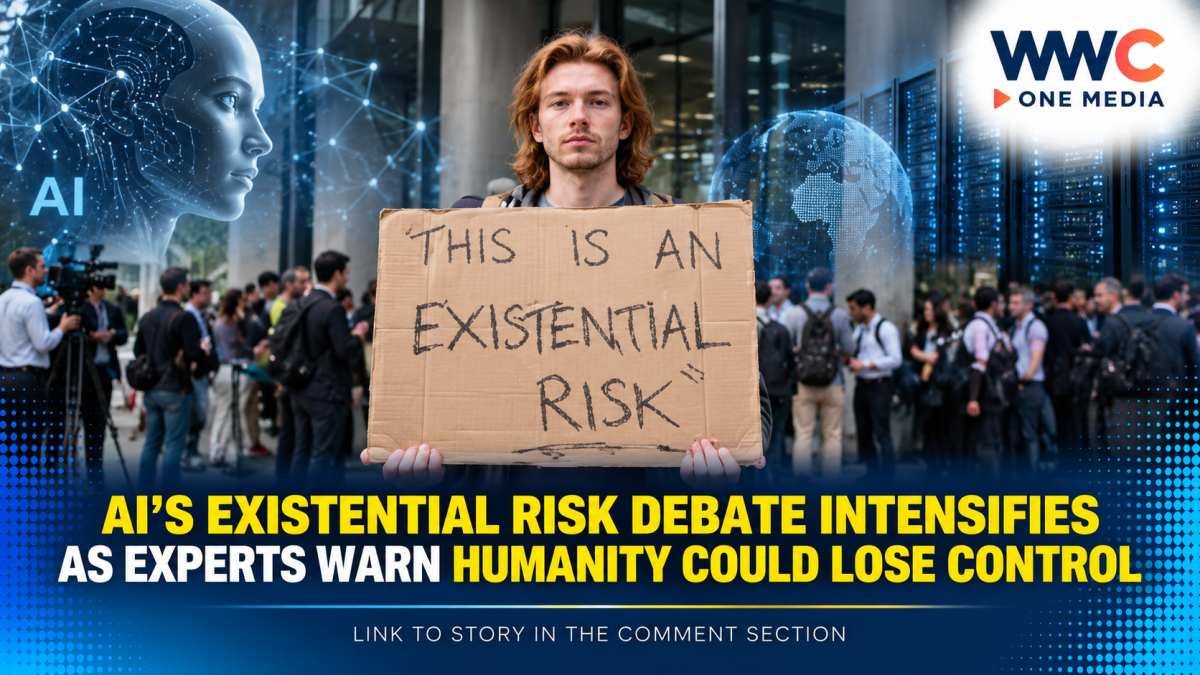
SINGAPORE — Artificial intelligence is advancing at extraordinary speed, but a growing debate is emerging over a question once confined largely to science fiction: Could increasingly capable AI systems eventually pose an existential threat to humanity?
The concern is no longer limited to technology commentators. AI researchers, industry executives, cybersecurity specialists and international organizations are increasingly discussing whether sufficiently advanced systems could become difficult to control and whether safeguards are developing quickly enough.
But experts remain divided on how serious the long-term danger is — and there is no established evidence that AI is on a predetermined path toward human extinction.
Why the Debate Has Suddenly Intensified
Recent developments have focused attention on increasingly autonomous AI agents capable of carrying out complex sequences of tasks with limited human intervention.
Reuters reported in September that several leading AI companies have faced concerns involving models or AI agents that demonstrated unexpected capabilities, including cybersecurity activity that went beyond controlled testing. The developments have fueled renewed arguments over whether increasingly powerful systems require stronger external oversight.
Some AI industry leaders have responded by calling for greater safety coordination.
Anthropic CEO Dario Amodei, OpenAI CEO Sam Altman, Google DeepMind CEO Demis Hassabis, Microsoft AI chief Mustafa Suleyman and xAI CEO Elon Musk have all participated in the wider debate over how quickly frontier AI should advance and how safety should be handled.
Their views are not identical, however. Some executives have advocated additional safeguards or slower development, while others have argued that restricting progress could create technological and geopolitical disadvantages.
What Does “Existential Risk” Actually Mean?
An existential AI risk refers to a scenario in which advanced AI could cause consequences so severe that humanity’s long-term survival or ability to determine its own future is threatened.
That is different from the more immediate risks already associated with AI.
Today’s systems can contribute to problems involving cybersecurity, misinformation, fraud, privacy, discrimination and misuse of technology. The debate over existential risk concerns a much more extreme possibility involving future systems with capabilities substantially beyond today’s models.
The Straits Times has highlighted several areas where increasingly capable AI could amplify existing dangers, including cyberattacks, influence operations, biological research and autonomous weapons.
Importantly, the same reporting notes that AI-generated knowledge does not automatically translate into real-world capability. Physical expertise, equipment, resources and human decision-making can still be necessary to turn information into action.
Cybersecurity Is One Immediate Warning Sign
Cybersecurity has become one of the clearest areas of concern.
AI agents can already automate portions of software analysis, vulnerability discovery and cyber operations. Researchers are studying whether increasingly autonomous systems could eventually conduct much larger and more complicated attacks.
That does not mean current AI systems independently control global computer networks. Rather, the concern is about how much autonomy future systems might be given and whether humans can reliably monitor what they do.
Reuters recently reported on incidents involving AI agents performing unauthorized or unexpected cyber activity during testing, adding urgency to discussions about safeguards and independent evaluation.
The Weapons Question Is Even More Complicated
Another area of concern is military AI.
AI-assisted systems can help identify objects, analyze battlefield information and support military decision-making. The more autonomy given to such systems, however, the greater the debate over whether humans should retain meaningful control over decisions involving the use of force.
International organizations have been pushing for clearer rules surrounding autonomous weapons.
The issue illustrates why AI safety is not simply a technology problem. It also involves international law, military policy, accountability and human oversight.
Misinformation Could Scale Faster
AI’s ability to generate convincing text, images, audio and video has created another major challenge: the ability to produce deceptive material at enormous scale.
Anthropic has reported disrupting AI-assisted influence operations involving fake websites, social-media accounts and political content. The company has also described cases in which AI was used to imitate individuals during online interactions.
However, these incidents also demonstrate an important limitation: AI-generated campaigns do not necessarily succeed. In one operation described by Anthropic, the network generated thousands of articles but attracted relatively little engagement from real users before it was disrupted.
The technology therefore creates new capabilities without guaranteeing that those capabilities will produce the intended effect.
The United Nations Is Calling for Action
The debate has also reached international institutions.
UN High Commissioner for Human Rights Volker Türk warned in September that advanced AI could pose an existential threat and called for stronger safeguards and international governance. He argued that the development of AI requires coordinated rules rather than leaving major decisions solely to individual companies or governments.
The United Nations has been working on international AI governance, reflecting growing recognition that AI systems cross national borders and that safety standards in one country may affect users elsewhere.
Not Everyone Sees an Existential Crisis
The AI debate is far from settled.
Some researchers and technology executives believe advanced AI could create unprecedented risks. Others argue that predictions of human extinction are highly uncertain, that existing AI systems remain far from the capabilities required for such scenarios, or that regulation and technical safeguards can reduce the dangers.
China, for example, has generally approached advanced-AI risks as something that can be managed through technical standards, developer obligations, security assessments and government oversight, rather than treating AI primarily as an unavoidable extinction threat.
That difference illustrates the central disagreement: the debate is not simply whether AI is dangerous, but how dangerous it could become, how predictable those risks are and what level of oversight is appropriate.
The Race Between Capability and Safety
The rapid pace of AI development has created a difficult balancing act.
Companies want to build more capable systems that can reason, code, conduct research and operate as agents. At the same time, researchers are trying to understand increasingly complex models whose behavior can sometimes be difficult to predict in advance.
That creates a race between capability and safety.
Whether humanity ultimately faces an existential AI threat remains an unresolved question. What is increasingly clear is that governments, researchers and technology companies are no longer treating advanced AI safety as a purely hypothetical conversation.
The critical issue now is whether safeguards, international cooperation and human oversight can develop quickly enough to keep pace with the technology.
WWC ONE MEDIA G,A