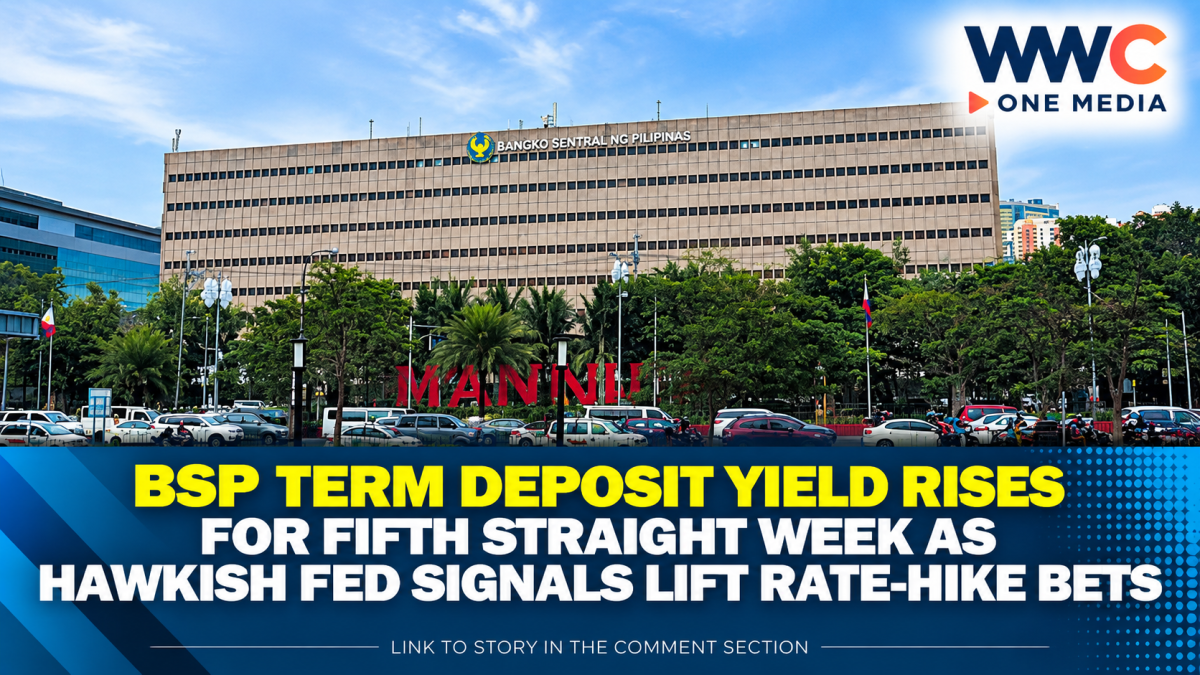
The average yield on the Bangko Sentral ng Pilipinas’ (BSP) seven-day term deposits rose for a fifth consecutive week on Wednesday, as weaker demand and renewed expectations of tighter US monetary policy pushed Philippine market rates higher.
The BSP accepted P106.074 billion in its seven-day term deposit facility against P120 billion on offer, with total bids reaching P114.324 billion. The bid-to-cover ratio fell to 0.95 times from 1.15 times a week earlier, indicating softer demand for the central bank’s liquidity-absorbing instrument.
Accepted yields ranged from 4.95% to 5.03%, compared with 4.90% to 5.02% in the previous auction. The weighted average accepted rate increased to 4.9965% from 4.9924%, according to the latest auction data.
The increase comes as global markets reassess the outlook for interest rates after the US Federal Reserve raised its policy rate to 3.75%-4.00%. Recent comments from Fed officials, together with stronger economic activity and renewed inflation pressures, have increased expectations that another rate increase could be considered.
Those developments are also influencing expectations for Philippine monetary policy. Analysts have said the BSP could consider another 25-basis-point increase to help manage inflation risks, peso volatility and the interest-rate differential with the United States.
The BSP’s own policy rate currently stands at 5.00% for the target reverse repurchase facility, with the overnight lending facility at 5.50% and the overnight deposit facility at 4.50%, based on the central bank’s latest published data.
Term deposits are one of the BSP’s tools for absorbing excess liquidity from the financial system. By accepting funds from banks for a specified period, the central bank can help keep market interest rates aligned with its monetary-policy stance.
The latest auction also reflects broader pressure on Philippine financial markets. Local investors have been watching US rates, oil prices, the peso and domestic inflation closely as they assess the direction of Philippine interest rates. Recent market commentary has pointed to rising Treasury yields and a weaker peso as additional factors affecting investor sentiment.
For banks and other financial institutions, persistently higher short-term market rates can influence funding costs and the pricing of loans and investments. For the BSP, the challenge is balancing inflation and currency stability against the need to support an economy facing weaker growth prospects.
The continued rise in the term-deposit yield therefore provides another indication of how global rate expectations are feeding into Philippine financial markets, with investors now watching closely for signals from both the Federal Reserve and the BSP on what comes next.