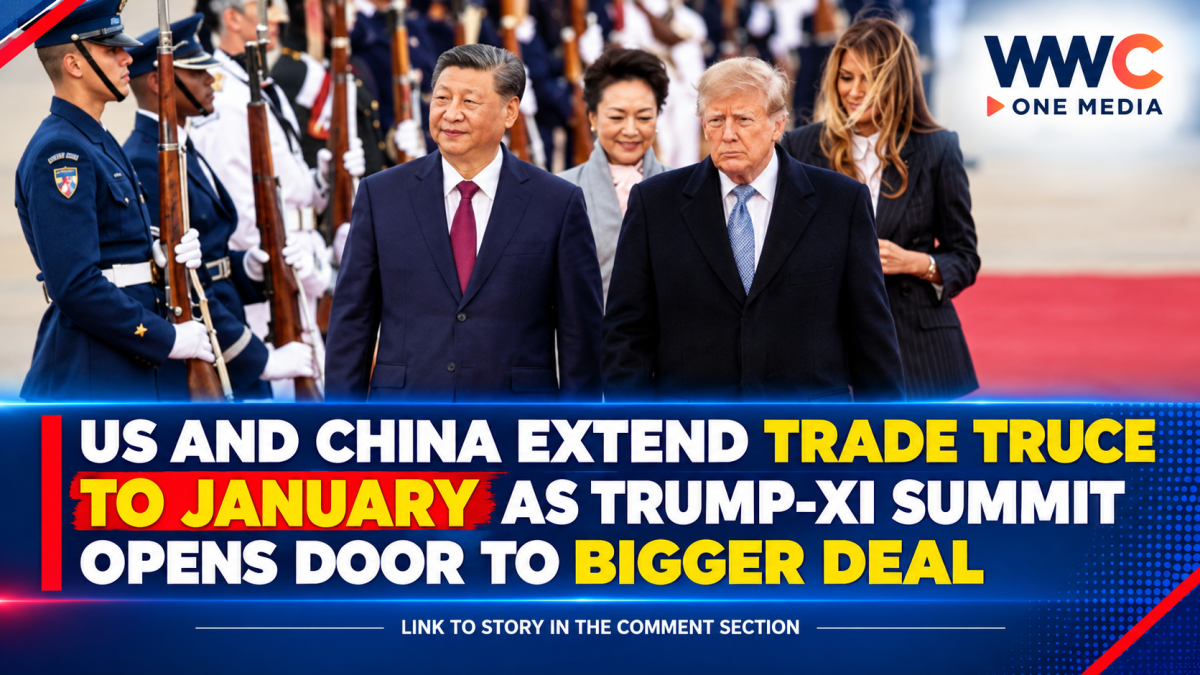
WASHINGTON — The United States and China have agreed to extend their fragile trade truce by two months, giving the world’s two largest economies additional time to negotiate a broader economic agreement as Chinese President Xi Jinping arrives in Washington for talks with U.S. President Donald Trump.
U.S. Treasury Secretary Scott Bessent confirmed the extension after meeting Chinese Vice Premier He Lifeng in Washington on Sept. 23. The agreement, known as the Busan Agreement, had been scheduled to expire on Nov. 10 but will now run until Jan. 10, 2027.
The extension came just hours before the highly anticipated Trump-Xi summit, putting trade at the center of a broader effort to stabilize relations that have been strained by tariffs, technology restrictions, critical-mineral controls and disagreements over other geopolitical issues.
From tariff truce to a potentially bigger deal
Bessent said Washington and Beijing used their latest meeting to consider whether they could move beyond a collection of smaller agreements and pursue a more comprehensive trade arrangement.
“We met today to see if we could do a bigger deal,” Bessent said, according to Reuters.
The two sides had previously agreed to reduce some of the tariffs imposed during their trade confrontation and to ease certain retaliatory measures. The Busan arrangement also included commitments involving agricultural purchases and China’s supply of rare-earth materials and other critical minerals.
The extension gives negotiators more time to address those commitments rather than allowing the current framework to expire while talks remain unfinished.
But major issues remain unresolved
The truce extension does not mean Washington and Beijing have settled their wider economic differences.
Bessent said China was meeting its commitment to purchase 25 million tons of U.S. soybeans, but was behind on a pledge to purchase another $17 billion worth of U.S. agricultural products. U.S. officials have also raised concerns about the pace of China’s rare-earth deliveries.
The countries are also discussing possible reciprocal tariff reductions covering roughly $30 billion in non-critical goods, along with agricultural products, financial services and other trade barriers.
The negotiations therefore involve much more than simply deciding whether existing tariffs remain suspended.
Rare earths remain a major pressure point
One of the most important unresolved issues is China’s control over rare-earth supply chains.
China is a dominant player in rare-earth mining, processing and the production of rare-earth magnets used in electronics, electric vehicles and other advanced technologies. Beijing’s previous restrictions on rare-earth exports caused concern across global manufacturing supply chains.
Washington wants more reliable access to these materials, while Beijing has pushed back against U.S. restrictions on Chinese access to advanced technology.
That creates a difficult negotiating balance: both countries have economic incentives to maintain stability, but each is also trying to protect strategic industries and national-security interests.
AI enters the trade negotiations
The talks are also expanding beyond conventional trade.
U.S. and Chinese officials have discussed establishing a communications mechanism for AI safety incidents, potentially creating a direct channel for the two governments to communicate about serious risks involving artificial intelligence. Reuters reported that the two sides agreed to launch such a communications hotline, although China’s official account of the discussions was less specific.
AI is particularly sensitive because Washington and Beijing are simultaneously competing for technological leadership.
The issue therefore presents an unusual combination of potential cooperation and strategic rivalry.
What Trump and Xi could discuss
Xi’s visit to Washington comes as both governments look for concrete results from the summit.
Reuters reported that possible announcements could involve agriculture, financial services and the proposed tariff reductions on non-strategic goods. The leaders could also discuss rare-earth supplies and technology restrictions.
The broader relationship, however, extends well beyond economics. Taiwan, Iran and artificial intelligence are also among the sensitive issues surrounding the summit.
The two governments therefore face a complicated task: preserve the economic stability created by the trade truce while negotiating disagreements that reach into technology, national security and geopolitics.
A pause in the trade war — not the end of it
The extension to Jan. 10 gives negotiators roughly two additional months to determine whether the current truce can evolve into something more permanent.
For businesses and global supply chains, the extension removes an immediate deadline for another round of tariff escalation. But it does not eliminate uncertainty.
The United States and China still have unresolved disagreements over agricultural purchases, rare-earth supplies, technology restrictions and market access.
And with Trump and Xi now meeting in Washington, the biggest question is no longer simply whether the trade truce will survive.
It is whether the two leaders can turn a temporary pause in the tariff conflict into a broader economic agreement — or whether January will bring another deadline that puts the fragile truce under pressure once again.
WWC ONE MEDIA G,A