
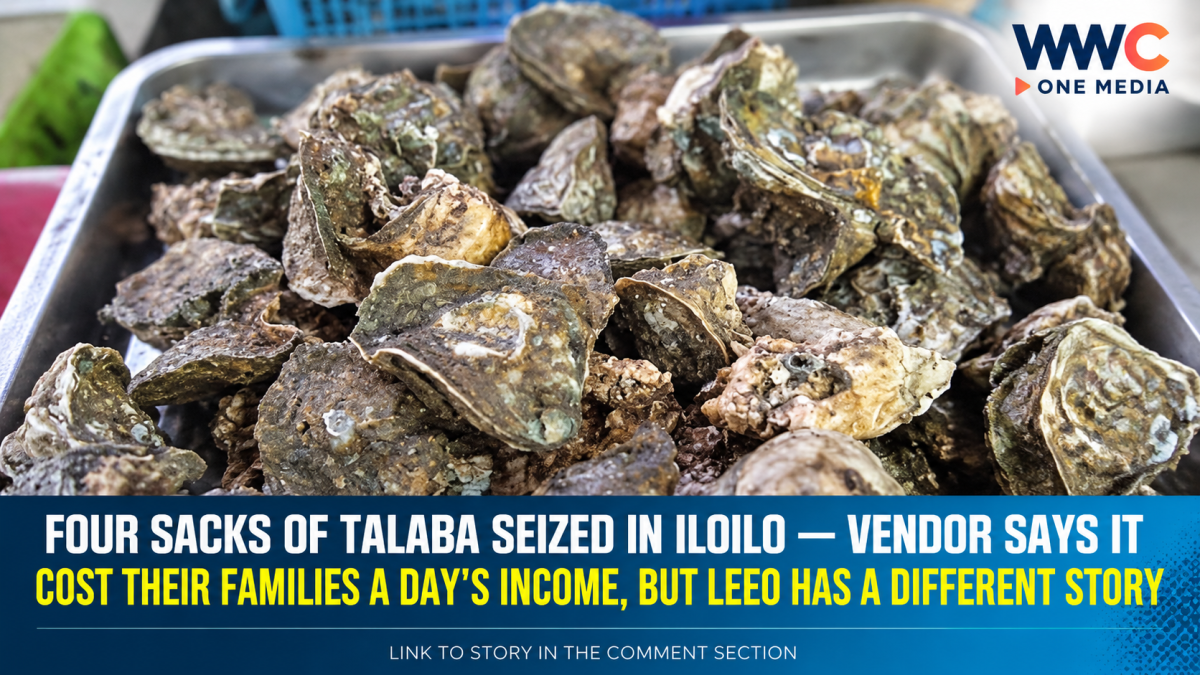
A routine clearing operation near the Iloilo Terminal Public Market has sparked a dispute between oyster vendors and the city office tasked with enforcing market and sidewalk regulations.
The incident happened on September 4 along Jalandoni Street, where personnel identified by the vendors as part of the Local Economic and Enterprise Office (LEEO) confiscated four sacks of talaba, according to Bombo Radyo Iloilo.
The vendors said they were caught off guard by the operation and questioned why their oysters were taken instead of simply being issued a violation ticket.
But a day later, the LEEO gave its side of the story—and said the confiscation was not arbitrary.
LEEO: The oysters were obstructing the sidewalk
LEEO head Maricel Mabaquaio said the oysters were positioned on the sidewalk and were obstructing the passageway, prompting the clearing team to enforce existing city rules.
She said personnel had already told the vendor to address the violation. However, according to Mabaquaio, the vendor allegedly fell asleep and was reportedly under the influence of alcohol at the time.
The LEEO subsequently took one sack of oysters and brought it to Balay Dalayunan. Mabaquaio said the office follows an ordinance providing that confiscated goods from certain violations are not returned.
She also stressed that clearing obstructions from public roads and sidewalks is part of the clearing team’s mandate.
But the vendors tell a different story
The vendors’ account, reported by Bombo Radyo a day earlier, was markedly different.
Christopher Catalan, the driver of the truck carrying the oysters, said the four sacks were placed on top of the truck when the clearing personnel arrived. He said the group was surprised when the oysters were taken.
Catalan acknowledged that the truck was obstructing the area but argued that the vehicle should have been ticketed rather than having their merchandise confiscated.
He also said the clearing team did not present documentation that would serve as notice for the seizure.
The vendors said the incident meant they could not sell their oysters and would return home without money for their families that day.
The bigger issue: sidewalk clearing versus vendors’ livelihoods
The dispute highlights a recurring challenge in Iloilo City: how to keep public sidewalks and roads clear while protecting the livelihoods of small vendors.
Iloilo City’s existing general ordinances prohibit placing materials or goods on public sidewalks, highways and streets when these obstruct or impede the free passage of pedestrians or vehicles.
The city has also previously created designated opportunities for sidewalk vendors. In December 2024, Iloilo City announced an “open sidewalk” program allowing more than 400 sidewalk vendors to operate in designated areas, provided they secured the necessary permits and followed restrictions designed to prevent obstruction.
That distinction is important in the latest incident: the issue is not whether vendors can ever sell on or near sidewalks, but whether the particular location and manner of selling complied with the city’s rules.
Enforcement tensions have surfaced before
The oyster confiscation also comes amid broader enforcement activity around Iloilo’s markets.
In August, the LEEO filed a case against an ambulant vendor following an alleged confrontation during a market clearing operation. The office said the vendor had previously been warned against selling in unauthorized areas around the market.
That incident underscores the increasingly difficult environment faced by both enforcement personnel and informal or ambulant vendors as the city attempts to maintain order around public markets.
What happens next?
For now, the two sides remain at odds over the September 4 incident.
The vendors argue that their merchandise should not have been confiscated and that the obstruction could have been addressed through a ticket.
The LEEO, meanwhile, maintains that its personnel were enforcing city regulations after an obstruction was identified and that confiscation was carried out under applicable rules.
There is no independent evidence in the reports reviewed that establishes wrongdoing by either side beyond the competing accounts, so claims about the exact circumstances of the confiscation should be treated as allegations unless supported by additional documentation or official records.
The real question
The incident raises a question that goes beyond four sacks of talaba:
When a sidewalk violation threatens a vendor’s daily income, where should the line be drawn between enforcing public-space rules and protecting a family’s livelihood?
That is the issue now hanging over the Iloilo oyster vendors’ dispute with the LEEO.
WWC ONE MEDIA M.J.E

Leave a Reply