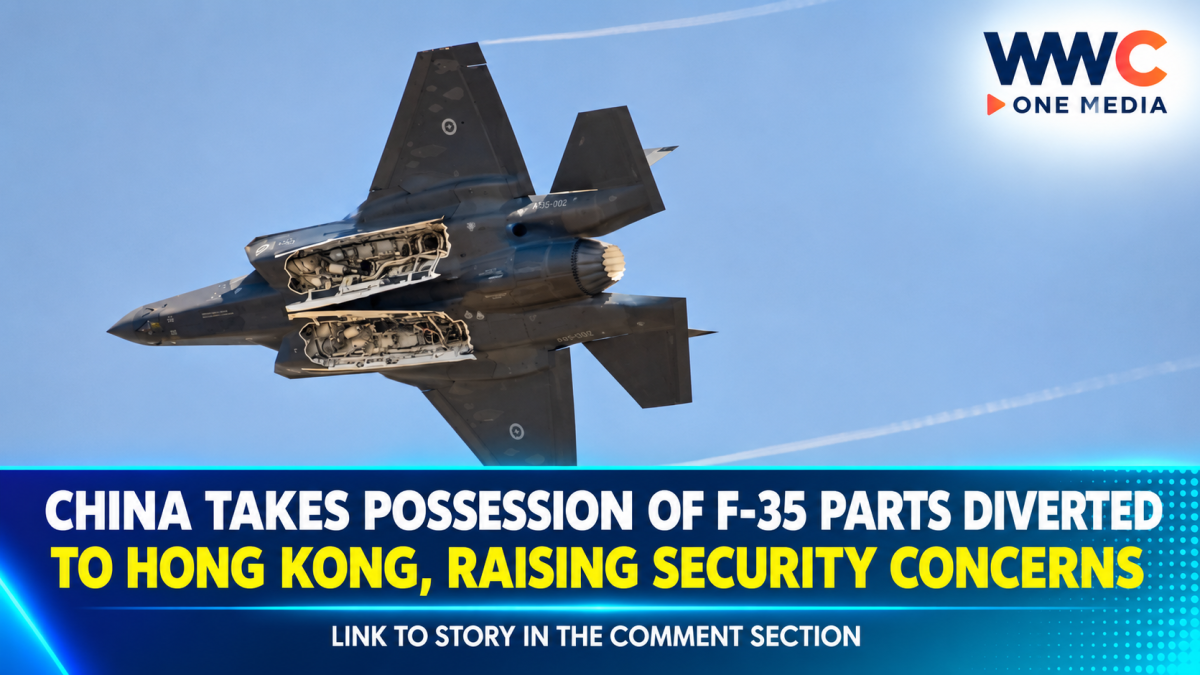
China has taken possession of F-35 fighter jet components that were unexpectedly diverted to Hong Kong while being shipped from Australia to the United States, raising concerns over the security of technology used in one of the world’s most advanced military aircraft.
The shipment, which originated in Australia and was supposed to reach the United States, was diverted to Hong Kong earlier this year. U.S. and Australian authorities are investigating how the components were rerouted and how they ultimately came under Chinese control.
Reports say the shipment included an F-35 cockpit canopy and a weapons-bay door. The components were reportedly being returned to the United States for inspection, repair or disposal after being classified as unserviceable. The canopy is particularly significant because F-35 canopies incorporate radar-absorbing technology linked to the aircraft’s stealth characteristics.
The Pentagon’s F-35 Joint Program Office has confirmed that it is aware of a “shipment issue” involving unserviceable F-35 components. Officials said they are working with U.S. authorities and industry partners to recover the parts, investigate what happened and introduce safeguards to prevent a similar incident.
Australia has also launched an examination of its involvement in the shipment. Defence Minister Richard Marles said Canberra was working with the United States and Lockheed Martin, the F-35 program’s prime contractor. He also said his understanding was that the missing components were not sensitive equipment, although other reports have raised concerns about the technology associated with the canopy.
The incident has drawn attention in Washington as well. The U.S. House Armed Services Committee has received multiple briefings and is conducting oversight of the case, amid concerns that the components could provide information useful for understanding or countering aspects of the F-35’s technology.
The route taken by the shipment remains unclear. Reports indicate that the components traveled from Australia and passed through South Korea before being diverted to Hong Kong. It is not yet publicly established whether the diversion resulted from an accidental shipping error, a deliberate rerouting or another failure in the supply chain.
The case is particularly significant because Australia operates the F-35 and serves as a regional hub for parts supporting F-35 aircraft used by several U.S. allies in the Indo-Pacific, including Japan, Singapore and South Korea. Australia has 72 F-35 aircraft, while numerous other countries participate in the program’s global supply network.
Questions are also being raised about the wider challenge of tracking F-35 components. U.S. defense officials have faced longstanding problems accounting for spare parts and equipment associated with the program, although the Hong Kong diversion is being treated as a separate incident.
For the United States and its allies, the immediate priority is determining exactly what components reached Hong Kong, who obtained them, whether any technical information was exposed and whether the parts can be recovered. Authorities have not publicly established that China has gained access to classified F-35 secrets as a result of the incident.
The investigation could ultimately put greater scrutiny on the F-35’s international logistics network, commercial shipping arrangements and safeguards for damaged or obsolete components. Until investigators determine how the shipment was diverted and what happened to the parts afterward, the full security implications remain unclear.