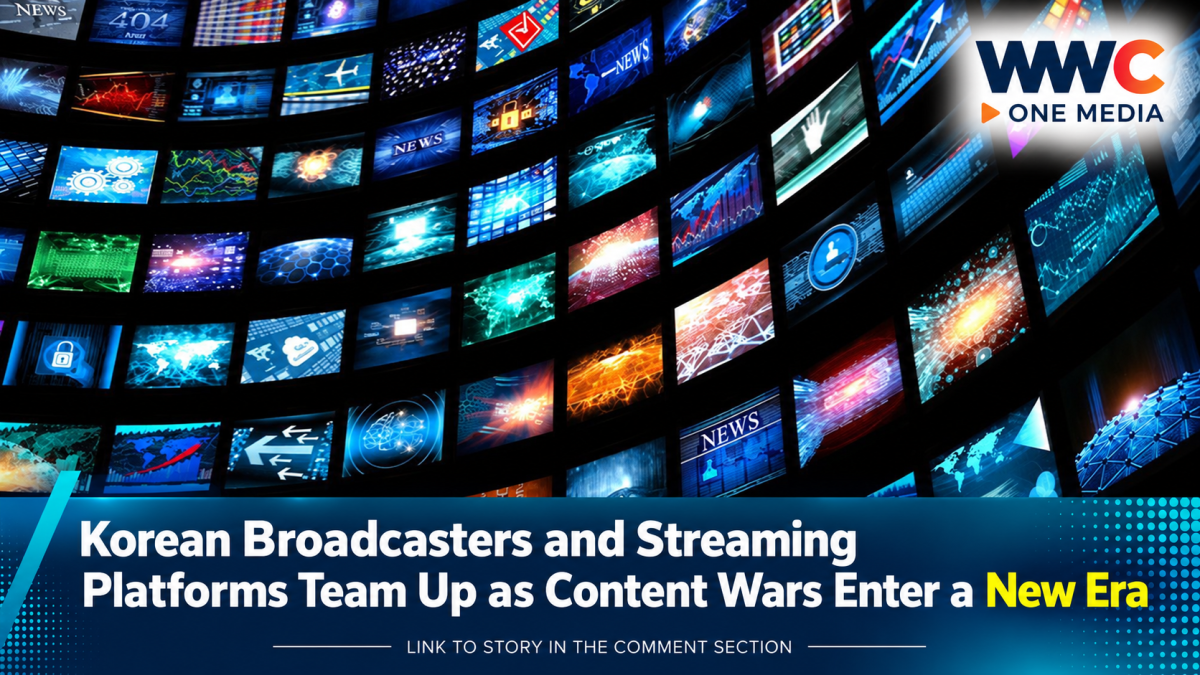
SEOUL — South Korea’s broadcasters and streaming platforms are rewriting the rules of the entertainment business, increasingly choosing cooperation over competition as shrinking TV audiences, weaker advertising revenues and soaring production costs reshape the market.
For years, traditional broadcasters and streaming services were viewed as rivals fighting over the same viewers.
Now, the dividing line is becoming harder to see.
Streaming originals are moving onto television, while broadcaster-produced programs are being distributed through online platforms. Instead of asking where a program premieres, companies are increasingly focusing on how many viewers it can reach across different platforms.
From Rivals to Distribution Partners
The shift reflects a major change in South Korea’s media landscape.
As viewers moved from scheduled television to on-demand services on smartphones, computers and tablets, terrestrial broadcasters faced declining ratings and advertising pressure.
Streaming platforms initially benefited from that migration, but they now face their own challenge: a saturated market filled with competing titles and subscription services.
Simply releasing another original series is no longer a guarantee of success.
That has encouraged both sides to reconsider the value of exclusive distribution.
‘Anna’ Shows Why Cross-Platform Distribution Matters
One of the clearest examples is Coupang Play’s Anna.
The series originally gained attention as a streaming original before moving to broadcast television, allowing it to reach viewers who might not have watched it through the streaming service.
The broadcast window effectively gave the title another opportunity to attract an audience and extend its commercial life beyond its original streaming release.
The strategy signals a broader change: a show’s first platform no longer necessarily determines where its audience ends up.
‘Bonjour Bakery’ Continues the Trend
The same approach is appearing with KBS and Bonjour Bakery.
The program illustrates how domestic streaming services and traditional broadcasters can use each other’s strengths rather than treating the other side exclusively as a competitor.
For broadcasters, acquiring established streaming content can fill programming schedules and potentially attract audiences.
For streaming services, television exposure can introduce their titles to viewers who may not subscribe to the original platform.
‘Perfect Crown’ Proved the Power of Two Platforms
This cross-platform strategy is not entirely new.
Earlier in 2026, MBC’s Perfect Crown, starring IU and Byeon Woo-seok, was released simultaneously through MBC and Disney+.
The series demonstrated how a Korean broadcaster can combine domestic television reach with the international distribution power of a global streaming service.
MBC reported that its fourth episode reached an 11.1% television rating, while the drama also ranked highly on Disney+ in Korea and internationally during its run.
The model gives broadcasters access to global audiences while allowing streaming services to benefit from the production capabilities and domestic reach of established television networks.
TVING and Wavve Are Also Breaking Platform Barriers
The cooperation trend is not limited to partnerships between broadcasters and global companies.
South Korea’s domestic streaming market is also seeing platforms cooperate directly.
In March, TVING and Wavve began exchanging selected original content, allowing programs produced for one service to become available on the other.
The companies described the arrangement as a way to strengthen their strategic partnership and expand the reach of their respective content libraries.
That development is significant because TVING and Wavve have traditionally operated as separate major Korean streaming services.
Their content-sharing strategy reflects a broader realization that platform exclusivity can limit the potential audience for expensive productions.
Even Disney+ Originals Have Appeared on Korean TV
South Korea has already seen the reverse phenomenon.
In 2024, MBC broadcast Disney+ original series Moving, marking an unusual case in which a major Korean television network aired a program originally created for a streaming platform.
The move illustrated how traditional television can become an additional distribution window even for streaming-first productions.
MBC’s earlier decision to air Disney+’s Big Bet similarly demonstrated both the opportunities and tensions created by this changing model.
But Cooperation Comes With Risks
Cross-platform partnerships are not universally welcomed inside the broadcasting industry.
When MBC aired Big Bet, some drama directors and production staff objected, arguing that broadcasting an outside streaming production could weaken investment in the network’s own programming.
MBC, however, pointed to its difficult advertising environment and the financial benefits of acquiring established content.
That debate highlights the industry’s central dilemma.
Partnerships can bring audiences and revenue — but excessive dependence on outside content could make broadcasters less competitive in producing their own programs.
Production Costs Are Changing the Equation
The economics behind the shift are becoming increasingly important.
Producing major Korean dramas and entertainment programs requires substantial investment, while audience attention is divided among an expanding number of services.
A program that succeeds on one platform may therefore still have considerable value elsewhere.
Broadcast television, domestic streaming services and international platforms can each provide different types of exposure.
That creates an incentive to treat content less like a product tied permanently to one platform and more like an asset that can generate value through multiple distribution windows.
Korea’s Streaming Market Is Getting More Flexible
The competition is also changing within Korea’s streaming sector.
Domestic services such as Wavve and TVING have experimented with free, ad-supported channels and continuous programming as they look for ways to retain users amid subscription fatigue.
Wavve, for example, has expanded its free live-channel offerings, while TVING has operated free live channels featuring popular Korean programs.
The goal is increasingly not just to acquire subscribers, but to keep people watching.
The New Battle Is No Longer TV vs. Streaming
The emerging Korean model suggests that the industry’s next phase may not be about eliminating traditional television.
Instead, television and streaming could become complementary distribution channels.
A drama might premiere on a broadcaster and stream internationally at the same time.
A streaming original might later move to television.
A program from one domestic OTT service might eventually become available through another.
Each additional window can create another opportunity to find viewers.
A New Era for K-Content
South Korea’s entertainment industry has already demonstrated how local productions can reach audiences worldwide.
The next challenge is making that global success financially sustainable.
As advertising becomes more difficult, production budgets rise and streaming competition intensifies, cross-platform cooperation is becoming an increasingly important part of the business strategy.
The biggest change may therefore be philosophical.
Broadcasters no longer necessarily need to defeat streaming platforms.
Streaming services do not necessarily need to replace television.
Instead, both sides are discovering that the same Korean drama, variety show or entertainment program can potentially be more valuable when it travels across multiple screens.
The future of K-content may not belong to one platform — but to the content that can successfully move between all of them.