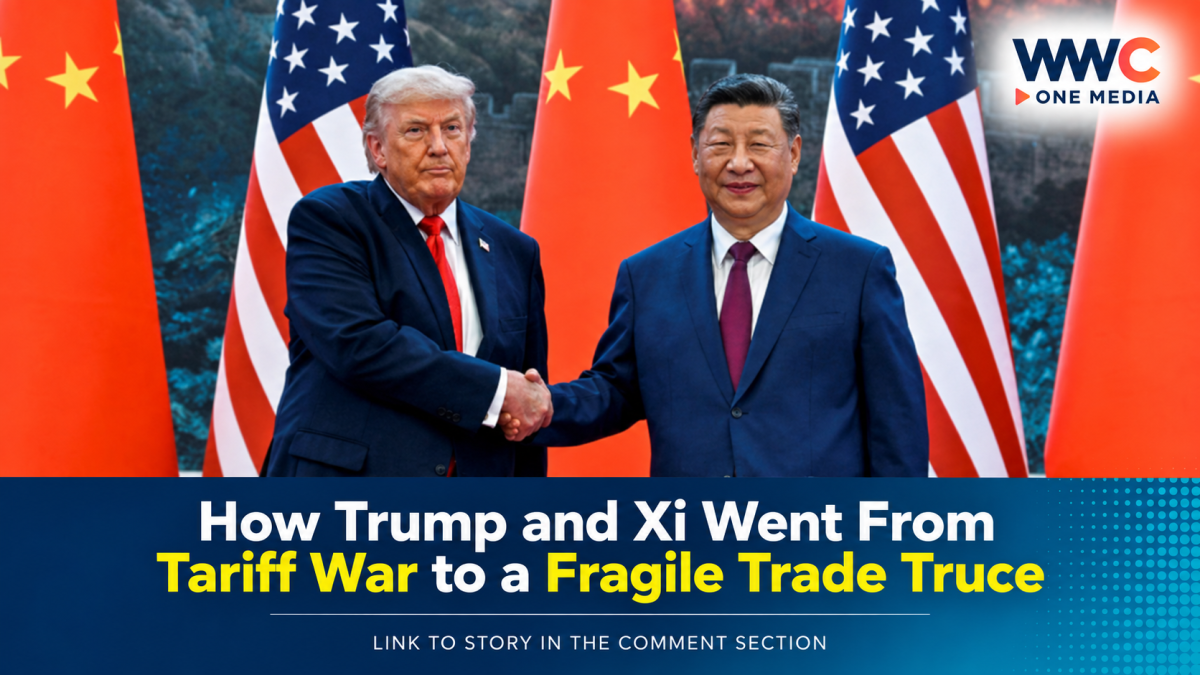
The United States and China went from a rapidly escalating tariff battle to a fragile trade truce in less than two years, but the latest chapter is far from settled.
US President Donald Trump is set to host Chinese President Xi Jinping at the White House on Sept. 24, with both sides looking for ways to keep a trade truce in place before it expires in November. The meeting comes after a series of tariff increases, retaliatory measures and negotiations that repeatedly pushed the world’s two largest economies toward a broader economic confrontation.
The conflict began soon after Trump returned to office in February 2025, when Washington imposed a 10 per cent tariff on Chinese imports, citing concerns including fentanyl and immigration. Beijing responded with tariffs on selected US products and restrictions involving several critical minerals.
In March, Washington doubled the fentanyl-related tariff on Chinese goods to 20 per cent, prompting another round of Chinese retaliatory tariffs targeting US agricultural exports.
The confrontation intensified dramatically in April 2025 when Trump announced his so-called “Liberation Day” tariffs. US duties on Chinese imports eventually climbed as high as 145 per cent, while Beijing raised its own tariffs on US goods to 125 per cent. China also tightened controls on rare-earth exports, increasing pressure on industries dependent on the materials.
That escalation proved difficult for both sides to sustain.
In May 2025, US and Chinese negotiators reached an agreement in Geneva that temporarily reduced tariffs and created a 90-day pause in the escalation. US tariffs on Chinese goods fell from 145 per cent to 30 per cent, while China’s tariffs on US goods dropped from 125 per cent to 10 per cent. The pause was later extended in August.
Tensions returned later that year. China expanded restrictions on rare-earth exports, while the Trump administration responded with another 100 per cent tariff threat and additional export controls. The two countries eventually reached a broader truce after Trump and Xi met in South Korea in October 2025.
Under that arrangement, Washington agreed to reduce some tariffs while Beijing committed to measures including action against fentanyl precursor chemicals, renewed purchases of US soybeans and a pause in some rare-earth export restrictions.
The relationship changed again in February 2026 when the US Supreme Court struck down Trump’s emergency tariffs imposed under a national-emergencies law. The administration subsequently pursued tariffs through other legal authorities.
In May, Trump travelled to Beijing for another summit with Xi. The two governments announced plans for new trade and investment mechanisms, while China pledged purchases of US agricultural products and Boeing aircraft. Some of those commitments, however, have moved slowly.
By September, Washington and Beijing were again trying to manage unresolved disputes rather than announce a comprehensive settlement.
US Treasury Secretary Scott Bessent and Chinese Vice Premier He Lifeng held preparatory discussions in New York ahead of the Trump-Xi meeting. Their agenda included trade, artificial intelligence, rare-earth materials and critical minerals, with Washington also pressing Beijing over fentanyl precursor chemicals.
The current truce has limited the scale of tariffs compared with the peak of last year’s confrontation, but significant barriers remain. The US has restored a 12.5 per cent tariff on Chinese goods over forced-labour allegations and is pursuing another investigation concerning China’s industrial capacity.
Meanwhile, China’s exports have remained strong despite US efforts to reduce its trade advantage. Its global trade surplus is projected to exceed US$1 trillion for a second consecutive year, while more than half of the roughly 6,500 product categories China has sold to the US this year have increased from 2025 levels.
That leaves the Sept. 24 summit with a narrower but important objective: preventing another tariff escalation while both governments try to negotiate longer-term arrangements.
Trade is not the only issue. Rare-earth supplies, artificial intelligence, technology controls, investment rules and Taiwan are all part of the broader US-China relationship. Washington has also been reaffirming its commitments to Japan, South Korea and Taiwan ahead of the meeting.
For businesses and global markets, the immediate question is whether Trump and Xi can extend the existing truce beyond November. A lasting trade agreement remains unresolved, leaving the world’s two largest economies in a relationship where cooperation and confrontation continue to exist side by side.