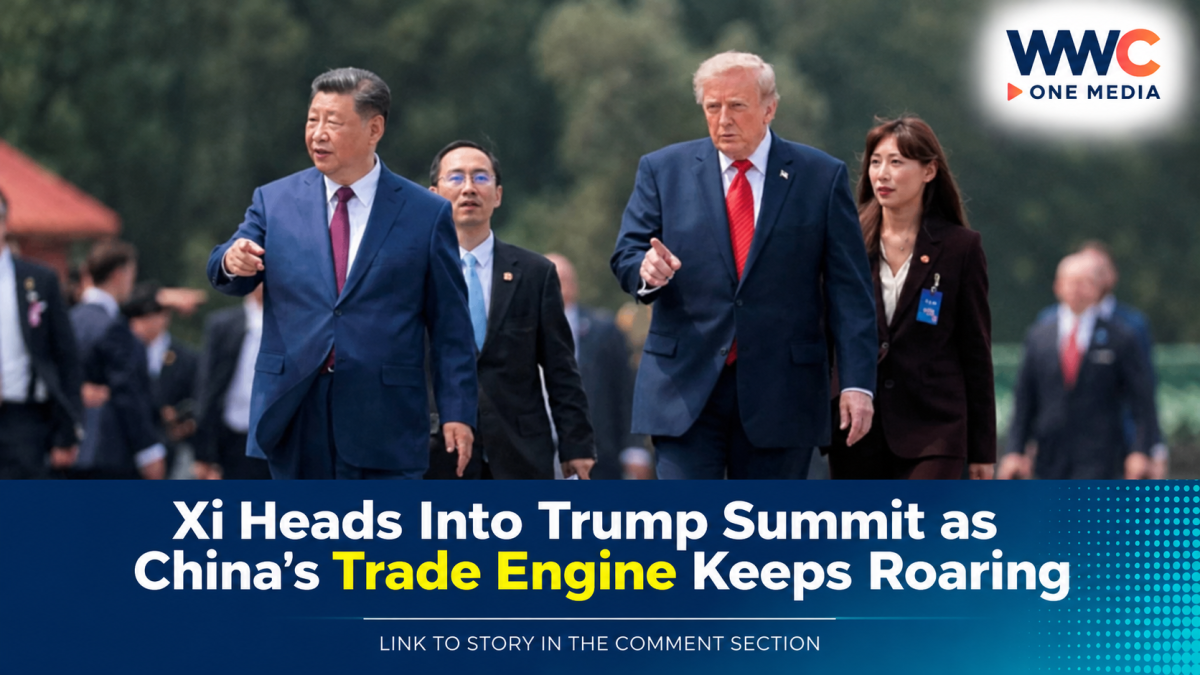
Chinese President Xi Jinping is heading to Washington for a closely watched meeting with US President Donald Trump as China’s exports continue to surge, giving Beijing a stronger position heading into talks aimed at preserving a fragile trade truce.
Xi is scheduled to meet Trump at the White House on Sept. 24, their second face-to-face meeting this year. The central economic question is whether the two sides can extend a tariff truce that is due to expire on Nov. 10 and avoid another escalation in the trade conflict.
China enters the summit with its global trade surplus on track to exceed US$1 trillion for a second consecutive year. Despite US tariffs and efforts to reduce China’s trade advantage, more than half of roughly 6,500 product categories that China has sold to the United States this year have recorded higher sales than in 2025.
The strength of China’s exports has become an important backdrop to the negotiations. Demand for technology products, including semiconductors and computing hardware linked to the global artificial intelligence boom, has helped support China’s trade performance even as domestic demand remains weaker and the property sector continues to face difficulties.
The situation is a significant change from the early stages of Trump’s second term, when Washington dramatically increased tariffs on Chinese goods in an effort to pressure Beijing over trade and other economic issues.
The resulting tariff battle threatened to disrupt global supply chains before Trump and Xi agreed to a temporary truce after their October 2025 meeting in South Korea. That arrangement lowered tensions but did not resolve the deeper disagreements between the two countries.
The current negotiations are expected to cover more than tariffs. Washington wants greater access for US agricultural products and progress on Chinese purchases of Boeing aircraft, while Beijing is seeking relief from restrictions on advanced US technology and other trade barriers.
Rare-earth materials and critical minerals are another major bargaining issue. China remains a dominant force across the rare-earth supply chain, making the flow of these materials important to industries ranging from automobiles and electronics to aerospace and defence. The United States wants more reliable access, while Beijing is seeking changes to US restrictions on technology exports.
Artificial intelligence is also emerging as a possible area for limited cooperation. US Treasury Secretary Scott Bessent and Chinese Vice Premier He Lifeng discussed the possibility of creating a new US-China AI dialogue, including communication mechanisms for serious AI-related security incidents.
But the relationship extends well beyond economics. Taiwan, the war involving Iran and broader US-China strategic competition are expected to feature in the discussions, adding complications to negotiations that are already focused on trade and technology.
For China, the strong export performance provides important economic leverage as Xi arrives in Washington. For Trump, the summit offers an opportunity to seek concrete trade commitments while trying to prevent another tariff confrontation.
The immediate outcome may therefore be less about producing a sweeping new trade agreement and more about determining whether the existing truce can survive. What Xi and Trump agree — or leave unresolved — could shape the next phase of US-China trade relations as the November deadline approaches.