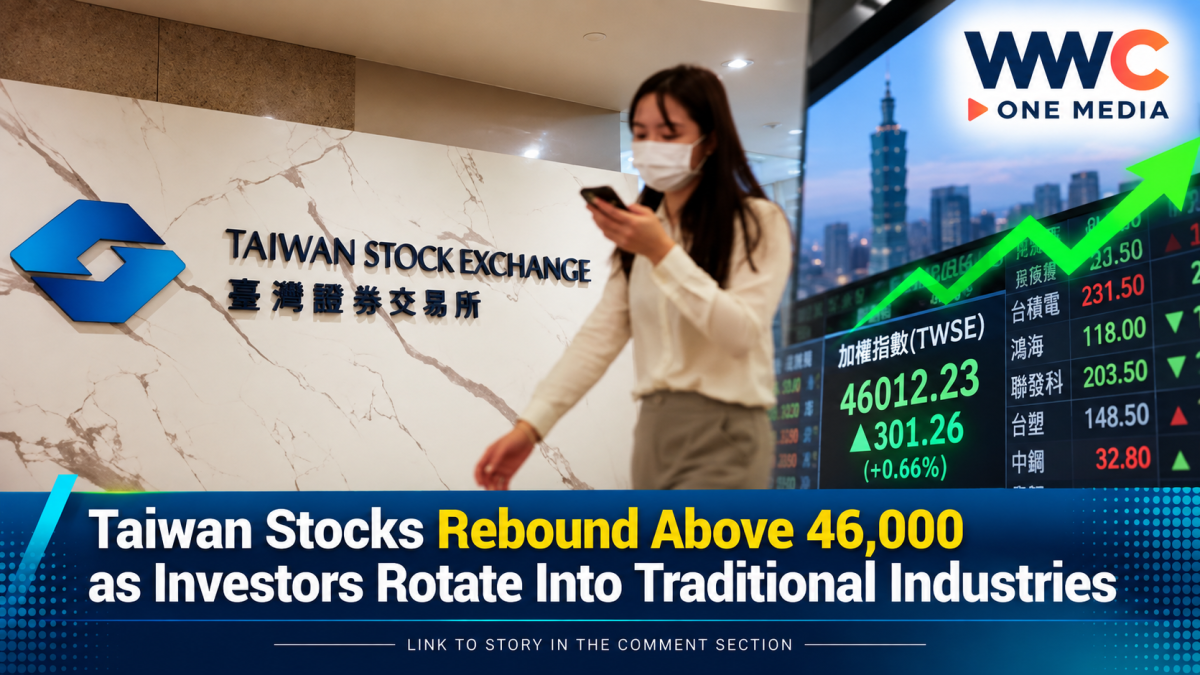
TAIPEI — Taiwan’s benchmark stock index staged a powerful rebound Thursday, climbing back above the 46,000-point mark as investors shifted money toward traditional industries while major technology stocks delivered a mixed performance.
The Taiwan Stock Exchange Capitalization Weighted Index (TAIEX) closed at 46,288 points on Sept. 17, gaining 439.1 points, or 0.96%. The index had surged as much as 1,025.94 points during the session, reaching an intraday high of 46,874.84, before giving up part of its advance.
Trading activity also accelerated. Turnover reached approximately NT$819.4 billion, compared with NT$643.8 billion in the previous session, while the total market capitalization of listed companies stood at about NT$151.4 trillion.
TSMC Leads the Rebound
Taiwan Semiconductor Manufacturing Co. (TSMC) was among the major drivers of the recovery.
TSMC rose 1.89% to NT$2,425, helping lift the heavily weighted technology sector. Foxconn also advanced 1.01% to NT$250.50, while ASE Technology gained 1.49% to NT$614.
Other major technology shares moved in different directions. MediaTek slipped 0.66% to NT$4,500, while Delta Electronics fell 1.46% to NT$1,685.
The mixed performance highlights a notable feature of Thursday’s trading: the rebound was not driven exclusively by Taiwan’s technology giants.
Traditional Industries Suddenly Take the Spotlight
One of the strongest moves came from traditional manufacturing companies, particularly petrochemical, plastics and polyester-fiber stocks.
Oriental Union Chemical gained 6.05%, while Lealea Enterprise and Tainan Spinning both climbed more than 4%. Formosa Plastics rose 3.53%, Taiwan Styrene Monomer advanced 6.36%, and Nan Ya Plastics jumped 5.36%.
Market coverage attributed some of the strength in polyester-related stocks to improving inventory conditions across the global apparel and textile supply chain.
After more than a year of inventory adjustments, European and US brands have reportedly become more active in preparing for the fall and winter selling season, supporting upstream orders for polyester-fiber materials.
Foreign Investors Return to Buying
Another important signal came from institutional trading.
According to market data reported by CTEE, foreign investors switched from selling to buying on Thursday, recording NT$121.85 billion in net purchases after five consecutive sessions of selling.
Domestic investment trusts bought another NT$77.14 billion, while dealers also shifted to net buying. Combined purchases by Taiwan’s three major institutional investor groups reached approximately NT$214.77 billion.
That change in positioning helped reinforce the broader market rebound.
However, one strong session does not by itself establish a lasting trend. Market analysts cited in Taiwanese media continue to point to US monetary policy, corporate earnings and trading volume as important factors for the market’s next moves.
AI Supply Chain Faces a New Question
While traditional industries rallied, some technology-related sectors faced pressure from concerns surrounding co-packaged optics (CPO).
CPO is a technology that integrates optical and electronic components more closely to transmit data at very high speeds. Taiwan’s copper-clad laminate (CCL) industry is watching the technology closely because changes in server architecture could affect future demand for some high-end materials.
Shares of Co-Tech Development, Elite Material and Taiwan Union Technology each fell more than 6%, according to Taiwan News.
Glass-fiber suppliers and several printed-circuit-board manufacturers also declined.
The market reaction illustrates how Taiwan’s AI boom is creating opportunities across the technology supply chain while simultaneously forcing investors to reassess which components could benefit—or face pressure—as next-generation infrastructure evolves.
Fed Decision Adds Another Layer of Uncertainty
The rebound came against a complicated global backdrop.
US stocks had sold off following the Federal Reserve’s first interest-rate increase in three years, adding to uncertainty for investors in Asian markets.
Taiwan’s market had also experienced several volatile sessions earlier in the week. On Sept. 15, the TAIEX fell 351.03 points, or 0.77%, to 45,511.49 as investors became more cautious about the outlook for AI-related companies.
The rapid recovery on Thursday therefore represented a significant reversal in sentiment.
What Investors Are Watching Next
Analysts cited by Taiwan media said the next test will be whether trading activity remains strong and whether the TAIEX can maintain its position above important technical levels.
CNA quoted senior securities analyst Wang Chao-li as saying the latest surge could be interpreted partly as short-covering after uncertainty surrounding the Fed decision eased. He also cautioned that the index remains at a relatively high level and could continue trading within a broad range in the short term.
Investors are also likely to focus on upcoming US corporate earnings, particularly as the October reporting season approaches.
For Taiwan’s market, the latest session underscores how quickly money can rotate between sectors. Technology remains central to the island’s economy, but Thursday’s trading showed that petrochemicals, plastics, textiles and other traditional industries can suddenly become major market movers when global demand and investor positioning change.
The TAIEX is back above 46,000—but whether Thursday’s surge marks a broader shift or simply a powerful rebound is now the question investors will be watching.