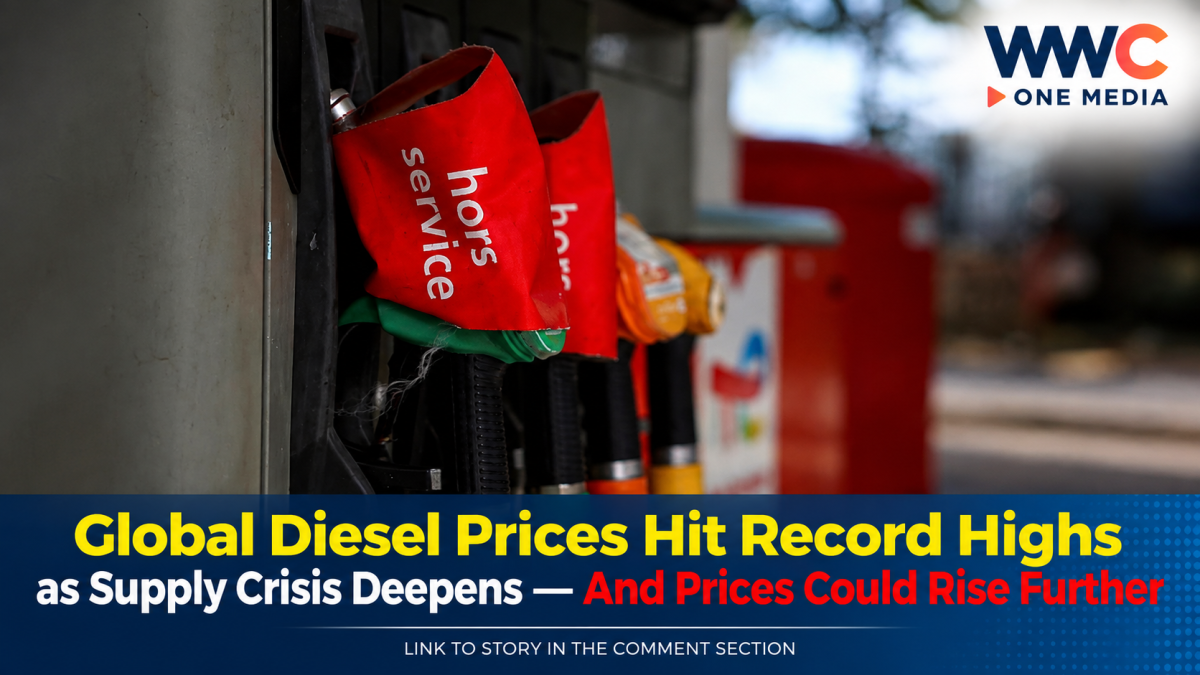
Diesel prices have surged to record levels across Europe and the United States, with the global fuel market facing a severe supply squeeze caused by disruptions linked to the wars in Iran and Ukraine.
European diesel futures reached an all-time high last week, more than doubling from their level at the beginning of 2026. The surge has been driven by disruptions affecting major diesel-producing and exporting regions, including Russia, Saudi Arabia and the United Arab Emirates.
The situation has become particularly serious because diesel supplies cannot easily be replaced. Refineries around the world are already operating at or near capacity, leaving limited room to increase production if additional supplies are lost.
The International Energy Agency has warned that the limited spare refining capacity could allow diesel prices to rise further in the coming months.
Middle Eastern diesel exports fell by half between March and August compared with the same period a year earlier, averaging about 800,000 barrels per day, according to shipping data from Kpler.
That decline matters for Europe because the Middle East supplied nearly 41% of Europe’s diesel imports in 2025. Any further disruption to fuel shipments through the Red Sea could therefore put additional pressure on an already tight European market.
Russia is adding another layer of pressure.
Ukraine’s attacks on Russian energy infrastructure have reduced refinery output, prompting Moscow to ban diesel exports in July. Russia had been one of the world’s biggest diesel exporters, supplying major markets including Turkey and Brazil.
European diesel inventories have also fallen significantly. Stocks at the Amsterdam-Rotterdam-Antwerp refining and storage hub were at their lowest level for this point in the year on Sept. 10, according to Insights Global.
In the United States, the pressure is already being felt at the pump.
Average US retail diesel prices climbed above US$6 per gallon for the first time this month. Although American refiners have been operating at exceptionally high levels, inventories remain well below normal seasonal levels.
US diesel inventories stood at 96.97 million barrels in the latest weekly data cited by Reuters, nearly 15% below the five-year average for that point in September.
The squeeze is also spreading across Asia.
Asian diesel prices remain close to record levels. A key regional diesel benchmark was trading around US$180 a barrel on Sept. 18, after reaching more than US$200 a barrel in March. Current prices remain roughly twice their pre-war levels.
China has provided some additional supply in recent months, with diesel exports reaching their highest level in almost two and a half years in August. But increased exports have also reduced China’s domestic inventories, limiting how much relief the country can provide to international markets.
The consequences extend far beyond motorists.
Diesel is heavily used by trucks, agricultural machinery, construction equipment, ships and industrial businesses. Higher diesel costs can therefore raise the expense of transporting food and manufactured goods, while also increasing operating costs for farmers and other businesses.
US farmers are already reporting sharply higher fuel expenses. Reuters reported that some agricultural operators are paying roughly twice as much for diesel as they did last year, adding another layer of pressure to food production and transportation costs.
There are some potential sources of relief.
Higher diesel prices and refining margins could encourage refiners to increase production, while China’s growing exports could provide additional barrels to international buyers. However, analysts say these measures may not be enough to quickly resolve the shortage.
A separate Reuters analysis found that the global diesel shortage could persist into 2027, with inventories in several major markets already at historically low levels.
The biggest risk remains another major disruption.
Further attacks on Middle Eastern energy infrastructure, continued restrictions on Russian exports or a significant refinery outage could remove even more fuel from the global market.
For consumers and businesses, that means the diesel crisis may not be over even if crude oil prices stabilize.
With inventories depleted and refineries already stretched, the next disruption could determine whether today’s record diesel prices become a temporary shock — or the beginning of an even more expensive fuel crisis.