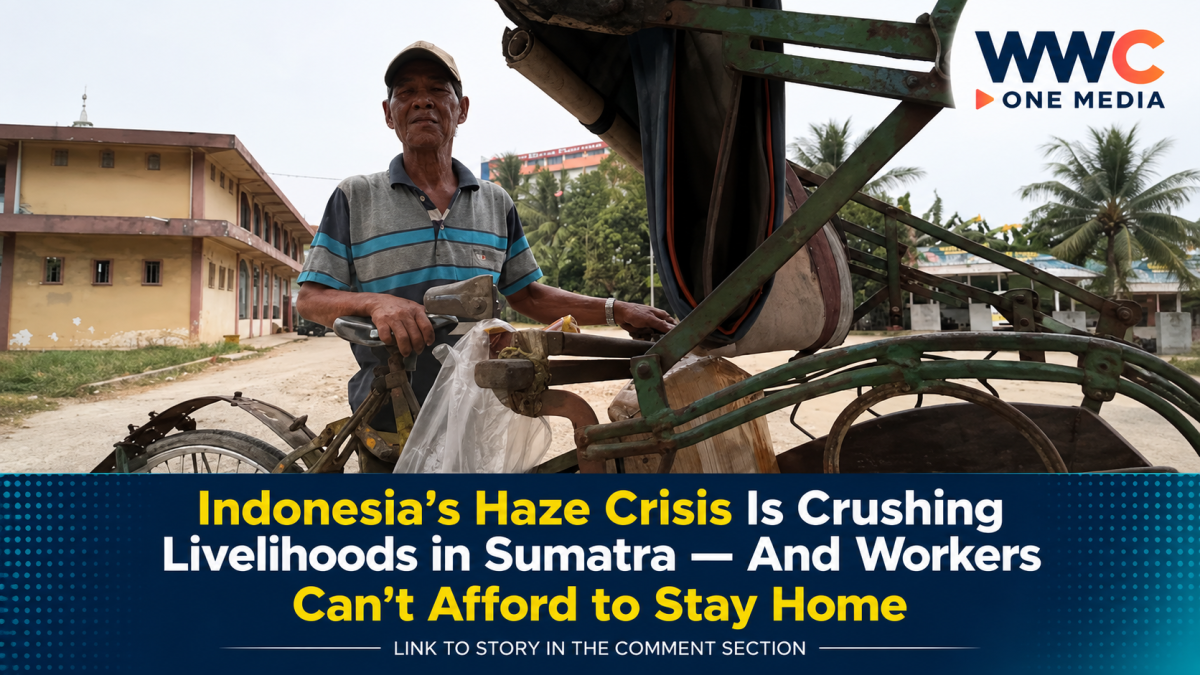
PALEMBANG, Indonesia — For workers in Indonesia’s Sumatra island, the wildfire crisis is becoming more than an environmental disaster. It is turning into a daily battle between protecting their health and earning enough money to survive.
In Palembang, South Sumatra, 60-year-old rickshaw driver Kholidi continues to pedal through streets blanketed by haze, even as fewer passengers venture outside.
The schools where he normally finds customers have closed, markets have become quieter and outdoor activity has dropped sharply.
One day, he said, he earned nothing.
Yet staying home is not necessarily an option.
With his wife temporarily unable to work because of respiratory problems and a teenage daughter still living at home, Kholidi has become the family’s sole breadwinner.
“I can only wait and hope for the haze to end,” he told CNA.
Thousands Of Hotspots Are Burning Across Sumatra
The scale of the crisis is enormous.
Indonesia’s Forestry Ministry recorded 5,983 hotspots across Sumatra as of Sept. 16, including 4,169 in South Sumatra, according to CNA.
The resulting smoke has spread beyond Indonesia, reaching neighbouring Malaysia and Singapore and, at times, the Philippines.
In Palembang, air-quality readings have remained between 150 and 275 since mid-August. Under Indonesia’s classification system, readings from 151 to 200 are considered unhealthy, while 201 to 300 are considered very unhealthy. Poor visibility has also forced authorities in parts of South Sumatra to close roads because of accident risks.
The crisis is being intensified by an unusually severe dry season associated with what Indonesian officials and meteorologists have described as a “super El Niño.”
Reuters reported that Indonesia is experiencing its most intense wildfire season in about 11 years, while Forestry Minister Raja Juli Antoni warned that fires could continue into October or even early November because the rainy season is expected to arrive later than previously forecast.
The Health Cost Is Rising With The Smoke
For many families, the economic damage is unfolding alongside a growing health crisis.
Indonesia’s Health Ministry reported that wildfire-related respiratory illness cases in seven affected provinces increased from 50,891 on Sept. 1 to 113,336 by Sept. 9.
More than 12.5 million people had been exposed to wildfire-related haze across those provinces, according to ministry figures reported by The Jakarta Post and Reuters.
Kholidi’s own household has felt that impact.
His wife, Emi, who normally works as a street sweeper, became sick enough to require oxygen at a clinic on two occasions. Concerned about her health, Kholidi asked her to stop working temporarily.
That decision, however, left the family dependent on his increasingly uncertain income.
Across Indonesia, authorities have responded with masks, oxygen supplies, additional medical personnel and temporary medical facilities in affected areas.
Small Businesses Are Taking A Direct Hit
The haze is also changing the economics of everyday life in Palembang.
Oktarina Pertiwi, who sells souvenir clothing at a night market near the city’s famous Ampera Bridge, told CNA that her stall normally brings in about 4 million rupiah per night.
Since the haze arrived, she said sales have fallen to roughly 1 million to 1.5 million rupiah on a good night.
The problem is straightforward: people are staying away.
A market that would normally be packed on Friday nights and weekends has become noticeably quieter as residents and tourists avoid prolonged outdoor exposure.
Drink seller Derian Winata has experienced a similar downturn.
He normally makes about 400,000 rupiah on weekdays and 600,000 rupiah on weekends selling drinks to people exercising at Palembang’s Jakabaring Sports Complex.
His income has roughly halved because fewer people are willing to exercise outdoors while air quality remains very unhealthy.
The knock-on effects extend beyond individual vendors.
Schools in affected areas have shifted to remote learning. Reuters previously reported that more than 1.4 million students across six provinces were studying remotely as of Sept. 2 because of the worsening conditions.
That creates another problem for businesses that depend on students, commuters and outdoor customers.
Why This Year’s Fires Are So Severe
Indonesia’s annual fire season is not new.
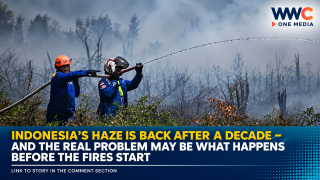
Land and forest fires have frequently been associated with land clearing for agriculture and plantations. Peatlands can make the problem particularly difficult because dry peat can burn underground and continue smouldering even when flames are not immediately visible.
This year’s weather conditions have made those vulnerabilities worse.
Reuters reported that prolonged drought and strong El Niño conditions have helped create exceptionally dry conditions, while Indonesian officials have intensified firefighting operations in Sumatra and Kalimantan.
The scale of the damage is substantial.
Government figures cited by Reuters showed that more than 202,000 hectares had burned between January and July. Independent estimates have put the area affected by fires even higher later in the season, illustrating the uncertainty surrounding the total footprint as fires continue and measurement methods differ.
The Jakarta Post has also reported that a significant portion of burned land identified through independent monitoring was located inside industrial concessions, while environmental researchers have pointed to long-term forest degradation, peatland conversion and land-clearing practices as factors that can worsen fires. Those findings concern contributing conditions and do not by themselves establish responsibility for individual fires.
Indonesia Is Throwing More Resources At The Fires
Authorities have significantly expanded the firefighting response.
Indonesia has deployed more than 50 aircraft for water bombing and cloud-seeding operations, while Japan has sent three CH-47 Chinook helicopters and personnel to assist with firefighting.
The government has also increased medical assistance in affected communities, including free oxygen and treatment through public hospitals and government clinics.
Indonesia’s Ministry of Micro, Small and Medium Enterprises has separately announced plans involving more than 618 billion rupiah to assist more than 200,000 MSMEs in disaster-affected areas.
But the programme’s eligibility and timing for businesses hit specifically by the latest wildfires had not yet been determined when CNA reported on Sept. 20.
That gap matters for people such as Kholidi and the small vendors whose incomes depend on customers showing up every day.
The Smoke Does Not Stop At Indonesia’s Borders
Indonesia’s wildfire crisis has become a regional problem.
Smoke from fires in Sumatra and Kalimantan has affected Malaysia and Singapore, while haze has also reached as far as the Philippines.
Malaysia has experienced particularly severe air-quality problems in parts of Sarawak, while Singapore has recorded unhealthy conditions during the current haze episode.
Reuters has reported that Indonesia’s fires generated 19.7 million metric tons of emissions in the week to Sept. 7, according to the European Union’s Copernicus climate monitoring service, underscoring the international scale of the episode.
The regional consequences include health problems, school disruptions, reduced visibility, transportation difficulties and pressure on businesses that rely on outdoor activity.
For Workers, There Is No Easy Choice
For the people earning a living on the streets of Sumatra, the crisis presents a brutal calculation.
Stay home and income disappears.
Go outside and health risks increase.
Kholidi has chosen to keep working because his family still needs money.
Derian is searching for customers in new locations, even though universities and other potential sources of business have also seen reduced activity because students can study remotely.
Oktarina continues selling clothes because she needs to earn money to support her parents, who live near areas affected by fires.
Their experiences illustrate why the Indonesian haze crisis is not simply a story about forests burning.
It is also a story about lost wages, empty markets, closed schools, medical bills and families forced to keep working under unhealthy skies.
And with Indonesian authorities warning that meaningful rainfall could still be weeks away, the uncertainty is far from over.
For thousands of workers across Sumatra, the question is no longer simply when the fires will stop.
It is whether their health — and their livelihoods — can hold out until the smoke finally clears.