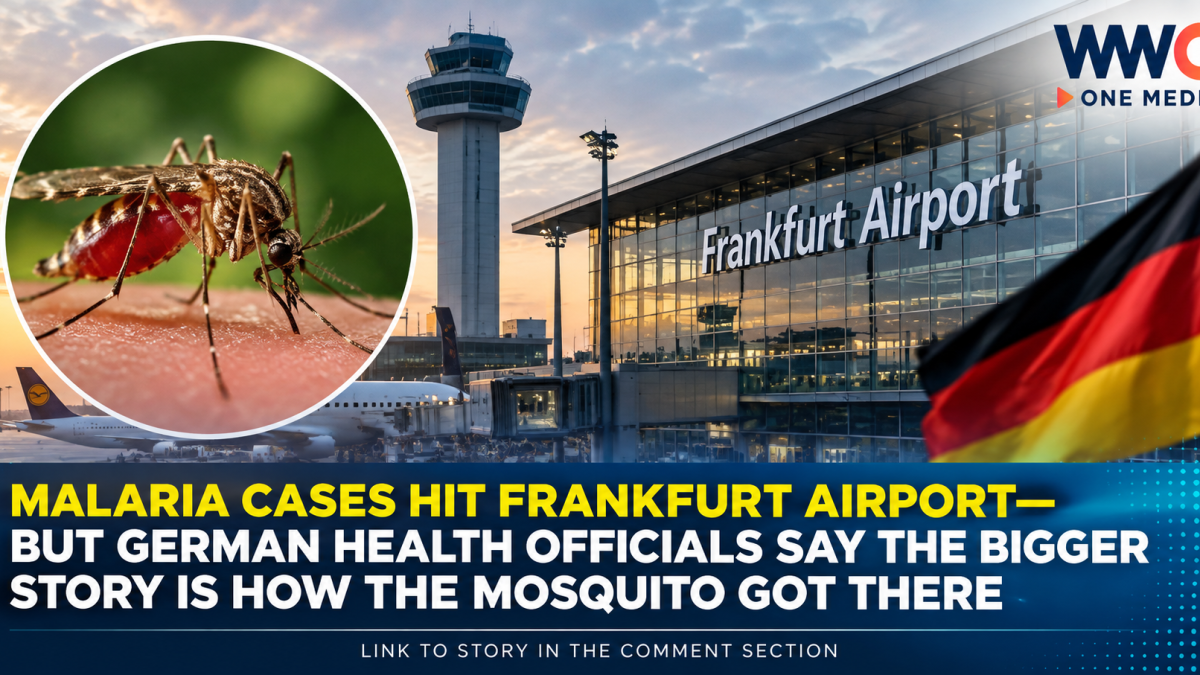
FRANKFURT, Germany — A rare cluster of malaria infections linked to the area surrounding Frankfurt Airport has raised concerns in Germany, but health authorities and disease experts say the incident does not signal that malaria is becoming a common disease in the country.
As of September 18, eight people had been diagnosed with Plasmodium falciparum malaria after apparently acquiring the infection locally around Frankfurt Airport. Six of those infected were airport workers, while two were residents of the nearby Schwanheim district. Three of the eight patients have died. None had reported recent travel to a malaria-endemic region.
The unusual cases have been classified as suspected “airport malaria”—a rare event in which an infected Anopheles mosquito is transported unintentionally by aircraft from a malaria-endemic area and subsequently bites people after arriving in a country where malaria is not normally transmitted locally.
How could malaria reach a German airport?
Unlike ordinary imported malaria, where a person becomes infected while traveling abroad, airport malaria involves the movement of an infected mosquito.
Experts believe an infected mosquito may have arrived in Frankfurt aboard an aircraft or inside luggage or clothing. The mosquito can potentially survive long enough in warmer airport environments to bite people and transmit the parasite.
The ECDC says the geographic and timing patterns of the Frankfurt cases suggest that multiple introductions of infected mosquitoes may have occurred, although investigations are still underway. Researchers are also examining whether local Anopheles mosquitoes could have played a role.
Germany’s Robert Koch Institute describes airport malaria as very rare, noting that malaria cases diagnosed in Germany are overwhelmingly associated with previous travel to malaria-endemic regions. Locally acquired infections through imported mosquitoes can occur, but only exceptionally.
The latest cluster is unusual—but not unprecedented
The current outbreak is not Germany’s first experience with airport-associated malaria.
According to reporting based on RKI data, the last documented German airport-malaria case before the current cluster occurred in 2023, also at Frankfurt Airport.
A review of airport and baggage-associated malaria cases in Europe found that such infections have occurred sporadically over decades. ECDC cited a systematic review identifying 105 airport-malaria cases reported between 1969 and 2022, with most occurring during the warmer months between June and September.
A separate analysis covering cases through early 2024 identified 145 instances of malaria acquired within Europe, with Germany accounting for nine historical cases in that dataset. Most malaria infections recorded in Europe, however, are imported by travelers rather than acquired locally.
Why are experts still calling the public risk “very low”?
The number of cases and three deaths make the Frankfurt cluster serious, but the circumstances required for airport malaria transmission are highly unusual.
Frankfurt health authorities continue to state that the risk to the general population is very low. Malaria cannot spread directly from an infected person to another person through casual contact. Transmission requires an infected mosquito to bite a person.
Travel-health authorities in the United Kingdom have similarly described the risk to the wider public as low and advised people to take usual precautions.
The ECDC also says that, despite the increase in cases, the risk to the general population remains very low.
But doctors face one important challenge
The danger lies partly in recognizing the disease quickly.
Because malaria is not normally acquired inside Germany, doctors may initially be less likely to suspect it in someone who has not recently traveled to a malaria-endemic country.
That is particularly important with Plasmodium falciparum, the parasite responsible for the Frankfurt infections. It can progress rapidly and become life-threatening if diagnosis and treatment are delayed.
Early symptoms can resemble other common illnesses and may include fever, chills, headaches and muscle pain. Nausea, vomiting and diarrhea can also occur.
Frankfurt health authorities have therefore advised people who live or work around the airport to seek medical attention if they develop unexplained symptoms consistent with malaria and to tell healthcare providers that they live or spend time near Frankfurt Airport.
Cooler weather may reduce mosquito activity—but the investigation continues
The arrival of autumn could further reduce the conditions favorable to mosquitoes and malaria parasites in Germany. However, experts caution that the possibility of additional cases cannot immediately be ruled out because P. falciparum can have an incubation period of roughly seven to 15 days.
German authorities are continuing epidemiological investigations, mosquito surveillance and genetic analysis of parasite samples to determine exactly how the infections occurred and whether the cases are connected.
The Frankfurt situation therefore presents a striking public-health paradox: the disease itself can be extremely dangerous, but the chance of the general public contracting airport malaria remains very small.
For now, authorities are urging awareness rather than alarm—particularly among people who work at or live close to Frankfurt Airport.