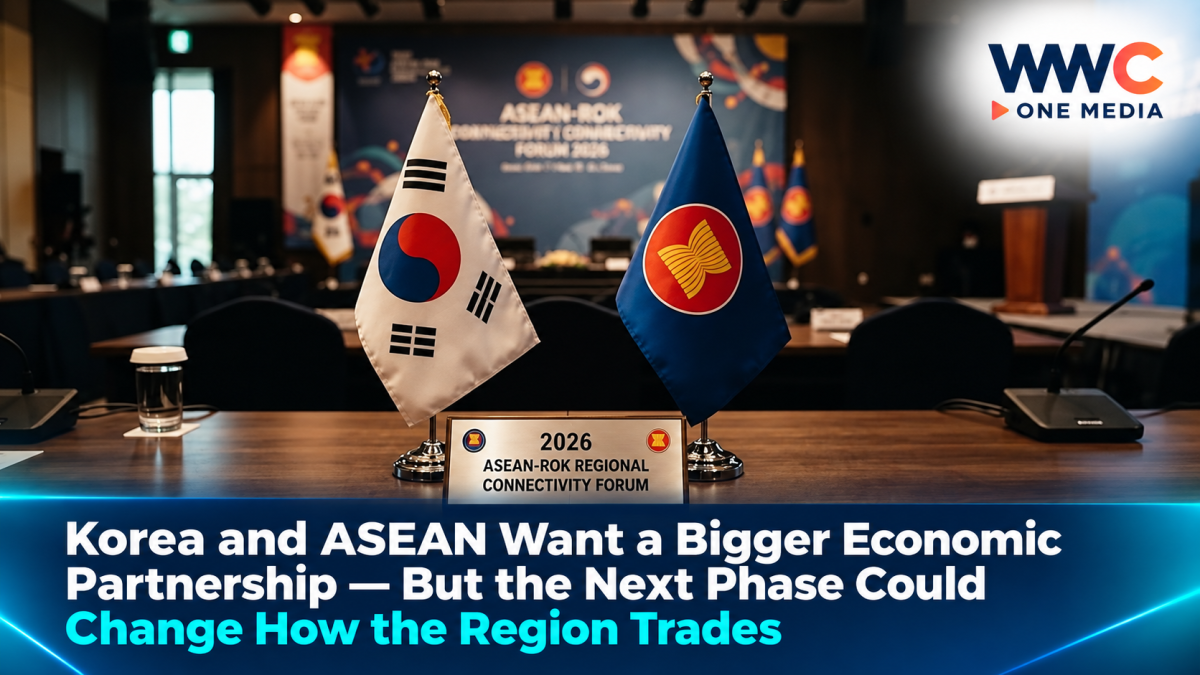
South Korea and ASEAN are looking to deepen policy cooperation as governments across Southeast Asia confront supply-chain disruptions, geopolitical uncertainty and the rapid rise of artificial intelligence and other emerging technologies.
The call emerged from the 13th Korea–ASEAN Community of Policy Exchange International Public Policy Symposium held in Pasay City on Sept. 18, where policymakers, academics and researchers discussed how Korea–ASEAN cooperation could help strengthen economic resilience and development across Southeast Asia.
Hosted by the University of the Philippines through the UP Center for Integrative and Development Studies and the UP Korea Research Center, the event brought together participants from Korea, ASEAN and Australia for discussions on economic development, public-sector capacity and regional cooperation.
Korea Signals a Shift From Partnership to Practical Action
Korean Ambassador to ASEAN Lee Chul described South Korea as ASEAN’s “partner of action,” saying Seoul wants to translate its strategic relationship with the bloc into projects that address current economic and development challenges.
Lee said Korea supports ASEAN’s efforts to narrow development gaps and improve competitiveness, particularly among the region’s transition economies.
Those challenges include geopolitical tensions, disruptions to global supply chains and the rapid emergence of new technologies.
He also pointed to areas reflected in the ASEAN 2045 vision, including artificial intelligence, digital norms, research and development, defense industries, and cultural and creative industries.
The message comes as ASEAN and South Korea move into a new phase of their relationship following the establishment of their Comprehensive Strategic Partnership in 2024.
Why the Economic Stakes Are Getting Bigger
The Korea–ASEAN economic relationship is already substantial.
ASEAN identifies South Korea as its fifth-largest trading partner and seventh-largest source of foreign direct investment based on 2024 data, when two-way trade reached about $208 billion and Korean FDI into ASEAN totaled approximately $7.5 billion.
More recent figures cited at the Manila symposium put Korea–ASEAN trade at about $204 billion in 2025, according to the Philippine News Agency.
The figures underscore why both sides are looking beyond traditional trade and investment.
The next stage increasingly involves supply-chain resilience, digital transformation, advanced manufacturing, clean energy, artificial intelligence and other technology-intensive industries.
ASEAN Wants Cooperation That Delivers Results
For ASEAN, the challenge is not simply attracting more investment.
The region is also trying to strengthen its ability to manage economic shocks and ensure that development reaches countries with different levels of industrialization and institutional capacity.
Philippine Foreign Affairs Secretary Ma. Theresa Lazaro, in a message delivered at the symposium, said ASEAN’s transition economies are particularly exposed to current uncertainties.
She emphasized that the policy challenge goes beyond achieving economic growth to sustaining development, strengthening resilience and ensuring that economic progress benefits people across the region.
That makes policy cooperation particularly important for countries such as Vietnam, Laos, Cambodia and Myanmar, which were specifically highlighted by the symposium.
The Philippines Is Positioned at the Center of the Conversation
The timing is significant for Manila.
The Philippines is serving as ASEAN chair in 2026 and is therefore helping facilitate regional discussions with external partners, including South Korea.
At the symposium, Philippine officials identified several areas where Korea–ASEAN cooperation could produce practical benefits, including:
- Food security
- Energy
- Technology and innovation
- Connectivity
- Information sharing
- Public-service delivery
- Government policy and institutional capacity
Undersecretary Maria Theresa Dizon-De Vega said these areas could benefit individual countries while also strengthening cooperation across the wider region.
The Philippine government and Seoul have also been discussing closer cooperation following the Korea–Philippines summit in March.
South Korean Ambassador to the Philippines Lee Dong-gy said in September that both sides intend to expand cooperation in diplomacy and security, the economy, people-to-people exchanges, artificial intelligence and the digital economy.
Trade Rules Are Also Being Reworked
The push for closer economic ties is happening alongside efforts to modernize the ASEAN–Korea Free Trade Area, or AKFTA.
ASEAN and South Korea have been working toward an upgrade of the agreement to make it more commercially relevant and responsive to changes in global trade.
South Korea’s trade ministry said in May that discussions with ASEAN were focused on expanding two-way trade, upgrading the AKFTA and strengthening supply-chain cooperation.
ASEAN’s economic agenda with Korea also includes cooperation in future-oriented sectors such as AI, digital trade, smart manufacturing, clean energy and resilient supply chains.
That means the relationship is gradually moving beyond conventional tariff reduction toward questions of technology, production networks and strategic economic resilience.
Supply Chains Are Becoming a Strategic Priority
The importance of this shift has grown as businesses and governments have had to contend with disruptions to global production and shipping.
ASEAN and South Korea’s 2026–2030 Plan of Action specifically calls for stronger cooperation on sustainable investment and diversification and resilience of global supply chains, including critical minerals.
The plan also calls for stronger cooperation involving green technology, Fourth Industrial Revolution technologies and manufacturing.
For manufacturers, this could eventually mean more diversified sourcing networks and greater cooperation between Korean companies and Southeast Asian production centers.
For governments, it means developing policies capable of supporting those investment flows while reducing vulnerabilities to external shocks.
AI Is Moving Into the Economic Partnership
Artificial intelligence is another major part of the emerging agenda.
ASEAN’s 2045 vision places digital transformation and emerging technologies among its long-term priorities, while Korea has increasingly positioned itself as a technology and innovation partner for Southeast Asia.
The emphasis is not limited to AI applications.
It also includes digital rules, research and development, manufacturing technologies, connectivity and the ability of governments to adapt to technological change.
This creates a potentially important area of cooperation because ASEAN economies are developing at different speeds and require different levels of technological and institutional support.
Development Assistance Is Another Piece of the Puzzle
South Korea’s role in ASEAN is also backed by development cooperation.
According to PNA, Lee said Korea has contributed about $258 million toward Southeast Asian development goals since its partnership with ASEAN began, with a significant portion of bilateral development cooperation directed toward transition economies.
That assistance gives Seoul another mechanism for supporting institutional development in addition to trade and investment.
The policy-exchange platform itself is designed to strengthen that knowledge-sharing dimension.
A Partnership Built Around More Than Business
The Manila symposium was not exclusively an economic forum.
The Korea–ASEAN Community of Policy Exchange is a Track 1.5 platform that connects senior policymakers, researchers and academics.
Its discussions cover governance, economic and industrial development, socio-cultural affairs and regional security.
That broader structure reflects the increasingly interconnected nature of economic policy.
Investment decisions are affected by political stability.
Supply chains depend on infrastructure and connectivity.
Digital economies require compatible rules.
And economic resilience increasingly overlaps with energy, food and national security.
ASEAN and Korea Are Already Working Under a New Framework
The latest push also builds on the ASEAN–Republic of Korea Comprehensive Strategic Partnership.
ASEAN and South Korea elevated their relationship to that status in 2024.
Their 2026–2030 Plan of Action covers political-security cooperation, economic cooperation, socio-cultural issues and cross-sector initiatives.
In July 2026, ASEAN and South Korea reaffirmed their commitment to implementing that plan at the 30th ASEAN–ROK Dialogue in Seoul.
The meeting reviewed progress and reiterated South Korea’s support for ASEAN centrality and the broader ASEAN 2045 agenda.
The ASEAN Post-Ministerial Conference with South Korea held in Manila in July also discussed ways to further strengthen the Comprehensive Strategic Partnership.
What Comes Next Could Matter More Than the Statements
The latest discussions point toward a familiar challenge in international economic diplomacy: turning broad strategic commitments into measurable projects.
The areas already identified are extensive — trade, investment, AI, clean energy, manufacturing, critical minerals, connectivity, food security and public-sector modernization.
The question now is how quickly governments, businesses and institutions can translate those priorities into actual investments, agreements, technology partnerships and development programs.
For Southeast Asia, the opportunity lies in gaining access to technology, capital, markets and policy expertise while strengthening resilience against external shocks.
For South Korea, deeper ASEAN engagement provides a broader economic and strategic network in one of the world’s most dynamic regions.
And for the Philippines, its role as ASEAN chair gives Manila an opportunity to help shape the regional agenda at a time when economic resilience and technological competitiveness are becoming increasingly intertwined.
The Bigger Picture
The Korea–ASEAN relationship is no longer defined simply by trade in goods.
It is increasingly about who builds the next generation of supply chains, who develops the technologies that power them, and how governments cooperate when global economic conditions become less predictable.
The Sept. 18 Manila symposium did not produce a single new trade deal that transforms the regional economy overnight.
What it did was highlight where Korea and ASEAN are trying to take the partnership next: toward deeper economic integration, stronger institutional capacity and cooperation in technologies and industries expected to shape the region’s future.
The next test will be implementation.