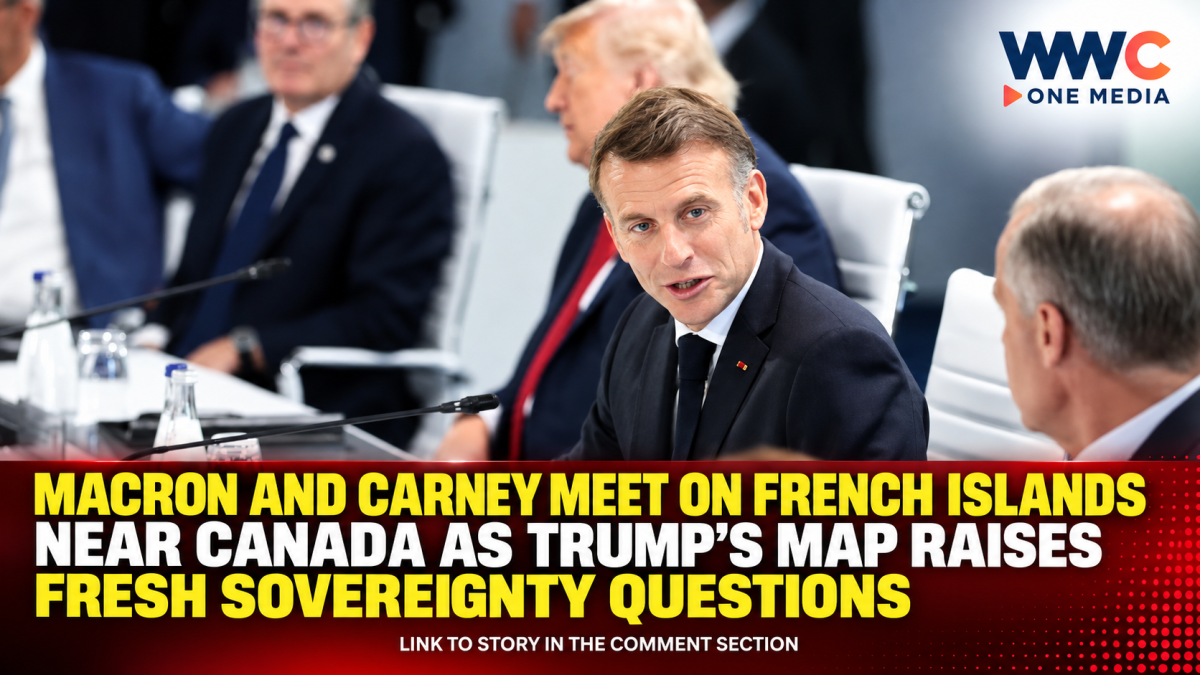
SAINT-PIERRE-ET-MIQUELON, Sept. 20, 2026 — French President Emmanuel Macron and Canadian Prime Minister Mark Carney are meeting Sunday on Saint-Pierre-et-Miquelon, a tiny French territory off Canada’s Atlantic coast, in a highly symbolic encounter focused on sovereignty, strategic cooperation and the rapidly changing geopolitical landscape in North America.
The meeting comes weeks after US President Donald Trump shared a map on social media depicting large parts of North America and the Caribbean in US colours, including Saint-Pierre-et-Miquelon. French officials have said the Macron-Carney visit is intended to underline national sovereignty and the close relationship between France and Canada.
Macron arrived on the archipelago on Saturday and directly addressed the issue, saying Saint-Pierre-et-Miquelon was French and that its status was not in question. AFP reported that Macron described French sovereignty over the territory as self-evident.
The symbolism is particularly notable because Saint-Pierre-et-Miquelon sits only about 20 kilometres from Newfoundland and Labrador, despite being more than 4,300 kilometres from mainland France. The archipelago has roughly 5,800 residents and is France’s only remaining territory in North America.
Why Saint-Pierre-et-Miquelon matters
The islands may be small, but their location gives them importance beyond their size.
France maintains a presence in the North Atlantic through the territory, including maritime surveillance and a permanent naval patrol vessel, the Fulmar. French officials have also highlighted the archipelago’s role in France’s broader presence across the world’s oceans and its proximity to the Arctic.
The visit also comes as Arctic routes, maritime security, critical minerals, energy and infrastructure become increasingly important to Canada, France and other Western countries.
According to Canada’s government, Carney and Macron are expected to discuss cooperation in aerospace, energy, critical minerals and advanced technologies, including quantum technology, satellites and supercomputing.
Macron has separately identified energy security as an important element of the relationship. France is seeking alternative sources of oil and liquefied natural gas amid disruptions and higher energy prices, while Canada is a major energy producer. AFP reported that Macron wants to explore greater flows of Canadian LNG toward the Atlantic coast and Europe.
Carney’s European pivot adds another layer
The meeting also follows an intensified Canadian effort to strengthen ties with Europe as relations between Ottawa and Washington remain strained.
Carney has said Canada is seeking a “unique alliance” with the European Union, rather than EU membership. Reuters reported that discussions have included deeper cooperation involving energy, artificial intelligence, defence, critical minerals and infrastructure.
The Wall Street Journal has also reported on discussions surrounding a possible future “associate member” relationship between Canada and the EU. Canadian officials have stressed that Ottawa is not seeking EU membership.
Reuters reported on Sept. 18 that the EU had made a symbolic offer involving associate-member status, although the proposed designation has no established legal precedent and faces questions about how such a relationship would work in practice.
That makes Sunday’s meeting more than a ceremonial visit: it takes place against a broader effort by Canada to diversify its economic and strategic relationships.
A historic first for a Canadian prime minister
Carney’s visit also has historical significance.
According to the French presidency and Canadian government, Carney is the first Canadian prime minister to make an official visit to Saint-Pierre-et-Miquelon. Macron is also the first French president to visit the territory since François Hollande travelled there in 2014.
The two leaders are scheduled to hold discussions and take part in a wreath-laying ceremony, according to Canadian Press reporting.
The meeting is therefore designed to send several messages at once: France’s continued presence in the North Atlantic, Canada’s relationship with France and Europe, and the importance both governments place on sovereignty and strategic cooperation.
Beyond geopolitics, the islands face pressing local problems
For residents, however, the visit is not only about international politics.
Saint-Pierre-et-Miquelon has struggled with the decline of its traditional cod-fishing industry, population pressures, high living costs and the effects of climate change.
The village of Miquelon has begun a relocation project because of rising sea levels. AFP reported that the project is entering a new phase, while local authorities are also seeking investment in the port and other infrastructure.
The territory is also looking toward new industries, including satellite-related activities and digital connectivity. France is considering ways to expand the archipelago’s role in space and communications infrastructure.
That combination of local economic challenges and wider strategic importance makes the Macron-Carney meeting unusually significant for a territory of its size.
The bigger picture
The encounter comes at a moment when traditional assumptions about North American alliances are being tested by trade disputes, Arctic competition, energy-security concerns and renewed debates over national sovereignty.
The Macron-Carney meeting does not by itself create a new alliance or alter the legal status of Saint-Pierre-et-Miquelon. Instead, it provides a highly visible setting for France and Canada to demonstrate closer cooperation while both governments pursue broader economic and strategic relationships. Reuters, AFP and Canadian reporting all point to sovereignty, energy and deeper Canada-France cooperation as important elements of the visit.
And that is what makes the location so striking: a handful of French islands just off Canada’s coast have suddenly become a stage for a much larger debate about sovereignty, trade, energy and the future shape of North American relations.