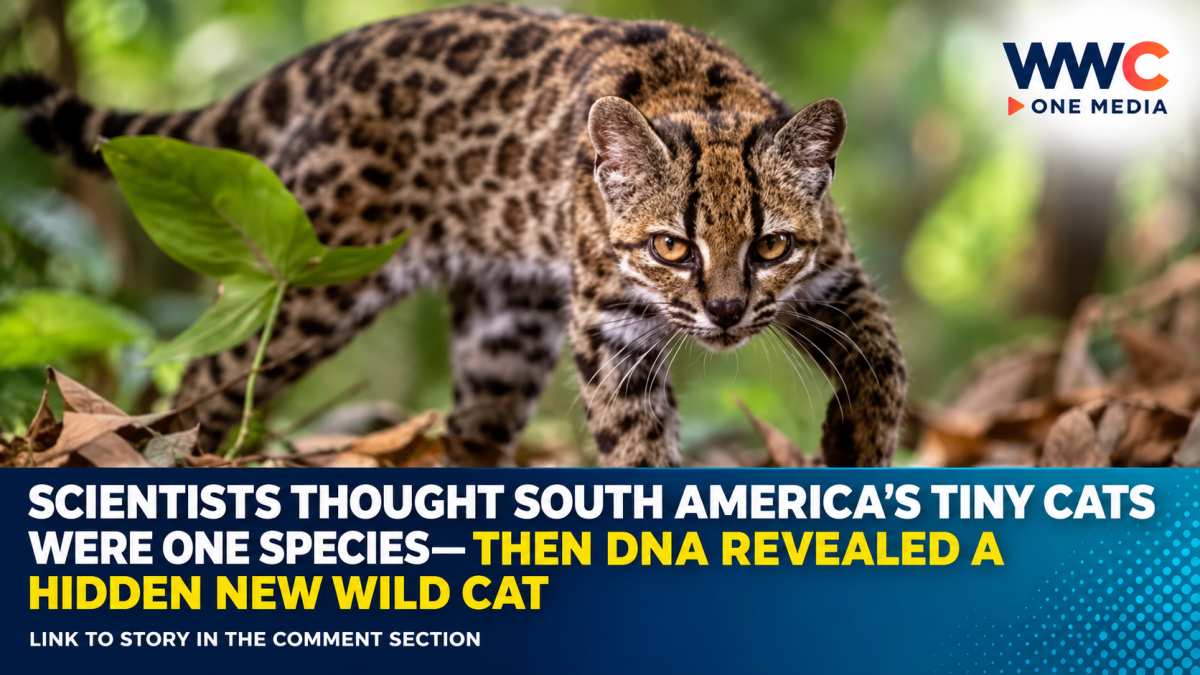
A tiny, spotted cat living in Bolivia has made natural-history headlines after scientists confirmed that it belongs to a previously unrecognized wild cat species—the first living wild feline formally named and described in more than a century.
The newly recognized species, Leopardus tilcayo, commonly known as the tilcayo cat, was identified in Bolivia’s Yungas cloud forests after researchers combined genetic evidence with information from museum specimens.
The discovery was reported in the scientific journal Current Biology and represents a major development in the study of South America’s small wild cats.
The cat that scientists almost overlooked
The story began not with an expedition into an unexplored jungle, but with a cat already living at a wildlife sanctuary in Bolivia.
Bolivian biologist Paola Nogales-Ascarrunz, a National Geographic explorer and one of the study’s lead authors, was asked to examine the unusual-looking feline at a sanctuary in the Yungas region.
The animal stood out because of its remarkably small size. The male tilcayo, now around 10 years old, measures about 18 inches (46 centimeters) from the head to the base of the tail and weighs approximately 3 pounds (1.4 kilograms)—smaller than many domestic cats.
Its light-brown coat is covered with dark, leopard-like spots.
What initially appeared to be an unusual individual turned out to be something much more significant.
DNA uncovered what appearances could not
Researchers analyzed complete genetic information from more than 30 cats collected from across South America, including animals from Colombia, Peru and Brazil.
Because fresh DNA samples were not available for every population, researchers also examined genetic material from bones and skins preserved in museums in the United States and Europe.
The results revealed that the tilcayo represents a distinct evolutionary lineage that separated from its closest relatives roughly 1.4 million years ago.
That finding also changed scientists’ understanding of South America’s so-called tiger cats.
For years, several visually similar cats had been grouped together, making it difficult to determine where one species ended and another began. The genomic analysis indicates that South America’s tiger cats comprise at least five distinct species, including the newly described tilcayo.
A “new” species that local communities already knew
There is an important twist to the discovery.
The tilcayo was not completely unknown.
Communities living in Bolivia’s tropical Andean cloud forests already had a name for the animal. Scientists adopted that local name when formally describing the species as Leopardus tilcayo.
Researchers said the decision recognizes the knowledge and long-standing relationship that local communities have with the animal.
In other words, science did not discover an animal that nobody had ever seen. Instead, modern genetic research established that a cat known locally was biologically distinct enough to be recognized as its own species.
The first newly named living wild cat in more than 100 years
The discovery is particularly notable because the cat family is comparatively well studied.
According to the researchers and reporting by the Associated Press, the last living wild feline species formally identified was the Uruguayan pampas cat in 1923.
That makes the recognition of Leopardus tilcayo the first newly named and described living wild cat species in more than a century.
The finding demonstrates that even among animals scientists have studied for generations, previously overlooked biodiversity can still exist.
Scientists now face a bigger question: How many tilcayos are left?
The discovery is exciting, but it also raises serious conservation questions.
Scientists currently know that the tilcayo occurs in Bolivia’s Yungas forests, but its complete geographic range has not yet been established.
Researchers also say they still need to learn much more about the animal, including its population size, diet, behavior and ecological requirements.
Its habitat is already under pressure from deforestation and gold mining, creating concern that the species could face conservation challenges before scientists even have a complete picture of its population.
Researchers therefore say identifying the species is only the beginning.
The race is now on to determine where the tilcayo lives, how many remain in the wild and what measures may be needed to protect its habitat.
Why this discovery matters
The tilcayo story is more than the addition of another name to a wildlife database.
It shows how genomic science, museum collections and Indigenous and local knowledge can work together to reveal biodiversity that conventional classification may have missed.
The researchers’ findings also suggest that the diversity of South America’s small wild cats may be greater than previously understood.
And there is a larger warning behind the discovery: species can remain scientifically unrecognized while their habitats are already disappearing.
For the tilcayo, scientists now have a name—and a genetic identity.
The unanswered question is whether they can learn enough about the tiny spotted cat before its threatened cloud-forest habitat changes beyond recognition.