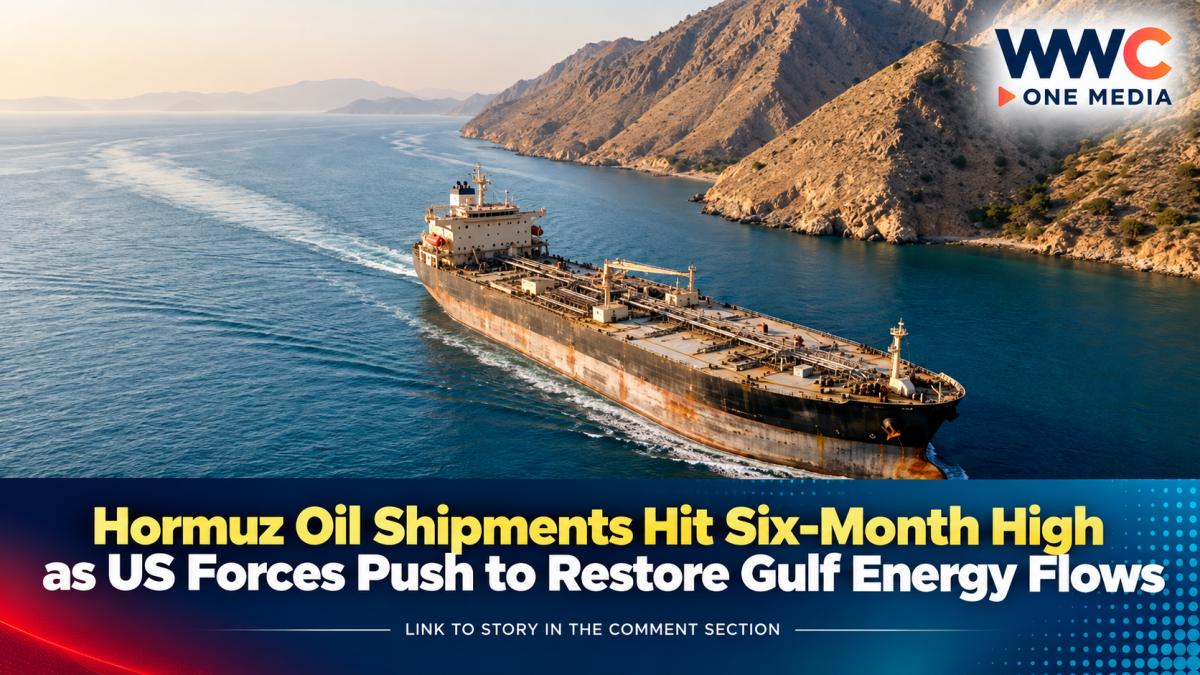
Oil and liquefied natural gas shipments through the Strait of Hormuz have climbed to their highest level in six months, according to the commander of U.S. Central Command, offering a sign that American efforts to facilitate commercial shipping through the strategic waterway are gaining traction.
Adm. Brad Cooper, head of U.S. Central Command, said Saturday that the volume of oil, LNG and other cargo moving through the Strait of Hormuz over the previous two weeks had reached its highest level in six months.
He attributed the increase to a combination of U.S.-supported mine-clearance operations, coordination with Gulf countries, insurers and shipping companies, and security measures designed to allow commercial vessels to navigate the waterway.
But the improvement comes against a backdrop of continuing conflict and significant uncertainty over how much oil is actually moving through the strait compared with prewar levels.
US says more than 1 billion barrels have moved
Cooper said U.S. forces have facilitated the movement of approximately 1 billion barrels of crude oil through the Strait of Hormuz during the past two months, while helping more than 2,000 commercial vessels transit the waterway.
He said the principal shipping lanes have been cleared of mines and that the United States is working with regional partners to increase maritime traffic.
The latest figures mark a significant change from the much lower shipping volumes seen earlier in the conflict.
The Strait of Hormuz is one of the world’s most important energy chokepoints, linking the Persian Gulf with the Gulf of Oman and the wider Arabian Sea. Oil producers including Saudi Arabia, Iraq, Kuwait, Qatar and the United Arab Emirates depend heavily on routes through or connected to the waterway.
But traffic remains below prewar levels
Despite the latest improvement, shipping through Hormuz has not returned to normal.
Reuters reported earlier this week that commercial vessel traffic dropped sharply on Sept. 16, with only three vessels recorded transiting the strait that day, compared with 12 the previous day and a 10-day average of about 17. The figures were based on preliminary ship-tracking data and may not capture vessels operating with their automatic identification systems switched off.
That discrepancy highlights an important issue surrounding current Hormuz statistics: different sources are measuring different aspects of traffic and using different time periods.
The Washington Post reported earlier that U.S. officials and commercial shipping trackers had produced significantly different estimates of the volume of oil moving through the waterway. Its reporting cited a 60-day average from TankerTrackers of about 7.85 million barrels per day, while a U.S. official put the seven-day average of oil and petroleum products at slightly above 10 million barrels per day at the time.
The latest CENTCOM claim therefore points to a clear improvement in recent flows, but does not mean the waterway has returned to its pre-conflict operating pattern.
Why the Strait of Hormuz matters so much
The Strait of Hormuz is critical because enormous quantities of Middle Eastern oil and gas pass through the narrow waterway on their way to global markets.
Any sustained disruption can affect crude prices, tanker rates, refinery supply and ultimately fuel costs for consumers far beyond the Persian Gulf.
The current conflict has already forced energy companies and governments to search for alternative transportation routes.
Saudi Arabia, for example, has been increasing crude shipments from its Gulf export facilities through ship-to-ship transfers involving Oman’s Sohar port. Reuters reported that Saudi Aramco was planning to move about 60 million barrels during September and October through this arrangement, averaging roughly 1 million to 1.5 million barrels a day.
Those alternative logistics are helping maintain supplies even while shipping through Hormuz remains risky.
US naval operations are changing how ships transit
The United States says it is working with commercial shipping companies, insurers and Gulf governments to make transits safer.
The military’s role includes providing information, coordination and security support rather than simply placing a warship alongside every commercial tanker.
The Washington Post reported that U.S. forces have been coordinating with shipping companies on timing, procedures and other measures designed to facilitate safer passages.
U.S. forces have also faced direct encounters with Iranian forces.
Axios reported that American forces destroyed two Iranian small boats on Sept. 14 after the vessels attempted to seize a U.S. Navy unmanned surface vessel operating near the Strait of Hormuz, according to U.S. officials. CENTCOM confirmed that Iranian small boats had attempted to take possession of the unmanned vessel.
The incident underscores the security risks that remain even as commercial traffic increases.
Iran’s oil exports remain under pressure
Cooper also said Iran had exported zero barrels of oil under the U.S. blockade.
That is a U.S. military assessment and has not been independently verified as a comprehensive measure of every Iranian oil movement.
The claim illustrates the broader economic pressure being applied to Iran’s energy sector during the conflict.
Iran, meanwhile, continues to dispute U.S. assessments of the situation around Hormuz. Iranian officials have maintained that they retain significant control and influence over the waterway, illustrating the competing narratives surrounding the security situation.
Saudi Arabia faces another energy challenge
The recovery in Hormuz flows also comes as Saudi Arabia deals with disruptions to another critical oil-export route.
Drone attacks damaged Saudi Arabia’s East-West pipeline earlier this month, forcing the kingdom to reduce exports from its Red Sea port of Yanbu.
Reuters reported that Saudi Aramco was compensating for some of the lost capacity by increasing Gulf exports and using ship-to-ship transfers near Oman.
That development demonstrates why the current energy crisis cannot be measured solely by Strait of Hormuz traffic.
Pipelines, alternative ports, tanker routes and strategic inventories are all becoming increasingly important as producers attempt to keep global markets supplied.
Oil prices face competing pressures
The increase in Hormuz shipments could provide some relief to global energy markets because greater physical supply reduces the immediate risk of a severe shortage.
But other disruptions are keeping pressure on the market.
Reuters reported that attacks affecting Saudi infrastructure have disrupted some exports, while increased Gulf shipments through alternative arrangements have helped offset part of the losses.
The result is a highly unstable energy market in which geopolitical developments can quickly change the outlook.
The Associated Press reported that oil prices have remained volatile during the conflict but have not reached some of the most extreme scenarios initially feared by analysts. It attributed part of that resilience to China’s large strategic oil inventories and changes in its energy sourcing.
The six-month high comes with a major caveat
The latest CENTCOM announcement is significant because it shows that commercial shipping is increasing despite the continuing security threat.
But six-month high does not mean normal.
Commercial shipping data earlier this week showed that traffic could still fall sharply from one day to the next.
The Washington Post likewise found that U.S. government estimates and commercial tracking data have sometimes differed substantially, making rolling averages more useful than individual daily figures when assessing the true state of the waterway.
For oil markets, that distinction matters enormously.
A temporary surge in tanker movements can provide short-term relief. A sustained return toward normal shipping volumes would be a much stronger signal that the supply shock is easing.
What happens next could matter more than the latest number
The immediate test will be whether the higher shipping volumes can continue.
If more tankers, LNG carriers and cargo vessels regularly pass through Hormuz under the current security arrangements, global energy markets could receive additional breathing room.
If attacks, mine threats or military confrontations again discourage commercial operators, shipping volumes could quickly fall.
The stakes extend well beyond the Middle East.
The Strait of Hormuz remains one of the world’s most consequential energy chokepoints, and every additional tanker that safely exits the Persian Gulf represents another shipment reaching refineries and consumers.
For now, the latest data point is encouraging: more oil is moving. But the real test is whether that six-month high can become a sustained recovery — without another escalation closing the route once again.