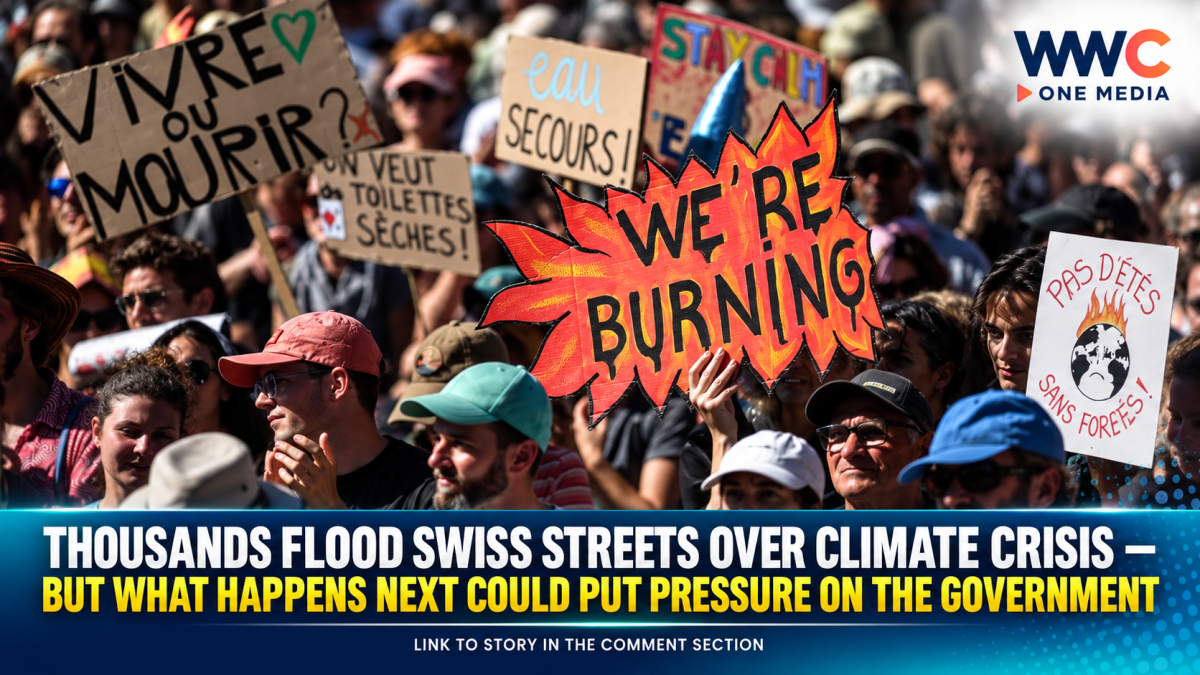
LAUSANNE, Switzerland — Thousands of people took to the streets of Lausanne and Geneva on Saturday, September 19, demanding stronger action on climate change after a summer marked by extreme heat, drought and water shortages.
The demonstrations were organised under the banner “No 50-degree summers!”, with more than 100 organisations and political parties backing calls for tougher climate policies, including measures to cut carbon emissions and strengthen Switzerland’s ability to adapt to increasingly severe heat.
In Lausanne, organisers initially estimated that at least 8,000 people joined the larger rally. Swiss public broadcaster SRF reported that attendance estimates varied considerably: Keystone-SDA initially counted about 6,000 participants, while police later put the number at around 12,000. In Geneva, organisers estimated about 7,000 participants, compared with a police estimate of roughly 3,000.
The demonstrations brought together people of different ages carrying signs including “No Planet B” and “We’re cooked!” Other messages called for greater use of public transport, stronger climate adaptation measures and reductions in greenhouse-gas emissions.
Extreme heat turns climate concerns into a street movement
The protests followed an exceptionally difficult summer for Switzerland.
SWI swissinfo.ch reported that summer 2026 was the country’s hottest and driest summer since measurements began in 1864, while drought and extreme heat affected communities, agriculture and water supplies.
The effects were visible beyond temperatures. The Straits Times, citing AFP, reported that Switzerland’s summer heatwaves contributed to the closure of a nuclear power station and record-low water levels in Lake Zurich.
For protesters, those conditions have reinforced the argument that climate change is no longer a distant environmental issue but one affecting water availability, farming, public health and everyday life.
One Lausanne demonstrator, actor Vincent Fontannaz, appeared dressed as a giant drop of water and said the shortage was particularly important for agriculture and survival, according to AFP.
Protesters demand both emissions cuts and climate adaptation
The coalition behind the demonstrations is calling for more than reductions in greenhouse-gas emissions.
Its campaign also demands measures to protect people from the consequences of a warming climate, including stronger adaptation policies. Organisers have argued that the summer of 2026 should serve as a warning and a catalyst for longer-term action.
SWI swissinfo.ch has separately reported that several Swiss cities have expanded heatwave measures such as alerts, public information campaigns and cooling facilities, but that Switzerland still lacks a comprehensive nationwide strategy for dealing with heatwaves.
The protesters’ demands therefore extend beyond climate targets to questions of how cities, agriculture, infrastructure and communities can cope with more frequent or intense heat and water stress.
Switzerland faces renewed scrutiny over climate policy
The demonstrations also come against the backdrop of a major 2024 ruling by the European Court of Human Rights.
In Verein KlimaSeniorinnen Schweiz and Others v. Switzerland, the court found that Switzerland had failed to meet its obligations concerning climate protection under the European Convention on Human Rights. The case was brought by the Swiss Senior Women for Climate Protection and concerned the effects of climate change, particularly heatwaves, on living conditions and health.
The ruling was significant because it established, in that case, a legal connection between inadequate climate protection and human-rights obligations.
The protesters’ latest demands come more than two years after that judgment, keeping climate policy under continued public scrutiny.
More demonstrations planned
Saturday’s rallies are not expected to be the final demonstrations.
SWI swissinfo.ch reported that 13 climate rallies had been planned across Switzerland between late September and early October. Further demonstrations are scheduled in several cities through October 2.
Organisers have described the September 19 protests as the beginning of a broader mobilisation rather than a one-day event.
The central question now is whether the demonstrations will translate into sustained political pressure for emissions reductions and stronger protection against extreme heat, drought and other climate-related risks.
For a country that has just endured an exceptionally hot and dry summer, the protesters’ warning is straightforward: the debate over climate change is increasingly being measured not only in emissions targets, but also in water levels, crop conditions and how safely people can live through the next heatwave.