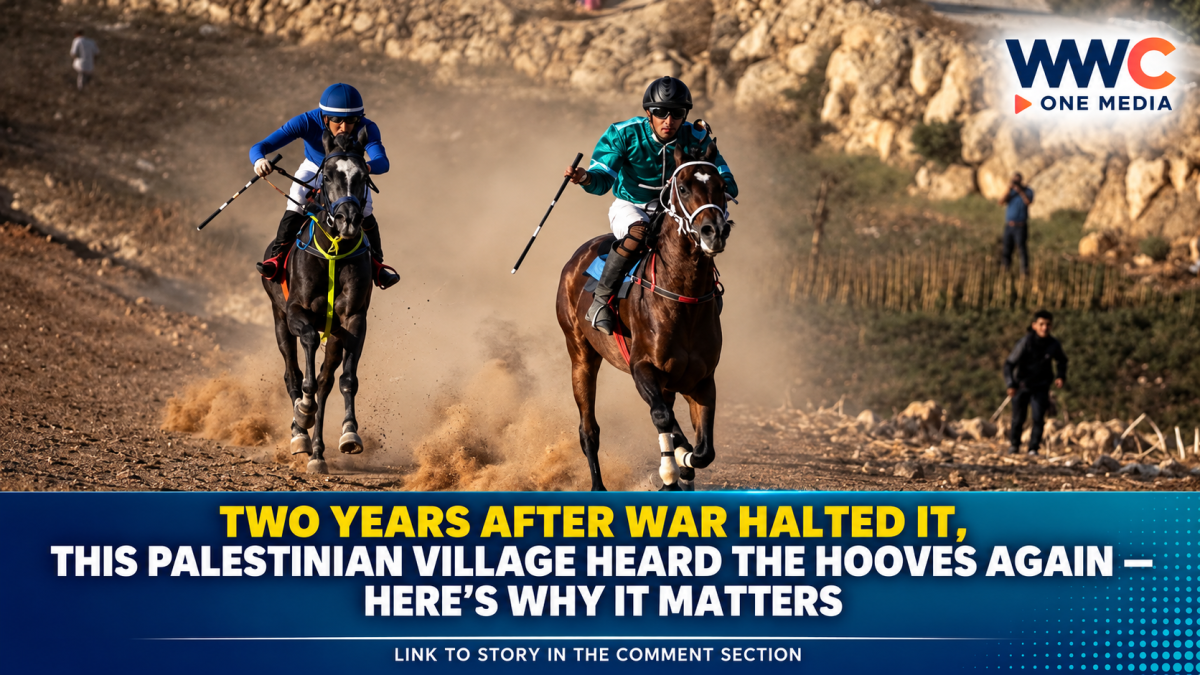
AL-MAJD, West Bank — The thunder of hooves once again echoed across the hills west of Hebron as Palestinian riders returned to the dirt track in the village of Al-Majd for an annual Arabian horse race that had been suspended for two years following the outbreak of the Gaza war.
The race, held on September 18, brought riders, families and spectators together along a winding track cutting through the village’s rocky landscape. Crowds watched from the course and nearby rooftops as the horses surged forward, kicking up clouds of dust.
The event’s return came amid continuing tensions in the region and highlighted the difficulties facing local equestrian communities, including limited financial and logistical resources.
“Our ambitions are constrained by a lack of financial and logistical resources needed to support the riders,” race coordinator Ismael Abu Awad told AFP. “We simply try to provide whatever we can.”
More than a race
For organizers and residents, the event represented more than a sporting competition.
Arabian horses have a longstanding place in Palestinian cultural life, with races and equestrian beauty competitions held in different parts of the West Bank. The Al-Majd event brought competitors from surrounding towns and villages together after a two-year interruption.
Abu Awad said the race was intended to help preserve an Arab heritage passed down through generations, while also giving local riders a chance to demonstrate their abilities.
The National’s coverage of the event similarly highlighted horse culture as an important form of recreation and community activity for Palestinians, while noting that breeders increasingly operate with limited open space.
Shrinking space, limited opportunities
The revival of the race also comes against a difficult backdrop for horse owners and breeders.
Open land suitable for racing is increasingly scarce in the occupied West Bank, while restrictions and other practical obstacles can make international participation difficult. Abu Awad said some horses and riders have difficulty travelling to Jordan or elsewhere to compete.
That leaves local competitions such as the Al-Majd race as important opportunities for riders who otherwise have limited access to larger equestrian events.
The recent race was also documented by Xinhua, which photographed Palestinian riders competing in Al-Majd near Dura, south of Hebron, on September 18.
A tradition looking beyond the village
Despite the obstacles, some competitors are already thinking beyond the local track.
Palestinian rider Mohammed Al-Ajlouni told AFP that he hopes one day to travel to Italy to pursue his passion for riding horses.
For now, however, the return of racing to Al-Majd offered something much closer to home: the chance for riders to compete, families to gather and a longstanding equestrian tradition to resume after two years away.
The sight of Arabian horses racing through the village may have lasted only minutes, but for the community, the return marked the revival of an event that had been missing from the local calendar since the war brought the previous races to a halt.