
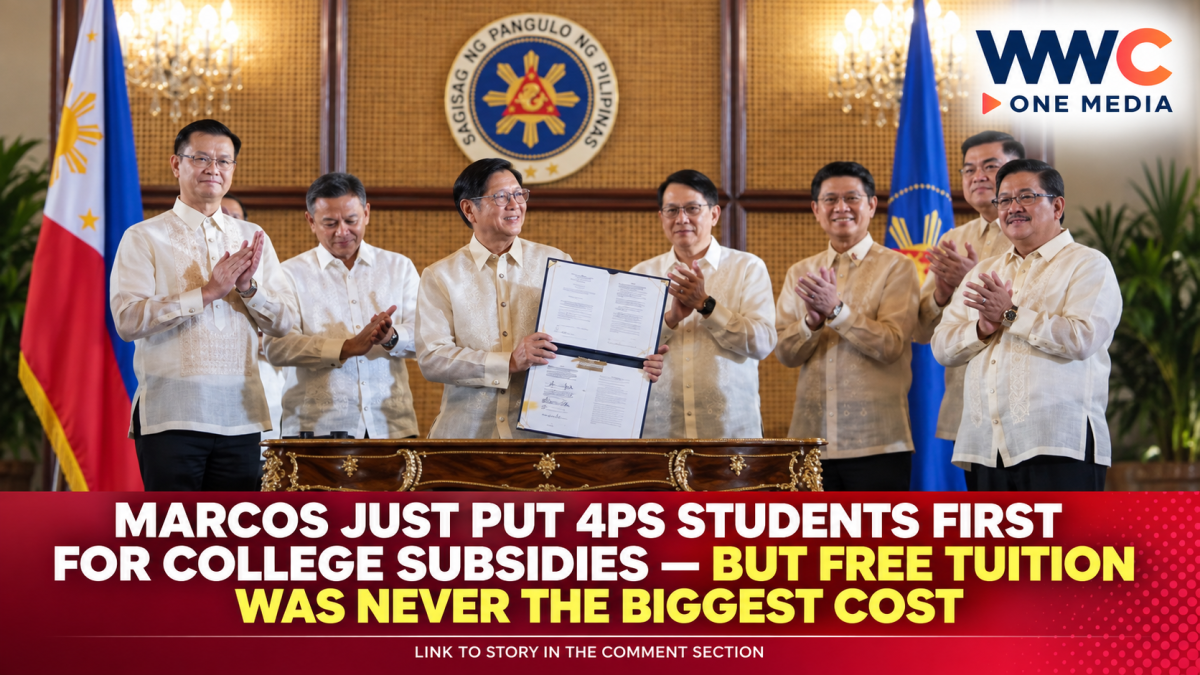
MANILA, Philippines — The Philippines already made tuition free for millions of students in public colleges.
Now the government is confronting a harder problem: what happens when a student can enter college for free—but still cannot afford to stay there?
President Ferdinand Marcos Jr. has signed Republic Act No. 12325, a major expansion of the country’s Universal Access to Quality Tertiary Education framework that redirects government subsidies toward financially disadvantaged students and extends assistance beyond tuition to some of the expenses that often push poor students out of school.
Albay 3rd District Rep. Raymond Adrian Salceda hailed the measure as a major pro-poor education reform, saying the President’s support could open new opportunities for Filipino families struggling to send their children through college. Salceda specifically praised Marcos for backing the legislation as one of the administration’s priority measures.
But the significance of the law goes far beyond political praise.
The legislation attempts to fix a striking weakness in the original subsidy program: government aid intended primarily for needy students had increasingly been reaching fewer of the country’s poorest households.
Why Congress Changed the Free College Law
The original Republic Act No. 10931, enacted in 2017, removed tuition and other mandatory school fees for qualified students in state universities and colleges, recognized local universities and colleges, and state-run technical-vocational institutions.
It also created the Tertiary Education Subsidy, or TES, to help students pay expenses that free tuition does not cover—such as books, transportation, accommodation and everyday living costs.
But EDCOM 2 found a troubling shift in who was actually receiving that assistance.
The share of TES grants going to students from the poorest households reportedly fell from 74.24 percent in 2018 to just 30.74 percent in 2022.
That meant a program intended to make higher education accessible to poor families was becoming progressively less concentrated on them.
RA 12325 attempts to reverse that trend.
Under the new prioritization system, eligible students belonging to Pantawid Pamilyang Pilipino Program, or 4Ps, households receive the highest priority for TES assistance. Remaining available slots are to be distributed based on household per-capita income.
That is arguably the biggest structural change in the law.
It moves the subsidy from a relatively broad assistance mechanism toward a more explicitly means-tested system designed to put the country’s poorest students at the front of the line.
Free Tuition Was Only Half the Problem
For many Filipino families, the tuition bill is not necessarily what ends a college education.
A student may pay zero tuition at a state university and still face daily expenses for transportation, food, dormitory rent, internet access, textbooks, uniforms and other requirements.
Students in health-related programs can face even larger costs.
Nursing and allied-health students, for example, must undergo clinical training and Related Learning Experience, or RLE, which can add substantial expenses beyond normal classroom education.
RA 12325 explicitly expands the types of costs that may be covered by tertiary assistance, including internships and RLE, professional licensure-related expenses and additional allowances for students with disabilities.
The law also allows a one-year extension of assistance for program completion under justified circumstances, potentially helping students who need additional time because of illness, financial hardship or other valid reasons.
That changes the philosophy behind free higher education.
The policy is increasingly moving from simply asking, “Can the student enroll?” toward asking, “Can the student remain in school long enough to graduate?”
Nursing Students Could Be Among the Biggest Beneficiaries
The inclusion of internship and clinical-training expenses is particularly significant for nursing and allied-health students.
Sen. Bam Aquino, one of the lawmakers involved in the amendments, has said RLE requirements can cost students between roughly ₱20,000 and ₱80,000, depending on their program and circumstances.
The government had already allocated ₱500 million in the 2026 national budget for the Allied Health Experiential Assistance for Deserving Students program, or AHEAD, which was designed to support around 19,000 allied-health students with RLE-related expenses.
By incorporating these kinds of expenses into the broader tertiary-assistance framework, the new law recognizes something students have complained about for years:
A course may technically have free tuition while still being financially impossible for a low-income household to complete.
Poor Students May Now Get Help in Private Colleges Too
Another major change is the creation of a Private Education Assistance, or PEA, program.
It is intended to provide government support to disadvantaged students taking priority programs in qualified private higher education institutions and TESDA-registered technical-vocational institutions when those students are not already covered by other government grants.
That could significantly widen students’ options.
Free higher education under the original law largely focused on public institutions. But state universities have limited enrollment capacity, and some specialized courses may not be available near a student’s home.
The new approach recognizes that private institutions can help fill those gaps.
House Higher and Technical Education Committee chair Jude Acidre said the public sector cannot absorb every student by itself and argued that assistance should be able to follow disadvantaged learners into qualified private institutions where appropriate.
But the PEA program is targeted—not a blanket promise that all private-college tuition will now be paid by government.
It is aimed at qualified disadvantaged students in identified priority programs, subject to the program’s eventual rules and funding.
Subsidies Will No Longer Be Treated as One-Size-Fits-All
RA 12325 also changes another long-standing weakness in TES: students studying very different courses have often received essentially standardized subsidy amounts despite dramatically different educational costs.
EDCOM 2 said the previous structure—reported at about ₱27,000 for students in private HEIs and ₱20,000 for students in public institutions under the existing setup—could restrict poorer students’ course choices because some programs simply cost far more to complete.
Under the amended law, assistance can vary according to the undergraduate program, with additional support for students entering government-identified priority fields.
That could have important workforce implications.
Instead of financial assistance unintentionally steering poor students toward whichever programs are cheapest, government can potentially provide stronger support for fields where the country needs more graduates.
The effectiveness of that approach, however, will depend heavily on how CHED and TESDA define “priority programs” and how much money Congress actually appropriates.
The Subsidy Must Now Keep Up With Inflation
Another potentially important provision requires the UniFAST Board to review and adjust TES amounts every two years to reflect inflation and changing education expenses.
That may sound technical, but it addresses a basic problem.
A subsidy that stays unchanged while transportation, rent, food and instructional costs increase becomes less valuable every year.
Periodic reviews do not automatically guarantee large increases, but they create a formal mechanism for recalibrating assistance instead of leaving grant levels frozen indefinitely.
Government Will Also Track Students More Closely
RA 12325 is not only an expansion of benefits.
It adds accountability mechanisms.
The government plans to establish a single learner reference code that can improve monitoring of students as they move from secondary school into tertiary education.
CHED and TESDA are also directed to establish mechanisms for handling student complaints, while authorities must submit annual reports to Congress covering program outcomes, budget utilization and employment-related tracking.
EDCOM 2 has argued that better targeting and monitoring are essential because simply spending more money does not guarantee that assistance reaches the students it was intended to help.
That lesson is especially relevant after the steep decline in the poorest households’ share of TES beneficiaries.
Marcos Is Also Putting More Money Behind Higher Education
The law comes as the administration proposes a larger education budget for 2027.
The Department of Budget and Management has proposed ₱61.10 billion for the Universal Access to Quality Tertiary Education program across state universities and colleges, CHED and TESDA.
The proposal includes about ₱27.44 billion for UAQTE requirements in state universities and colleges, ₱27.79 billion under CHED and ₱5.87 billion under TESDA.
More broadly, DBM is proposing ₱176.5 billion for higher education as part of approximately ₱1.326 trillion in whole-of-government education spending for 2027.
Those numbers are important—but they are still part of the proposed National Expenditure Program, not the final 2027 General Appropriations Act.
Congress can still change them during budget deliberations.
There Is Also a Warning Hidden in the Budget Story
Government has already encountered funding gaps under the existing free-higher-education system.
DBM said it released ₱9.753 billion in August 2026 to cover validated Free Higher Education funding deficiencies at 108 state universities and colleges.
That matters because RA 12325 expands what the system is expected to accomplish.
The law now promises better targeting, support for more types of expenses, private-school assistance, more flexible subsidy levels and stronger protection for disadvantaged students.
Those reforms can make the system more equitable.
They can also make it more expensive and administratively demanding.
The real test will therefore not be the signing ceremony.
It will be whether CHED, TESDA, UniFAST, DBM and Congress can translate the law into enough funded slots, predictable payments and simple application procedures for the students who actually need the assistance.
Salceda Calls It a Win for Poor Families
Salceda described the law as evidence that both the executive branch and Congress want education to become a genuine route out of poverty.
He said disadvantaged Filipino youth are the biggest winners because additional assistance could give families new hope that their children can complete tertiary education.
That political framing is understandable.
But whether RA 12325 becomes a transformative anti-poverty measure will ultimately be decided by outcomes rather than speeches.
Will more 4Ps graduates actually enter college?
Will they receive their subsidies on time?
Will nursing students stop dropping out because of clinical-training costs?
Will poor students gain access to expensive but high-demand degree programs?
And most importantly, will graduation rates improve?
EDCOM 2 Executive Director Karol Mark Yee summarized the policy challenge succinctly: access without completion remains an unfinished promise.
That may be the most important way to understand RA 12325.
The Philippines already removed one of the biggest barriers to public college when it abolished tuition in 2017.
Nine years later, the government is acknowledging that getting through the university gate was never the same thing as being able to afford the entire journey to graduation.
Marcos has now expanded the safety net. The bigger test is whether the poorest students actually make it all the way to a diploma.\
WWC ONE MEDIA M.J.E



Leave a Reply