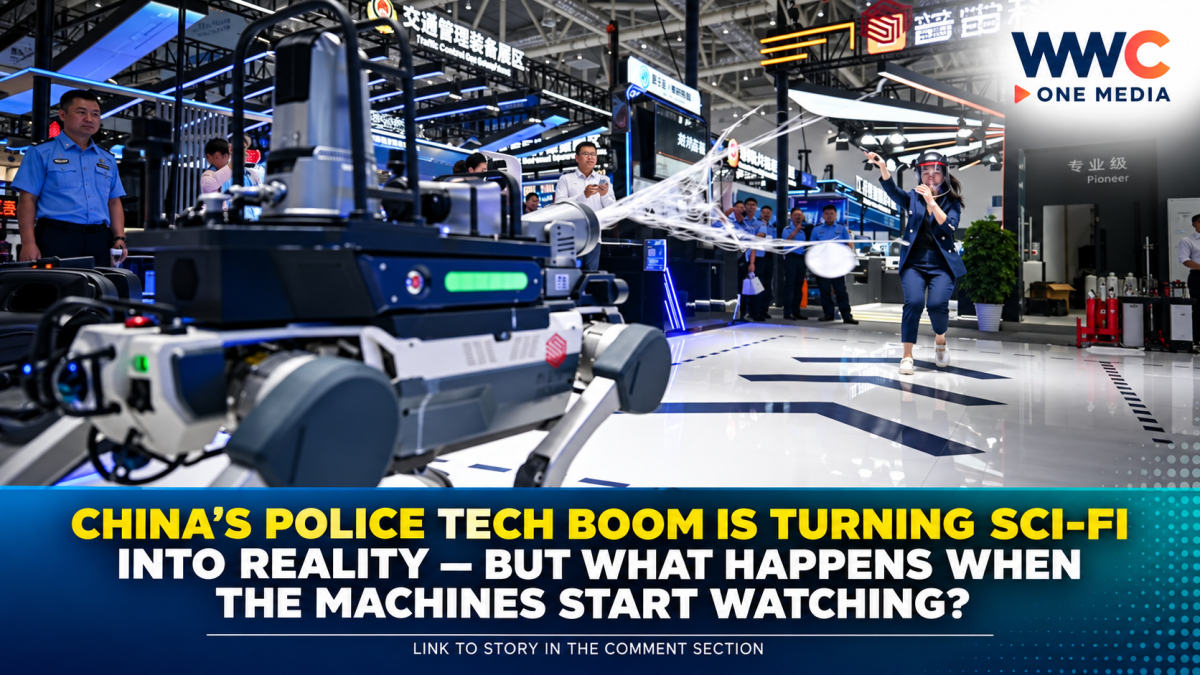
JIANGSU, China — A knife is raised. A four-legged robot detects the threat. Moments later, it can launch a net designed to restrain the person.
It sounds like a scene from a science-fiction film. But at a public-security technology exhibition in eastern China, this was presented as a potential tool for real-world policing.
The AI Patrol Net-launch Robot Dog Pro, developed by Chinese robotics company Nexwise, was among a growing range of technologies displayed at the third Public Security Tech Expo in Lianyungang, Jiangsu, held from Sept. 7 to 11.
The exhibition offered a glimpse into an increasingly sophisticated Chinese police-technology industry — one combining artificial intelligence, robotics, facial analysis, biometric monitoring, aerial systems and non-lethal restraint equipment.
The scale of the industry is also growing.
According to figures cited by China Daily from a 2026 industry report, China’s public-security information-technology market expanded from 10.8 billion yuan in 2015 to 25.5 billion yuan in 2025, representing a compound annual growth rate of 8.96 per cent.
And the technology is no longer confined to exhibition halls.
From robot dogs to robot police
Nexwise told The Straits Times that its robotic systems have been sold to 30 prefecture-level cities across nine provinces.
The company’s robodogs have reportedly been used in locations including Ningxia, Guangxi and Zhuhai, and were deployed during major public events, including China’s 2025 National Games.
Nexwise also said its robotic solutions have been exported to more than 20 countries spanning Europe, the Americas, South-east Asia and the Middle East.
The development fits into a wider Chinese push toward what is known as embodied AI — artificial intelligence incorporated into physical machines that can perceive their surroundings and perform tasks.
The technology is becoming increasingly visible in ordinary policing.
In August, Reuters reported that Hangzhou had deployed wheeled robot police officers to help manage traffic.
The 1.88-metre-tall T2 robots use cameras, radar and onboard computing to identify certain traffic violations, issue warnings and reproduce standard traffic-police gestures with mechanical arms. They do not have arrest powers or weapons.
SUPCON Information, the developer, said 15 robots had been deployed in Hangzhou and that nearly 50 were operating across several Chinese cities. The company said it expected deployments to approach 200 by the end of 2026, although Reuters noted that it could not independently verify the company’s reported enforcement figures.
The distinction is important: China’s police robots are not simply mechanical replacements for human officers. Many are being designed to perform specific, repetitive functions such as traffic management, patrol assistance, monitoring or public interaction.
Cameras that claim to read more than faces
The technology goes well beyond robots.
At law-enforcement exhibitions in China, companies have demonstrated systems that claim to extract physiological and behavioural information from video.
One example is Tiandy’s MicroSense Solution, which the company says was developed over decades with Chinese government involvement.
According to The Straits Times, the system analyses facial micro-expressions and changes in reflected light from a person’s face. The company says this can provide physiological information such as heart rate, blood pressure, blood oxygen levels and breathing rate. It is reportedly being used by police in Beijing’s Haidian district and in Jiaozhou, Shandong province.
South China Morning Post reporting in June described a broader Chinese law-enforcement technology market in which companies were showcasing biometric systems designed to assess physical condition, emotional state and other characteristics of people being investigated.
Claims surrounding technologies that attempt to infer emotions, intentions or deception should nevertheless be treated carefully. Demonstrating a system’s capability at an exhibition is not the same as independently establishing that it can reliably determine whether someone is lying or accurately infer their mental state.
That distinction is becoming increasingly important as AI moves deeper into policing.
The surveillance question
China has spent years building extensive digital infrastructure for public security.
Research from the Oxford Institute of Technology and Justice says AI has become integrated across parts of China’s criminal-justice system, including law enforcement, prosecution and courts. It identifies systems involving facial recognition, big-data analysis and predictive-policing applications.
The Associated Press has also conducted a major investigation into China’s surveillance infrastructure, examining how technologies including facial recognition, fingerprint databases and other digital systems have been developed and supplied for policing and government surveillance. AP’s reporting was recognised with the 2026 Pulitzer Prize for International Reporting.
Meanwhile, research published in the Asian Journal of Criminology found that Chinese police officers surveyed expressed stronger support for crime-fighting robots than service-oriented robots. The study surveyed 1,194 Chinese police officers and examined attitudes toward AI-powered policing technologies.
Together, these developments illustrate a broader transformation: police technology is moving from databases and fixed surveillance cameras toward systems capable of interpreting information and acting in the physical world.
The machines are also being built to restrain
Not every innovation at the Jiangsu exhibition relied on artificial intelligence.
One striking example was the Feiteng Smart Trapper, developed by Zhang Tengfei, a police officer with the Xuzhou Municipal Public Security Bureau.
According to The Straits Times, Zhang developed the device after suffering a knee injury during a confrontation with a knife-wielding suspect in 2020.
The device uses a forked head with movable serrated teeth designed to tighten when a person pulls away. The device can also be fitted with a nozzle capable of spraying water or tear gas.
Zhang said nearly 50,000 units had been manufactured and were being used by police units as well as border-control agencies, hospitals, schools and courts. He also said the device had been exported to countries including Saudi Arabia, Indonesia and Kazakhstan.
The technology raises an obvious question: as police equipment becomes more sophisticated, how should societies balance operational effectiveness with safeguards surrounding the use of force?
That question is not unique to China. But China’s enormous technology manufacturing base and its increasingly integrated public-security infrastructure make the country’s approach particularly significant.
Police with wings
The futuristic equipment on display also included an aircraft.
The ZR-028, developed by Jiangsu Digital Eagle Group, is a lightweight single-seat aircraft designed to carry a person weighing up to 226kg.
The company says it can reach a maximum speed of 100km/h and remain airborne for up to 36 minutes.
For police applications, the aircraft can be equipped with warning lights, searchlights, speakers and other equipment, including systems for launching nets and deploying tyre spikes. Potential uses include aerial patrols, mountain rescue and rapid emergency transport.
Civilian versions, without police equipment, are being marketed for activities including tourism, sightseeing and outdoor recreation.
A growing export industry
Perhaps one of the most significant developments is that China’s police technology market is not purely domestic.
Chinese companies are increasingly presenting security technology to international buyers.
Nexwise told The Straits Times that its products have reached more than 20 countries. Other Chinese surveillance and security technologies have also attracted international attention.
South China Morning Post reported in 2024 that Chinese police-equipment exhibitions were showcasing AI-enabled monitoring systems, biometric technologies and equipment designed to counter drones and monitor detainees.
The overseas expansion, however, faces regulatory and technical obstacles.
Reuters reported that Chinese robotics companies see potential for police robots in overseas markets, but deployment can require integration with local law-enforcement systems, regulatory certification and compliance with data-protection rules.
Those requirements could become particularly important for technologies that collect biometric or location information.
Where does policing end and surveillance begin?
That may ultimately be the most consequential question raised by China’s police-tech boom.
A robot directing traffic is one thing.
A machine capable of identifying a person, analysing biometric information, predicting suspicious behaviour and transmitting that information into a larger law-enforcement database represents a much more consequential form of technology.
China’s expanding public-security technology sector shows how rapidly those capabilities are converging.
The immediate future of policing may therefore involve fewer Hollywood-style humanoid “RoboCops” than people might expect.
Instead, it could look more like a network of specialised machines: robots patrolling streets, cameras analysing faces and physiological signals, drones watching from above, software processing massive databases and AI systems helping officers decide where attention should be directed.
The technology is advancing quickly.
The harder question may be whether laws, oversight and public safeguards can advance at the same speed.
And that is where China’s police-tech experiment could become much bigger than China itself.