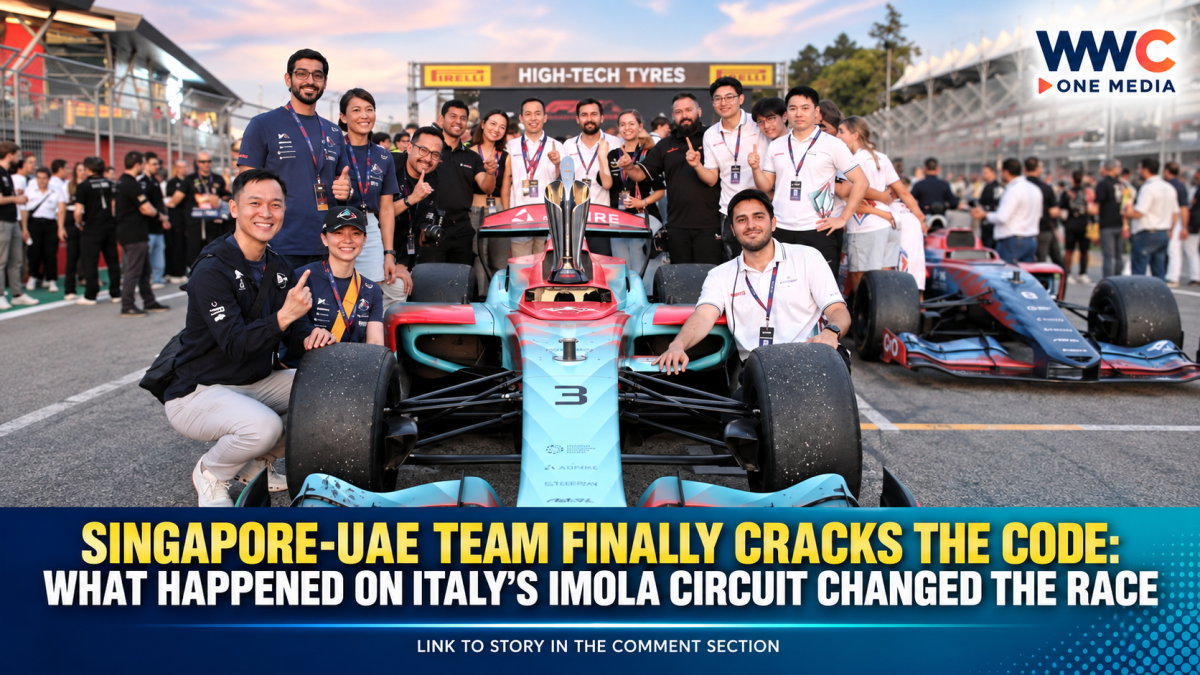
A Singapore-UAE partnership has turned years of setbacks, testing and software development into a landmark victory after Team Kinetiz won the first international race of the Abu Dhabi Autonomous Racing League (A2RL) at Italy’s legendary Imola Circuit.
For more Singapore and autonomous-racing coverage, see our Singapore hub and Sport desk.
The victory on Sept 5, 2026, was Team Kinetiz’s third attempt at the A2RL competition. The team comprises members from Nanyang Technological University (NTU) in Singapore, UAE technology company K2 and autonomous-systems specialist Alp Autonomy.
But the win was far from an overnight breakthrough.
In the inaugural A2RL event in 2024, Kinetiz failed to reach the final four after finishing sixth in a pre-qualifying round. A year later, the team made significant progress, winning the virtual Sim-Sprint competition before finishing fourth in the 2025 Grand Final.
This time, the team went all the way.
From fourth on the grid to first place
Team Kinetiz started the Imola race fourth on the grid, behind Unimore Racing, PoliMOVE and defending champions TUM.
By the chequered flag, however, the Singapore-UAE entry had moved into first.
Kinetiz finished 10.963 seconds ahead of Germany’s Constructor Racing, while PoliMOVE and Unimore Racing were affected by a collision during the race. Two-time defending champions TUM also encountered a technical issue and ultimately finished fifth.
The result marked A2RL’s first race outside Abu Dhabi and the first time the league staged a multi-car autonomous race in Europe.
Five fully autonomous cars competed over 12 laps at the 4.9km Imola circuit, one of motorsport’s best-known venues.
There was no human driver behind the wheel
What makes the result particularly notable is what was — and wasn’t — inside the cars.
The autonomous race cars operate without a conventional driver controlling the steering, throttle or brakes. Instead, teams develop software capable of interpreting sensor information and making split-second decisions.
The cars use technologies including cameras, lidar, radar and navigation systems. Their software must determine how to accelerate, brake, steer and respond to surrounding vehicles in real time. The cars can reach speeds of up to 300kmh, according to The Straits Times.
The cars themselves are based on the Dallara Super Formula SF23 platform, with teams competing on essentially identical hardware. That puts much of the competitive emphasis on software, perception, planning, control and real-time decision-making.
Imola presented a completely different challenge
The move from Abu Dhabi to Italy was more than a change of scenery.
A2RL’s previous races were held at the relatively familiar Yas Marina Circuit. Imola introduced elevation changes, bumps, narrow racing lines, limited run-off areas and difficult overtaking zones.
That meant the autonomous systems had to cope with a track environment very different from the one they had already learned.
Before the race, teams had only nine days of physical testing at Imola, with conditions ranging from rain to hail. A2RL also used high-fidelity digital simulations to allow teams to develop and test their algorithms before arriving at the circuit.
The dramatic moment that changed the race
The victory also came after a major incident involving two Italian teams.
Unimore Racing initially led and recorded the fastest lap, but subsequently suffered a technical problem that caused its car to slow dramatically. PoliMOVE, which was following closely, could not avoid the slowed vehicle and collided with it.
The incident eliminated both teams from contention and helped open the way for Kinetiz to take the lead and maintain it to the finish.
PoliMOVE’s car reached 252.3kmh, highlighting just how quickly the autonomous vehicles were operating when the incident occurred.
Why the victory matters to Singapore
For NTU, the result represents more than a motorsport trophy.
NTU researchers and students have been working with industry partners on autonomous systems and AI-driven racing technology, with the experience from successive A2RL competitions providing real-world data that can be used to improve autonomous systems.
NTU team lead Associate Professor Holden Li said the accumulated experience from three consecutive years made a major difference, rather than there being a single “magic algorithm” responsible for the victory.
The university says the technologies and lessons developed through the programme could eventually have applications beyond racing, including autonomous mobility and robotics.
Li also said the team hopes to translate what it has learned into broader applications for autonomous systems and robotics in Singapore.
A bigger test for driverless technology
The significance of the Imola race extends beyond the result.
A2RL was launched in Abu Dhabi in 2024 as a testbed for autonomous racing and AI. The competition has since evolved toward multi-car racing, where autonomous systems must not only drive quickly but also respond to other vehicles operating around them.
The National reported ahead of the Imola event that the gap between human and autonomous lap times in the series had narrowed substantially between 2024 and 2025, although autonomous racing remains a different challenge from conventional human-driven motorsport.
Euronews similarly highlighted the unusual nature of the competition: although the cars operate without drivers, teams of engineers still spend enormous amounts of time developing the AI systems that effectively “drive” them.
That distinction is important. Winning an autonomous race does not mean driverless technology is ready to replace human drivers everywhere. Instead, competitions such as A2RL provide controlled environments where researchers can test perception, planning, vehicle control and decision-making at high speed.
From disappointment to victory
For Team Kinetiz, the Imola result represents a three-year progression:
2024: Failed to reach the A2RL final four.
2025: Won the virtual Sim-Sprint and finished fourth in the Grand Final.
2026: Started fourth at Imola — and finished first.
The team’s victory also ended TUM’s run of two consecutive A2RL championships.
The next chapter will take the competition back to Yas Marina Circuit in Abu Dhabi, where A2RL plans to continue developing its autonomous racing programme after its landmark international debut at Imola.
For Singapore, the result puts NTU researchers and students at the centre of a rapidly developing field — one where the driver may be absent from the cockpit, but the battle increasingly takes place inside the algorithms controlling the car.
And after three years of learning, testing and refining, Team Kinetiz has now shown what can happen when those algorithms finally get it right.