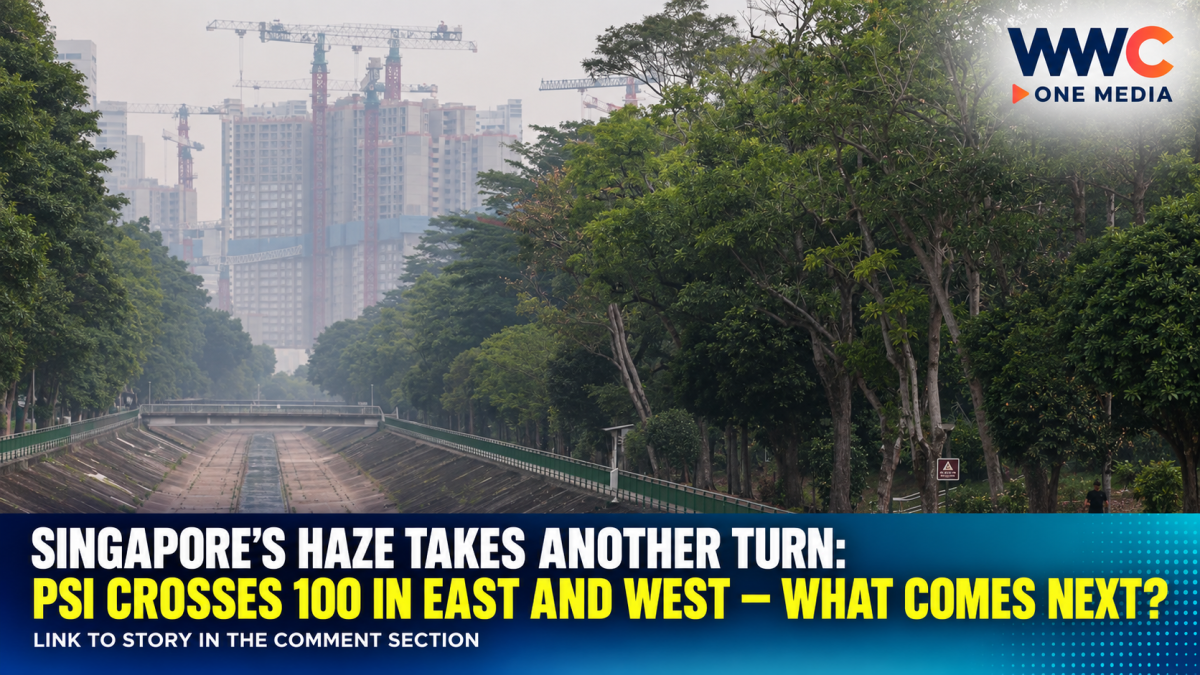
SINGAPORE — Singapore’s haze situation worsened on Sunday, Sept. 20, with air quality in three of the island’s five regions reaching the unhealthy range, as smoke haze from fires in Indonesia continued to affect the Republic.
For more Singapore air-quality and regional haze briefs, see our Singapore hub and Asia desk.
At about 7am, the 24-hour Pollutant Standards Index (PSI) stood at 123 in the central region, 105 in the west and 102 in the east, according to figures reported by The Straits Times. The north and south remained in the moderate range, at 84 and 89 respectively.
The latest deterioration means residents in the eastern and western parts of Singapore have joined those in the central region in experiencing unhealthy 24-hour PSI levels.
Singapore classifies a PSI reading of 101 to 200 as unhealthy, while 51 to 100 is considered moderate and 0 to 50 is considered good. When the PSI enters the unhealthy range, the National Environment Agency (NEA) advises the public to reduce outdoor activities.
Haze risk remains as smoke drifts from Indonesia
The worsening conditions come as dry weather persists over parts of southern Sumatra and Kalimantan, where smoke plumes from fires have been observed.
Singapore’s Meteorological Service said on Sept. 19 that smoke haze from southern and central Sumatra had drifted towards Singapore, while smoke plumes were also observed over southwestern Kalimantan. Prevailing winds were expected to blow from the east-southeast or southeast, creating a continued risk of haze affecting Singapore.
The agency forecast Singapore’s 24-hour PSI to remain in the high-moderate to mid-unhealthy range.
CNA likewise reported that NEA had warned of the possibility of smoke haze reaching Singapore as dry conditions continued in parts of Indonesia.
A recurring pattern throughout September
The latest spike is part of a wider deterioration in Singapore’s air quality this month.
The central region first crossed into the unhealthy range on Sept. 4, when its 24-hour PSI reached 101. Since then, readings in the central, eastern and western parts of the island have periodically crossed the unhealthy threshold.
The situation became particularly severe on Sept. 15, when all five regions of Singapore recorded unhealthy PSI readings. The central region reached 154 that morning. It was the first time since September 2019 that unhealthy air quality had been recorded across the entire island.
Air quality subsequently improved, but the respite was temporary. The central region returned to the unhealthy range on Sept. 19 before the east and west followed overnight.
Why has the central region often recorded the highest readings?
Experts cited by The Straits Times said the central region’s higher readings may be linked partly to its dense urban environment.
High levels of urbanisation and heat from buildings and concrete surfaces can create turbulent air conditions that help trap particulate pollution closer to the ground. Smoke particles arriving from Indonesia can also mix with local emissions, potentially contributing to higher pollution levels in heavily urbanised areas.
However, the pattern can change when a thicker plume of haze moves across the island. That was evident on Sept. 15, when all five regions recorded unhealthy air.
Indonesia facing a major wildfire season
The Singapore haze is occurring against the backdrop of a severe wildfire situation in Indonesia.
Reuters reported that Indonesia is experiencing its worst wildfire season in more than a decade, with extensive fires affecting parts of Borneo and Sumatra. Extreme heat and drought have contributed to worsening fire conditions, while the resulting smoke has affected Indonesia as well as neighbouring Malaysia and Singapore.
Indonesian authorities have expanded firefighting efforts, including aerial operations, as fires continue to threaten communities and air quality.
Reuters also reported that Indonesian President Prabowo Subianto has called for tougher action against those responsible for illegal land and forest burning. Indonesian authorities have launched criminal investigations as the government responds to the fires.
PSI and PM2.5: What should Singapore residents watch?
The 24-hour PSI is designed to provide an indication of overall air quality over the preceding 24 hours and is useful for planning activities for the day ahead.
For immediate outdoor activity, authorities advise checking the 1-hour PM2.5 concentration, which provides a more immediate indication of fine particulate pollution.
The Meteorological Service specifically advises residents to use the 1-hour PM2.5 readings when deciding whether to engage in outdoor activities immediately, while the 24-hour PSI forecast can be used when planning activities for the following day.
NEA has also cautioned that Singapore’s PSI should not be directly compared with air-quality indexes produced by other websites because different systems use different calculation methods and pollutants.
What happens next?
For now, Singapore remains exposed to further haze as long as dry conditions persist over affected parts of Indonesia and winds continue carrying smoke towards the island.
The latest official forecast puts Singapore’s 24-hour PSI in the high-moderate to mid-unhealthy range, meaning conditions could continue to fluctuate depending on rainfall, wind direction and the movement of smoke plumes.
With the east and west now joining the central region above the unhealthy threshold, the coming days will be closely watched for whether the haze eases — or whether more parts of Singapore again see unhealthy air.
For residents, the key message is simple: check the latest 1-hour PM2.5 reading before heading outdoors, monitor the 24-hour PSI forecast, and follow NEA’s health advisories as conditions change.