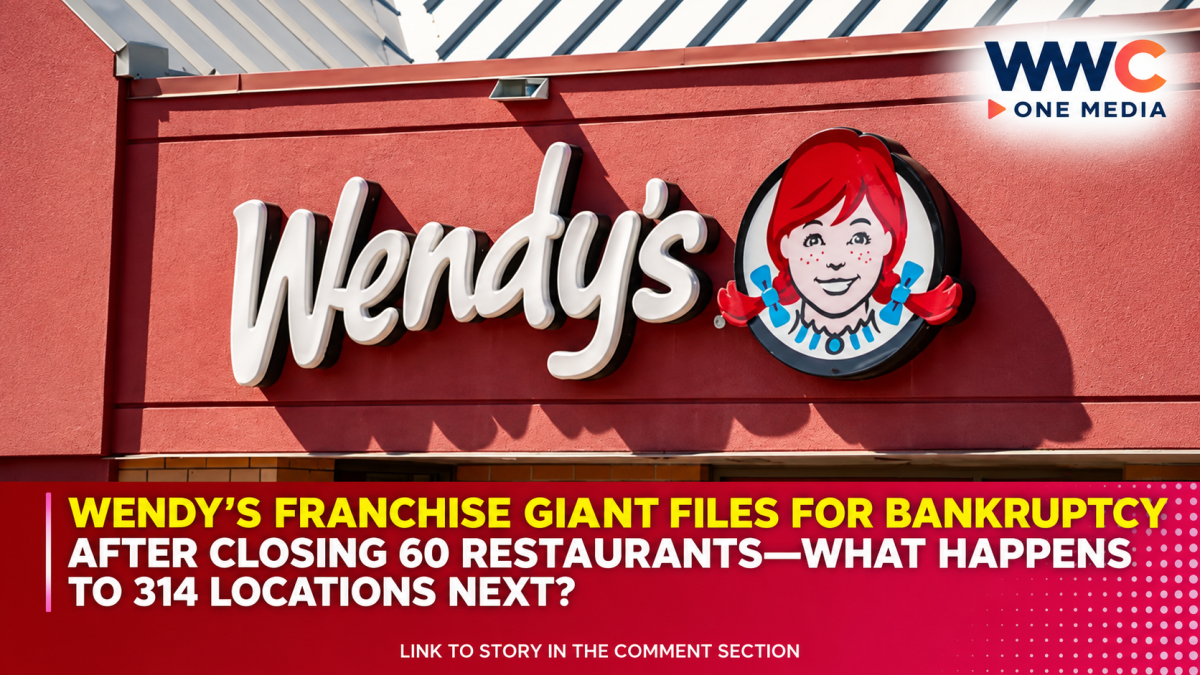
GRAND RAPIDS, Mich. — A major Wendy’s franchise operator has filed for Chapter 11 bankruptcy protection, putting hundreds of restaurants and thousands of employees under the spotlight as the fast-food chain battles declining sales, rising costs and a broader turnaround effort.
Meritage Hospitality Group, one of the largest Wendy’s franchisees in the United States, voluntarily filed for Chapter 11 protection on September 17 in the U.S. Bankruptcy Court for the Western District of Michigan.
The company operates 314 Wendy’s restaurants across 15 states, along with one Bojangles restaurant and five independently branded concepts. It employs approximately 9,000 people.
But despite the bankruptcy filing, Meritage says customers should not expect its restaurants to suddenly disappear.
The company says it intends to keep its restaurants operating during the restructuring and continue paying employee wages and benefits, subject to court approval of its initial bankruptcy motions. It also expects to continue paying suppliers and vendors for goods and services provided after the filing.
This is not a Wendy’s corporate bankruptcy
The distinction is important.
The Wendy’s Company has not filed for bankruptcy.
Instead, the Chapter 11 case involves Meritage Hospitality Group, an independent franchise operator whose business is heavily concentrated in Wendy’s restaurants.
Because the majority of Meritage’s portfolio operates under the Wendy’s brand, the franchisee said problems affecting the broader Wendy’s system have had a significant effect on its financial position.
That makes the filing significant for Wendy’s, even though the parent company remains outside bankruptcy court.
314 restaurants—and roughly 9,000 employees
Meritage currently operates Wendy’s locations in Arkansas, Connecticut, Florida, Georgia, Indiana, Massachusetts, Michigan, Missouri, Mississippi, North Carolina, Ohio, Oklahoma, Tennessee, Texas and Virginia.
The company had already taken aggressive steps to reduce costs before turning to bankruptcy protection.
According to Restaurant Dive, Meritage had closed at least 60 underperforming restaurants and changed or eliminated breakfast operations at roughly 120 locations as it attempted to improve restaurant-level profitability.
The Detroit News also reported that Meritage had closed nearly 60 restaurants earlier this year as part of efforts to improve its financial performance.
Those measures, however, were not enough to resolve the company’s financial pressures.
What pushed Meritage into Chapter 11?
Meritage said its decision followed more than a year of efforts to work with lenders and its franchisor outside of court.
The company cited what it described as sustained, system-wide headwinds affecting the Wendy’s brand.
The financial deterioration has been substantial.
The Wall Street Journal reported that Meritage’s store-level EBITDA fell 48% in 2025, pushing restaurant-level profitability to a roughly 30-year low. Factors cited in the company’s reporting included higher beef costs, aggressive discounting under previous Wendy’s management and marketing problems.
Restaurant Dive likewise reported that beef inflation, discounting and marketing issues contributed to the deterioration in franchise-level margins.
Wendy’s has been struggling too
Meritage’s bankruptcy comes as Wendy’s itself is attempting to reverse a prolonged sales decline.
Wendy’s reported in August that U.S. same-restaurant sales fell 7.0% in the second quarter of 2026, while global systemwide sales declined 6.5%. U.S. systemwide sales were down 8.2%.
The company also withdrew its 2026 financial outlook and reduced its dividend as new CEO Bob Wright began implementing a turnaround strategy.
Wright identified five areas for improvement: rebuilding the menu around quality and value, strengthening marketing, improving restaurant operations, enhancing the digital experience and using restaurants as a growth engine.
The timing is significant because franchisees bear much of the direct cost of operating individual restaurants.
When sales weaken while labor, food and occupancy costs remain elevated, franchise operators can face pressure much faster than the corporate parent.
Bankruptcy doesn’t necessarily mean the restaurants are closing
Chapter 11 is generally designed to give a financially troubled company an opportunity to reorganize while continuing operations.
That’s precisely what Meritage says it intends to do.
The company is pursuing debtor-in-possession financing, which is intended to provide liquidity while the restructuring proceeds. Meritage said the financing, combined with cash generated from ongoing operations, is expected to support the business during the Chapter 11 process.
So far, Meritage has not announced that the Chapter 11 filing itself will result in another wave of restaurant closures.
Instead, the company says the restructuring will allow it to strengthen its balance sheet, create financial flexibility and evaluate strategic alternatives.
That does not guarantee that every restaurant will remain open permanently. It means the immediate objective is restructuring rather than an announced liquidation of the entire portfolio.
The bankruptcy follows a difficult year for Wendy’s franchisees
Meritage’s filing is also part of a broader pattern in the U.S. restaurant industry.
Restaurant Dive reported that several franchise operators across major fast-food brands have sought bankruptcy protection in 2026 as operators contend with intense competition, inflation and consumers becoming more selective about restaurant spending.
For franchisees, the economics can be particularly difficult.
Operators must pay labor, food, rent, utilities and other expenses while also meeting obligations under franchise agreements. If customer traffic falls, those fixed and semi-fixed costs can consume a much larger share of revenue.
That makes prolonged sales weakness especially painful for large operators with hundreds of locations.
Wendy’s says it is working with struggling franchisees
Wendy’s has acknowledged the difficulties facing franchise operators.
A company spokesperson told the Wall Street Journal that Wendy’s works closely with franchisees experiencing financial challenges and evaluates individual situations on a case-by-case basis.
That approach could become increasingly important as Wendy’s attempts to execute its turnaround strategy.
The company needs franchisees to continue investing in restaurants, staffing and operations while simultaneously trying to restore customer traffic and improve value perception.
What happens next?
Meritage’s Chapter 11 case now moves into the court-supervised restructuring process.
The company is seeking financing to maintain liquidity, while management works with lenders, Wendy’s and other stakeholders on a longer-term restructuring.
The immediate question is not whether Wendy’s is disappearing.
It isn’t.
The more important question is whether Meritage can stabilize hundreds of restaurants while Wendy’s attempts to repair the sales and franchise economics that contributed to the operator’s financial problems.
For now, Meritage says its restaurants will continue serving customers and that its roughly 9,000 employees are expected to continue receiving wages and benefits during the restructuring, subject to court approval.
But after closing roughly 60 restaurants before entering bankruptcy court, the latest filing leaves a much bigger question hanging over the chain:
How many of those 314 Wendy’s locations will still be part of Meritage’s portfolio when the restructuring is finished?