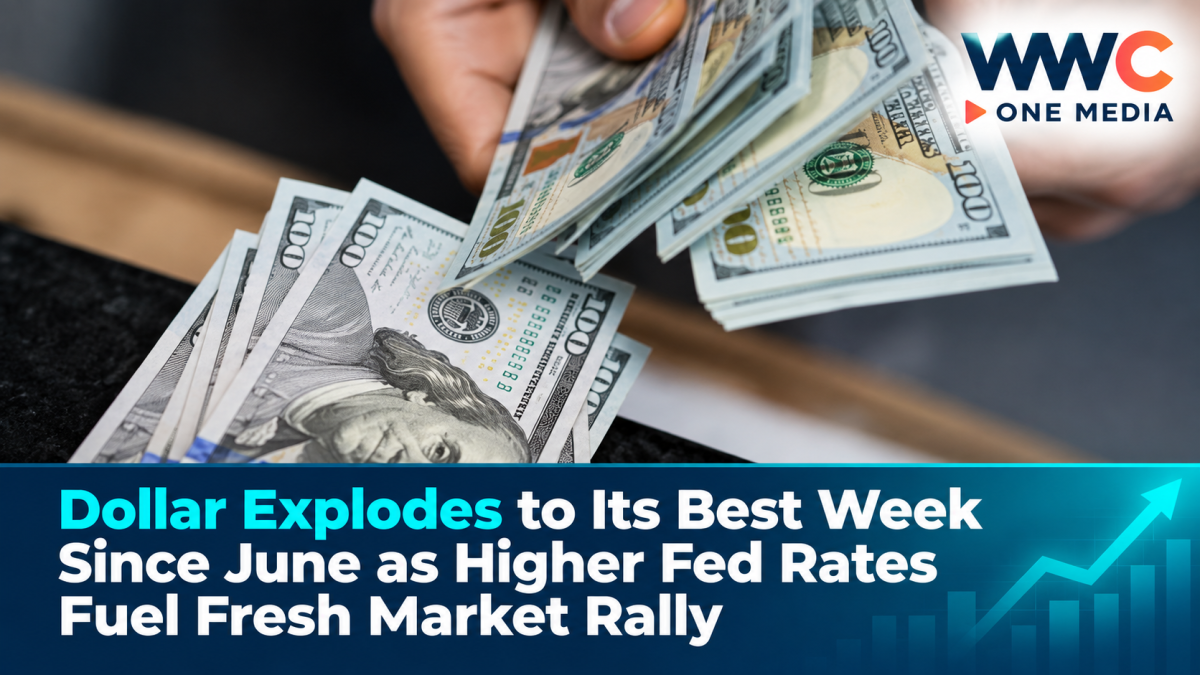
The U.S. dollar just delivered its strongest weekly performance in more than three months, as investors rapidly adjusted to the possibility that the Federal Reserve may keep interest rates higher for longer.
The Bloomberg Dollar Spot Index gained about 1.1% for the week, putting the greenback on track for its strongest weekly advance since June. The rally followed the Federal Reserve’s September rate decision, which signaled that another increase could still be on the table before the end of 2026.
The move marks a significant shift in currency markets, where traders had previously been positioned for easier U.S. monetary policy.
The Fed Changed the Rate Equation
On September 16, the Federal Reserve raised its benchmark interest-rate target by 25 basis points to 3.75%–4%, its first rate increase since 2023.
The Fed said inflation remained elevated and that the latest move was intended to support a return toward its 2% inflation target.
More importantly for currency traders, the Fed’s latest projections showed a median federal-funds-rate forecast of 4.1% at the end of 2026, compared with 3.8% in its June projections.
The projections also showed median PCE inflation at 3.7% for 2026, up from the previous 3.6% forecast, while core PCE inflation was projected at 3.4%.
Reuters reported that 16 of 18 policymakers expected at least one additional quarter-point rate increase before the end of the year.
That combination — higher rates and the prospect of additional tightening — made dollar-denominated assets more attractive relative to currencies backed by central banks perceived to be moving more slowly.
Dollar Hits a Seven-Week High
The dollar’s advance accelerated immediately after the Fed meeting.
Reuters reported that the U.S. Dollar Index climbed to a seven-week high, reaching about 100.37 on Thursday, while Treasury yields also moved higher following the Fed announcement.
The dollar subsequently eased somewhat as Treasury yields and oil prices retreated, but the broader weekly gain remained intact.
By Thursday, the Dollar Index was still around 1.4% higher than a week earlier, according to Reuters.
Market analysts attributed much of the move to expectations that U.S. interest rates could remain elevated for longer.
The Yen Added Another Layer to the Dollar Rally
The dollar’s strength was not driven solely by the Federal Reserve.
Japan’s central bank also raised interest rates by 25 basis points on Friday, taking its policy rate to 1.25%. But the Bank of Japan’s communication was viewed by markets as less aggressive than some investors had anticipated.
That helped push the yen lower against the dollar and widened the perceived policy gap between the two countries.
Reuters reported that the dollar rose sharply against the yen after the BOJ decision, while investors reassessed expectations for the pace of additional Japanese tightening.
The result was a powerful combination for the greenback: a Federal Reserve signaling further tightening and a Bank of Japan that did not provide the hawkish guidance some traders had expected.
Oil Prices Are Still Part of the Story
Energy markets are also complicating the currency outlook.
Brent crude remained above $100 a barrel amid continuing Middle East supply concerns, although prices retreated during the latter part of the week as concerns about additional supply disruptions eased.
Higher oil prices can reinforce inflation pressures, particularly in energy-importing economies.
That matters because persistent energy inflation could make central banks more reluctant to cut rates — or force some to consider additional tightening.
For the United States, meanwhile, higher oil prices can also support the dollar through safe-haven demand and expectations for tighter monetary policy, although the relationship is not one-directional.
What the Dollar Surge Means for the Philippines
The dollar’s strength is particularly relevant to the Philippines because movements in the U.S. currency affect import costs, inflation pressures, overseas remittances and the peso.
The Bangko Sentral ng Pilipinas’ official reference rate showed the peso at ₱62.785 per U.S. dollar on September 18, compared with ₱62.732 on September 17.
Philippine market data also showed the peso finishing Friday at around ₱62.73 per dollar, while local stocks fell amid concerns about higher energy costs.
The broader Asian currency picture remains challenging. A Reuters survey published September 17 found that bearish sentiment toward many emerging Asian currencies had intensified as investors dealt with rising U.S. Treasury yields and elevated oil prices. The Philippine peso was among the currencies facing significant bearish positioning.
A stronger dollar and expensive oil can create a difficult combination for economies that import substantial amounts of energy because fuel and other dollar-priced commodities become more expensive in local-currency terms.
The Rally Still Has a Major Question Hanging Over It
Despite the dollar’s powerful weekly advance, the outlook is not settled.
One reason is that financial markets can move faster than central-bank projections.
Reuters reported that investors were pricing in a more aggressive rate path than the Fed’s official projections, including expectations for more tightening beyond the single additional hike reflected in the Fed’s median 2026 forecast.
That creates a potential source of volatility.
If U.S. inflation remains elevated and energy prices stay high, expectations for additional Fed tightening could strengthen further.
But if inflation pressures ease, oil prices retreat and U.S. economic data weaken, markets could begin scaling back those expectations.
In other words, the dollar’s latest surge has been driven not simply by the rate increase that already happened, but by the possibility that the Fed’s tightening cycle may not be finished.
For currency markets, that next signal could matter more than the rate hike investors have already absorbed.
The Bottom Line
The dollar has entered the final stretch of September with significant momentum: the Bloomberg Dollar Spot Index gained roughly 1.1% during the week, its strongest weekly performance since June, after the Fed raised rates and signaled that another increase could come before year-end.
But the rally is now confronting a new test.
Markets must determine whether the Fed’s projected path of higher rates will actually be supported by incoming inflation, labor-market and energy data.
Until that becomes clearer, the dollar, Treasury yields, oil prices and Asian currencies — including the Philippine peso — are likely to remain closely linked to every major signal from U.S. monetary policy.