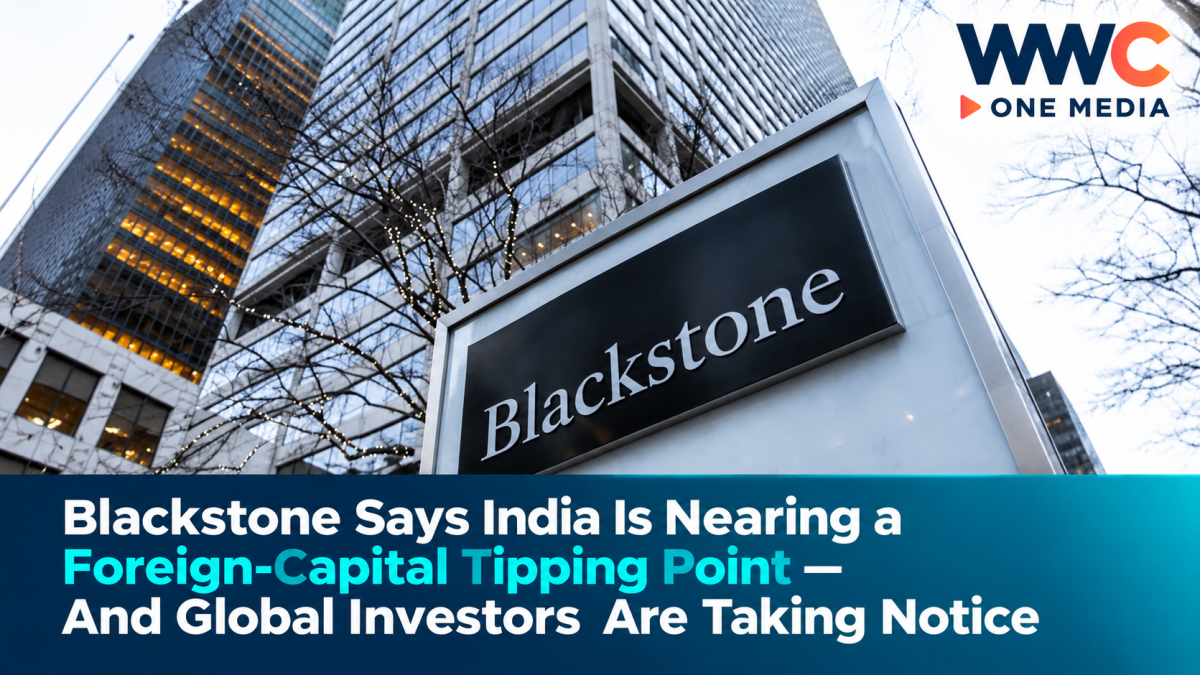
NEW DELHI — India may be approaching a point where its economic growth, infrastructure improvements, expanding capital markets and huge talent pool begin attracting foreign investment on a significantly larger scale, according to Blackstone President Jon Gray.
Gray said India has become Blackstone’s highest-returning private-equity market globally, following a major shift in the firm’s investment strategy toward control or equal-control positions and sectors such as information technology services, commercial real estate and domestic manufacturing.
His assessment comes as India continues to expand its role in the global economy — but also as foreign investment faces new challenges from trade tensions, energy prices and a still-evolving regulatory environment.
Blackstone’s India story started with hesitation
Blackstone’s early experience in India was far from the success story it is today.
Gray recalled that the firm initially operated with a small team and struggled to find an investment strategy that produced attractive economics.
The global financial crisis added to those difficulties.
Rather than aggressively expanding, Blackstone largely pulled back.
The investment giant later changed its approach, deciding that it needed a more substantial presence and a different strategy for India’s market.
That shift eventually transformed the country’s role inside Blackstone’s global portfolio.
The strategy changed — and so did the returns
Blackstone eventually began taking majority or equal-control stakes in Indian businesses rather than relying primarily on minority investments.
The firm concentrated on areas where it believed India’s domestic growth could create scalable businesses.
Those included:
- Information-technology services
- Commercial real estate
- Domestic manufacturing
- Digital infrastructure
- Other businesses tied to India’s expanding consumer and corporate economy
Gray said that approach helped turn India into Blackstone’s best-performing private-equity market worldwide.
That history is central to his current assessment.
Blackstone is not simply betting that India will grow.
It is betting that India’s economic structure has reached a stage where large institutional investors can deploy increasingly large amounts of capital and still find opportunities capable of generating attractive returns.
What does “tipping point” actually mean?
Gray’s “tipping point” comment should not be interpreted as a forecast that India is about to suddenly experience an investment explosion.
Rather, he is describing a stage of economic development in which improvements in infrastructure, institutions, capital markets and business scale can reinforce one another.
Gray argued that economies need time to reach a point where their growth rate can begin expanding more rapidly.
His view is that India is getting closer to that stage.
That is an assessment from one of the world’s largest alternative-asset managers — not an official economic forecast.
India’s economy has changed dramatically
The scale of India’s economic transformation is one reason the investment case has attracted global attention.
Data cited in the Bloomberg report show that India’s GDP has grown almost fivefold since 2005, reaching about $3.69 trillion and moving the country into fourth place among the world’s largest economies.
The country is also home to approximately 1.47 billion people, providing companies with one of the world’s largest consumer and labor markets.
India’s economy grew 7.6% in fiscal 2026, according to the World Bank figure cited in the report.
That combination — a huge population, relatively rapid economic growth and rising corporate sophistication — is central to the foreign-capital argument.
India’s talent pool may be an even bigger attraction
India’s investment appeal extends beyond its population size.
Mohandas Pai, former chief financial officer of Infosys, said roughly 11 million people graduate from Indian colleges every year, including approximately 800,000 to 1 million engineers or near-engineers.
Pai estimated that roughly 500,000 could be trained for technology-sector roles.
The argument is that India’s workforce can provide a large pool of skilled employees for global technology, financial and business-services companies.
For international investors, that can translate into a potential combination of lower operating costs, technical skills and access to a huge domestic market.
Infrastructure was once India’s biggest obstacle
Gray identified infrastructure as one of the major factors that previously held India back.
But he said the issue extends beyond roads, airports, ports and other physical assets.
It also includes legal and capital-markets infrastructure.
His assessment is that India has made significant progress in these areas over the past two decades.
He credited the administration of Prime Minister Narendra Modi with improving infrastructure and the broader investment environment.
That assessment is Gray’s view, however, rather than an independent measurement of every aspect of India’s regulatory or institutional environment.
Foreign investment is already flowing into new sectors
India’s investment story is not limited to private-equity firms buying established companies.
The country has also been attracting enormous amounts of capital into digital infrastructure.
EY and the Indian Venture and Capital Association reported that India’s private-equity and venture-capital investments totaled $20.5 billion across 604 deals in the first half of 2026.
Real estate was the largest sector by investment value at $4.1 billion, followed by technology at $3.1 billion and financial services at $3 billion.
But the numbers also provide an important reality check.
The $20.5 billion total was 36% lower than the $31.8 billion recorded in the first half of 2025.
Deal volume was also down 18% year-on-year.
So while Blackstone sees India’s long-term opportunity expanding, the current investment market is not moving upward in a straight line.
Data centers are becoming a major magnet for capital
One of the clearest examples of India’s growing infrastructure investment opportunity is data centers.
EY-IVCA reported that data centers and related sectors attracted approximately $45.3 billion in commitments and investments between 2021 and June 2026 across 86 deals.
Investment activity reached a record level in the first half of 2026.
The growth is being driven by:
- Artificial intelligence
- Cloud computing
- Rising data consumption
- Digital services
- Enterprise technology adoption
Blackstone-backed AirTrunk has also announced a potential $30 billion investment commitment in India, illustrating the scale of capital being considered for the country’s digital infrastructure buildout.
India’s foreign-investment rules are also evolving
New Delhi has been making changes designed to make certain forms of foreign investment easier.
In August, India’s Ministry of Commerce and Industry said 29 foreign direct investments totaling ₹4,895.65 crore had been reported under a revised framework for investors connected to countries sharing a land border with India.
The revised rules allow certain investors with non-controlling ownership of up to 10% from land-border countries to invest through the automatic route, subject to applicable sectoral limits and other conditions.
The government said the reform is intended to reduce transaction times and provide greater certainty for investors.
That is significant because regulatory clarity can be particularly important for large institutional investors planning multi-billion-dollar transactions.
But India still has hurdles
Gray himself acknowledged that the India opportunity will not be free of risks.
He pointed to disagreements between India and the United States over tariffs and the impact of higher energy costs associated with the conflict in Iran.
Those risks matter because India remains heavily dependent on imported energy.
A sustained rise in oil prices can increase India’s import bill, put pressure on the rupee and raise domestic inflation.
Recent Reuters reporting showed the Indian rupee closing at around 95.875 per U.S. dollar on September 18, after losing about 0.3% over the week. Traders were watching the 96-per-dollar level as an important threshold while the Reserve Bank of India was reported to be intervening in the foreign-exchange market.
Trade tensions could complicate the investment boom
India’s relationship with the United States remains another variable for investors.
Washington’s proposed sanctions legislation targeting countries that purchase significant quantities of Russian oil has created additional uncertainty for India because Russia remains an important source of Indian crude imports.
Reuters reported that the proposed U.S. measures could complicate ongoing trade negotiations between Washington and New Delhi.
For investors, geopolitical uncertainty can affect currency values, energy costs, export competitiveness and the expected returns from new projects.
That does not eliminate India’s investment appeal, but it adds another layer of risk.
Blackstone’s experience offers a bigger lesson
Blackstone’s India journey demonstrates why long-term foreign investment can look very different from short-term capital flows.
The firm struggled to make its early India strategy work.
It then changed its approach.
Instead of treating India simply as another market for minority investments, it focused on sectors where it could exercise greater influence over businesses and benefit from the country’s structural growth.
That patience eventually produced what Gray describes as Blackstone’s highest private-equity returns globally.
For other global investors, the message is potentially significant:
India may increasingly reward investors that understand the country’s domestic market rather than treating it simply as an outsourcing destination or low-cost manufacturing base.
India is becoming more than an outsourcing story
For years, India’s global economic reputation was heavily associated with IT outsourcing and business-process services.
Those industries remain important.
But the investment opportunity has broadened.
Foreign capital is now targeting:
Real estate.
Manufacturing.
Financial services.
Data centers.
Artificial intelligence infrastructure.
Digital services.
Technology.
Consumer businesses.
That diversification is part of what makes the current investment story different from India’s earlier development phases.
Blackstone is not the only investor watching
The broader private-capital market also shows continued interest.
The EY-IVCA data indicate that large transactions remain an important part of India’s investment landscape even though overall deal values have fallen from 2025 levels.
In the first half of 2026, 46 transactions worth more than $100 million accounted for $13 billion of investment.
That concentration suggests large institutional investors continue to see opportunities even in a more selective market.
The challenge is finding assets that can justify high valuations and deliver sufficient returns.
The foreign-capital opportunity is enormous — but so is the competition
India is competing for global investment against other major emerging and developed markets.
Investors can choose between Southeast Asia, the Middle East, Latin America, Eastern Europe and developed economies offering their own incentives.
India therefore needs to compete on more than economic growth.
Investors also care about:
- Rule of law
- Tax certainty
- Regulatory predictability
- Infrastructure
- Currency stability
- Exit markets
- Corporate governance
- Skilled labor
- Access to financing
Progress in those areas can determine whether foreign investors merely enter India or commit capital at increasingly large scale.
The next phase could be about scale
The biggest change may be the scale of investment that India can absorb.
As its economy grows, the country needs enormous amounts of capital for infrastructure, housing, technology, manufacturing, energy and digital networks.
That creates opportunities for private-equity firms, pension funds, sovereign wealth funds, insurers and other long-term institutional investors.
Blackstone’s own experience suggests that large-scale investment can become more attractive once the surrounding infrastructure and capital markets mature.
But “tipping point” does not mean risk-free
India’s growth trajectory still faces potential disruptions.
Energy prices can rise.
The rupee can weaken.
Trade disputes can escalate.
Regulatory rules can change.
Asset valuations can become expensive.
And foreign investment can slow when global interest rates rise.
The first-half PE/VC figures are a useful reminder: India can simultaneously have a powerful long-term investment story and a weaker short-term deal environment.
Those two realities are not contradictory.
The Blackstone bet is ultimately a long-term one
Gray’s assessment reflects a long-term investment philosophy.
India has spent years expanding infrastructure, improving its financial system and developing a massive pool of skilled workers.
The question now is whether those improvements can reinforce one another enough to push economic growth and capital formation into a faster phase.
Blackstone believes the country is approaching that point.
But the next stage will depend on whether India’s economic expansion can translate into productive investment, stronger companies and sustainable returns, rather than simply higher asset prices.
For foreign investors, that distinction may be crucial.
India has already become too large to ignore.
The question now is whether it is reaching the stage where global capital begins treating the country not simply as a promising emerging economy, but as a core destination for long-term institutional investment.
Blackstone’s answer is increasingly clear.
The tipping point may be getting closer — but the next wave of capital will still have to prove that the opportunity can deliver returns.