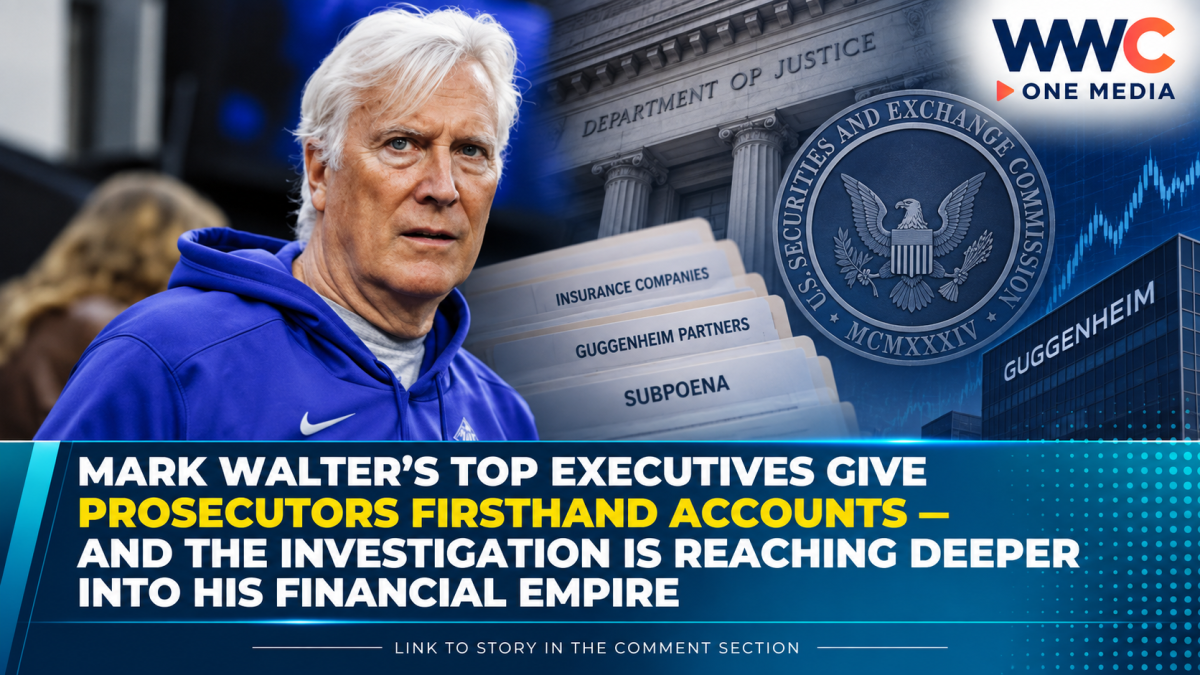
NEW YORK — Federal prosecutors investigating billionaire Mark Walter’s sprawling financial empire have obtained information directly from some of his most senior executives, adding a new layer to a probe examining the business relationships between his insurance companies and Guggenheim Partners.
Among those who have provided information are Daniel Towriss, who heads Walter’s insurance business, and Andrew Rosenfield, president of Guggenheim Partners, according to people familiar with the investigation cited by Bloomberg.
The developments show that the federal inquiry is reaching senior levels of Walter’s organizations.
But there is an important qualification: neither Towriss nor Rosenfield is believed to be a target of the investigation, according to people familiar with the matter. No criminal charges have been filed, and investigators could ultimately decide not to bring any.
Prosecutors are examining two interconnected parts of Walter’s empire
The investigation has focused on dealings involving Walter-controlled insurance companies and the investment businesses associated with Guggenheim.
At the center are questions about related-party investments, loans involving affiliated businesses and accounting practices at Guggenheim Private Investments.
The investigation is being conducted alongside scrutiny by the U.S. Securities and Exchange Commission.
The Department of Justice’s interest in interviewing executives does not itself establish wrongdoing. Bloomberg Law reported that investigators may ultimately bring no charges.
Walter’s companies have said they are cooperating with authorities.
Rosenfield gave grand-jury testimony
Rosenfield, one of Walter’s longest-serving senior executives, provided testimony before a federal grand jury, according to people familiar with the matter.
He had initially declined to testify, after which prosecutors obtained a court order granting him immunity, one person said.
That immunity is significant procedurally but does not mean Rosenfield committed or admitted wrongdoing.
A grant of immunity can allow a reluctant witness to testify without relying on Fifth Amendment protections against self-incrimination for the compelled testimony.
Bloomberg Law reported that Rosenfield was told he was not a target of the investigation.
Rosenfield joined Guggenheim in 2004 and previously co-founded the consulting firm now known as Compass Lexecon.
His testimony could give prosecutors firsthand information about how senior management understood transactions and business practices under investigation.
However, the contents of his testimony have not been publicly disclosed.
Towriss also spoke with investigators
Towriss, meanwhile, voluntarily met with prosecutors in New York last month, according to people familiar with the matter.
He has been involved with Walter’s insurance operations since their creation in 2009 and now leads Group 1001, the insurance business that includes Delaware Life Insurance Co. and Clear Spring Life and Annuity Co.
Towriss also oversees Walter’s racing interests and is associated with the Cadillac Formula One operation.
Unlike Rosenfield’s grand-jury testimony, Towriss’s interview was described as voluntary and was not conducted under oath, according to Bloomberg Law.
Group 1001 President and CFO Linda Wang has also had communications with prosecutors in recent weeks, according to people familiar with the investigation.
Guggenheim executives have also testified
The investigation is not limited to Walter’s top two lieutenants.
At least several senior executives reporting to Dina DiLorenzo, president of Guggenheim Investments, have also testified before a federal grand jury this year, according to people familiar with the matter.
That suggests prosecutors are seeking information from multiple levels of the organization rather than relying solely on Walter’s closest senior executives.
The precise questions asked of those witnesses have not been publicly disclosed.
The accounting questions date back to a whistleblower complaint
One major strand of the investigation involves the accounting of advisory fees at Guggenheim Private Investments, a smaller unit within the asset-management business.
A whistleblower complaint filed in 2025 raised concerns about how the unit recognized revenue from four entities linked to Walter.
The complaint questioned approximately $275 million of revenue recorded under contracts involving those entities for services provided during 2024.
The four amounts identified in reporting were:
- $30 million from Calton Holdings
- $95 million from Amistad Capital Funding
- $25 million from DLHP II Private Investments
- $125 million from Private Debt Investors Feeder
The whistleblower questioned the timing and description of the services associated with those fees.
Guggenheim has maintained that it discussed the issue with its auditors and believes the accounting treatment was appropriate.
KPMG raised accounting concerns
The matter also reached Guggenheim’s auditors.
According to the Financial Times, KPMG identified shortcomings in how certain revenues were recognized in its audits of Guggenheim Private Investments’ 2024 and 2025 accounts, although the firm ultimately issued clean audit opinions.
That does not mean KPMG concluded that the accounting was fraudulent.
Rather, the reporting indicates that auditors identified deficiencies in revenue-recognition practices while still issuing their opinions after considering the relevant information.
The whistleblower’s concerns were also brought to the attention of prosecutors.
The insurance companies became a second major focus
The investigation later expanded to Walter’s insurance companies.
Delaware Life and Clear Spring received grand-jury subpoenas in February 2026, according to regulatory filings.
The subpoenas concerned private-credit investments and whether certain investments involving Walter-affiliated entities had been properly disclosed as related-party transactions.
The issue became particularly significant at Delaware Life.
The insurer previously reported approximately $1.4 billion, or about 3% of invested assets, as related-party investments.
After an internal review prompted by the investigation, Delaware Life disclosed an additional $16 billion in affiliated private-credit investments.
That brought the disclosed related-party exposure to at least $17 billion, or roughly 39% of its invested assets as of the end of 2025, according to previously reported regulatory information.
Why the $16 billion disclosure matters
The issue is not simply the size of the investments.
Insurance companies manage money backing policyholders’ contracts, which makes regulators particularly sensitive to transactions involving related businesses.
When an insurer invests in assets connected to its own controlling shareholders or affiliated companies, regulators examine whether those transactions are properly disclosed, appropriately valued and consistent with the insurer’s obligations to policyholders.
The current investigation is examining whether some of Walter’s insurance businesses failed to properly characterize or disclose those relationships.
That remains an investigative question, not an established finding of fraud.
Regulators are watching the insurers closely
The insurance revelations have also attracted attention from state insurance regulators and credit-rating agencies.
Delaware Life has said it is implementing a remediation plan designed to reduce affiliated investments and strengthen internal controls.
S&P Global Ratings maintained Delaware Life’s A- financial strength and credit ratings but changed its outlook from stable to negative following the disclosures.
Group 1001 has maintained that its capital position and liquidity remain strong and that its financial-strength ratings are unchanged.
The company has also said it remains focused on its policyholders and contract holders.
The SEC is conducting its own interviews
Federal prosecutors are not working alone.
The Securities and Exchange Commission has sought interviews with current and former Guggenheim Investments employees, according to Bloomberg Law.
The SEC’s involvement matters because it can pursue civil enforcement actions even when prosecutors do not bring criminal charges.
Bloomberg Law reported that the SEC’s evidence-gathering could indicate that at least part of the matter might eventually be resolved through civil rather than criminal proceedings, although no such outcome has been determined.
FBI searches added another layer
The investigation has also involved the FBI.
Bloomberg previously reported that agents executed a court-authorized search at Chicago’s Midway International Airport in September 2025 and seized a mobile phone and laptop from Walter’s private aircraft.
The FBI confirmed that it had executed a search warrant but did not disclose what information investigators were seeking.
The devices were reportedly connected to the broader investigation into Walter’s financial businesses.
A search warrant, like a subpoena or interview request, does not establish criminal conduct.
Prosecutors have examined other parts of the empire
Earlier reporting also indicated that prosecutors had examined a transaction involving Mubadala Capital, an investment arm of Abu Dhabi’s sovereign wealth fund.
In 2025, Mubadala agreed to anchor a $10 billion syndicated investment in TWG Global, Walter’s holding company.
Bloomberg reported that investigators had examined whether Mubadala may have been misled about valuations in connection with the transaction, although it remained unclear whether that line of inquiry was still active.
Mubadala declined to comment to Bloomberg.
The transaction illustrates why the investigation has attracted attention beyond the insurance industry.
Walter’s businesses span asset management, insurance and major sports investments, creating a network of financial relationships that investigators are now examining.
Walter’s empire is undergoing restructuring
The investigation comes as Walter restructures portions of his business empire.
Last month, TWG agreed to a $6.5 billion asset swap involving Delaware Life, while Walter agreed to sell his stake in the Los Angeles Lakers for approximately $12.5 billion.
This week, he also agreed to sell his stake in Chelsea Football Club.
TWG has rejected the characterization that the transactions represent a forced “fire sale” and has said Walter intends to continue investing in sports and other businesses.
The timing has nevertheless drawn attention because the sales are occurring while investigators and regulators are examining relationships between Walter’s insurance and investment operations.
The financial web is becoming the central question
The broader issue investigators are examining is how money moves among businesses controlled by or connected to Walter.
The Financial Times reported that after a tense August call with creditors concerning Guggenheim Investments, entities connected to Walter began paying nearly $200 million in outstanding advisory fees that had accrued during the previous year.
Some of those entities had connections to Walter and his insurance businesses.
Guggenheim Investments told the FT that the fees had been paid or were expected to be paid within 30 days of their due dates.
The payment flows have raised questions about the extent to which Walter’s different businesses rely on one another financially.
Again, the existence of intercompany payments does not itself establish wrongdoing.
The concern for investigators is whether those transactions were properly structured, disclosed, valued and accounted for.
Guggenheim says it believes its personnel acted lawfully
Guggenheim Investments has rejected suggestions that the investigation demonstrates wrongdoing.
A company representative told Bloomberg Law:
“No charges have been filed and we do not believe any decision has been made to recommend or file charges.”
The company also said it firmly believes Guggenheim and its personnel have acted lawfully and properly.
TWG has similarly said that Walter and the holding company have acted in good faith and are cooperating with authorities.
Those statements are important because the investigation remains active and has not resulted in criminal charges.
Why the investigation matters to policyholders
The probe has significance beyond Walter himself.
His insurance companies manage billions of dollars connected to retirement and annuity products.
The Wall Street Journal has reported that Delaware Life and Clear Spring are major sellers of fixed and fixed-indexed annuities, meaning their financial strength is directly relevant to large numbers of policyholders and financial advisers.
The scrutiny has therefore raised broader questions about how insurance companies owned by investment firms allocate policyholder-backed assets.
Regulators are particularly interested in conflicts of interest and the use of affiliated or illiquid investments.
No charges have been filed
That remains the most important qualification in the entire story.
Federal prosecutors are investigating.
The SEC is conducting its own inquiries.
Senior executives have provided information.
Grand-jury testimony has been obtained.
Search warrants have been executed.
And insurance companies have disclosed previously underreported affiliated investments.
But none of those developments constitutes a criminal conviction or a finding that Mark Walter committed fraud.
Prosecutors can end investigations without filing charges.
Bloomberg Law specifically noted that the Justice Department’s interest in speaking with executives does not mean those individuals are suspected of wrongdoing and that authorities could ultimately decide not to bring charges.
What happens next?
The latest interviews and grand-jury testimony suggest that investigators are continuing to gather evidence.
The key questions include:
- How were affiliated insurance investments structured?
- Were related-party relationships properly disclosed?
- How were private-credit investments valued?
- How did money move among Walter-controlled businesses?
- Were Guggenheim advisory revenues recognized appropriately?
- What did senior executives know about the transactions?
- Did investors, regulators or policyholders receive complete information?
The answers could determine whether the investigation results in enforcement action, civil proceedings, criminal charges or no charges at all.
For now, prosecutors appear to be gathering firsthand accounts from people who were close to the operations under scrutiny.
And that may make the testimony of Walter’s senior lieutenants an important piece of the investigation’s next chapter.