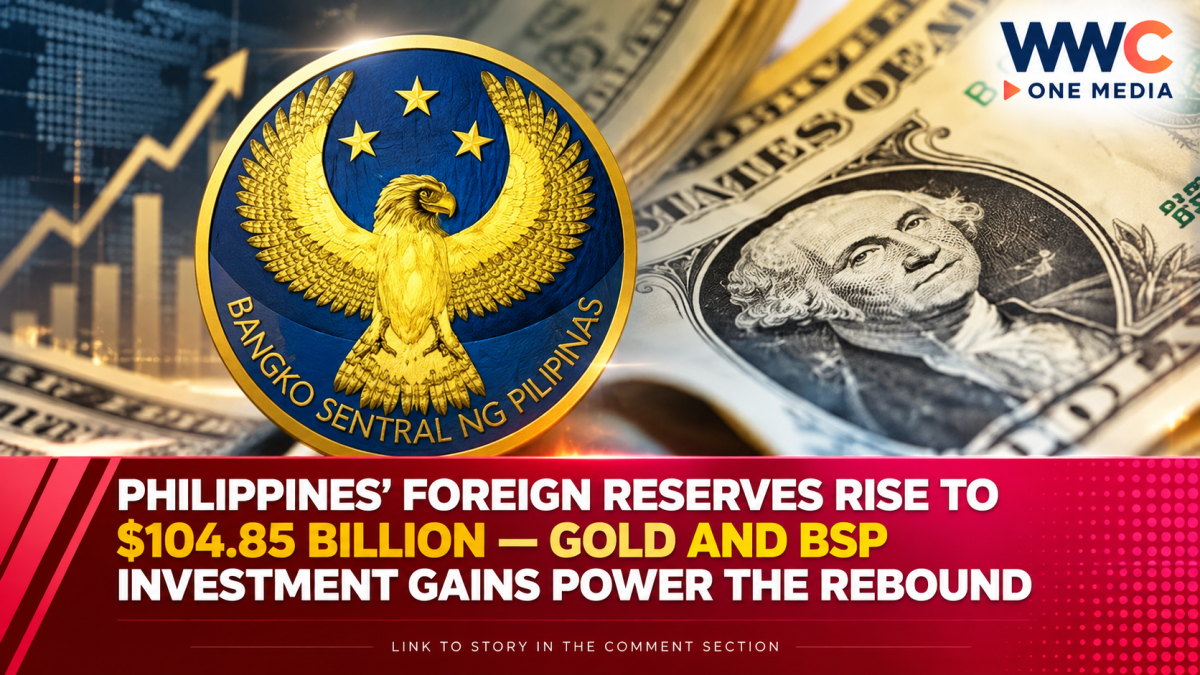
MANILA — The Philippines’ foreign-exchange reserves bounced back to nearly $104.85 billion in August, recovering from a 1½-year low in July as surging gold valuations and earnings from the Bangko Sentral ng Pilipinas’ overseas investments strengthened the country’s external financial buffer.
Preliminary BSP data showed that gross international reserves (GIR) reached $104.8129 billion at the end of August, up from $103.3167 billion in July—a monthly increase of about $1.50 billion, or 1.45%.
The August figure was the highest in five months, or since March, but remained below the $107.098 billion recorded a year earlier.
The latest numbers offer a mixed picture: the country’s reserve cushion remains substantial, but the recovery was driven significantly by the valuation of gold and investment earnings rather than a broad surge in foreign-currency holdings.
Gold is doing much of the heavy lifting
One of the clearest changes in the BSP’s reserve portfolio was gold.
The central bank’s gold holdings rose to approximately $19.11 billion in August from $17.49 billion in July, an increase of about 9.3% in one month. Compared with August 2025, the value of the BSP’s gold holdings was up roughly 31.6%.
The BSP attributed the monthly increase in overall reserves primarily to upward valuation adjustments in its gold holdings as international gold prices increased.
In other words, a significant portion of the reserve increase came from the higher dollar value assigned to gold already held by the central bank.
That distinction matters.
The increase does not mean the Philippines suddenly accumulated $1.5 billion in new cash or foreign currency.
BSP’s foreign investments also generated income
The central bank also reported higher net income from its investments abroad.
The BSP invests part of its international reserves in foreign assets, including highly liquid securities. Those investments generate interest and other income, which can contribute to the growth of the reserve portfolio.
UnionBank chief economist Ruben Carlo Asuncion said the BSP’s reserves include safe foreign assets that generate investment income and can support reserve growth over time.
At the same time, the government was drawing down some of its foreign-currency deposits held with the BSP to service external debt.
Those withdrawals partly offset the gains from gold and investment income.
The surprising jump: “other reserve assets”
The BSP data also show a striking movement in the category called other reserve assets.
Other reserve assets rose from approximately $12.13 billion in July to $15.44 billion in August, an increase of about $3.32 billion.
This is the figure behind the Bilyonaryo headline about the $3.3-billion increase.
But the term “other reserve assets” should not be interpreted as a mysterious new pile of cash.
The BSP defines this category as including items such as overnight investment/repo pools, amounts due from or to brokers, accrued interest receivables, and investments under the Asian Bond Fund and Bank for International Settlements Investment Pool.
So the increase reflects changes in the composition and valuation of the central bank’s reserve assets rather than simply a $3.3-billion deposit into a Philippine dollar account.
Foreign-currency securities moved in the opposite direction
Another major component moved lower.
The BSP’s holdings of foreign-currency securities fell from $67.16 billion in July to $64.02 billion in August, a decline of roughly $3.13 billion.
Currency and deposits also declined from about $1.88 billion to $1.55 billion during the same period.
This shows why looking only at one component can be misleading.
The overall GIR increased because movements across several reserve categories, including gold, securities, deposits and other reserve assets, are consolidated into the country’s total international-reserve position.
How much protection does $104.85 billion provide?
The size of the reserve stock remains significant.
According to the BSP, the end-August GIR was equivalent to about 6.8 months of imports of goods and payments for services and primary income. It was also equivalent to around 3.69 times the country’s short-term external debt based on residual maturity.
The BSP considers reserves adequate by convention when they can finance at least three months of imports.
By that measure, the Philippines’ reserve position remains above the conventional adequacy threshold.
The reserves therefore provide a buffer that can help the country meet foreign-currency obligations and withstand external shocks.
But the reserves are still below last year’s level
Despite the monthly recovery, the bigger year-on-year picture is less dramatic.
The August 2026 GIR of $104.81 billion was about 2.1% lower than the $107.10 billion recorded in August 2025.
It was also well below the $113.26 billion record reached in February 2026.
That means the latest increase represents a recovery from the July low rather than a return to the year’s peak.
Why did reserves fall earlier in the year?
The reserve trajectory in 2026 has been influenced by several factors.
The BSP’s data show GIR reached $113.26 billion in February before falling sharply in March and April.
The decline came amid changes in gold valuations, foreign investment holdings, government foreign-currency transactions and other movements in the reserve portfolio.
Analysts have also pointed to foreign-exchange intervention and external debt payments as factors affecting the reserve position during periods of currency volatility.
RCBC chief economist Michael Ricafort said future reserve movements will depend on global gold prices, structural dollar inflows and the country’s external payments. These include OFW remittances, BPO revenues, tourism receipts and foreign investments on the inflow side, while imports, external debt payments, overseas investments and possible foreign-exchange intervention can pull in the opposite direction.
The Philippines still has a large external buffer
The reserve figure matters because the Philippines relies on foreign currency to pay for imports, service external debt and settle other international obligations.
A stronger reserve position can provide policymakers with additional room to respond to periods of financial-market stress or sharp movements in the peso.
GMA News reported that the BSP considers the current reserve level sufficient to meet import needs, service external debt and provide protection against external economic shocks.
BusinessMirror likewise reported that economists viewed the reserve position as an important source of resilience despite continuing global economic and geopolitical uncertainty.
But reserves alone do not tell the entire economic story
The latest reserve increase should not be interpreted as proof that all external pressures on the Philippine economy have disappeared.
The country’s balance of payments, trade position, foreign investment flows, remittances and external financing all influence the broader external account.
Recent reporting also pointed to continued pressure from the country’s merchandise trade deficit and other external outflows.
That means the direction of the reserves over the coming months will depend on whether dollar-generating inflows can keep pace with the country’s foreign-currency requirements.
OFW remittances remain part of the equation
One of the Philippines’ most important structural sources of foreign exchange is money sent home by overseas Filipino workers.
Remittances provide a recurring source of dollar inflows that can help support the country’s external accounts.
Other important sources include business-process outsourcing revenues, tourism receipts, foreign direct investment and portfolio investment.
But these inflows compete with large foreign-currency requirements arising from imports and external debt payments.
Gold could remain a major swing factor
The latest figures also highlight how important gold prices have become to the BSP’s reserve valuation.
Because the central bank holds a substantial quantity of gold, changes in international gold prices can significantly affect the dollar value of the reserve portfolio even without the BSP purchasing large amounts of additional gold.
The August increase is a clear example.
Gold holdings rose by more than $1.6 billion in value in a single month, helping push total GIR higher.
If global gold prices remain elevated, the valuation component could continue supporting the headline reserve figure.
Conversely, a significant decline in gold prices could reduce the dollar value of the same physical holdings.
What the latest BSP data really say
The latest numbers tell a more nuanced story than simply “Philippine reserves surged.”
The Philippines entered August with reserves of just over $103.3 billion after reaching a 2026 low in July.
By the end of August, the figure had recovered to $104.81 billion.
Gold values rose sharply.
Investment income contributed.
Other reserve assets increased by about $3.32 billion.
At the same time, foreign-currency securities and currency deposits declined, while government withdrawals for external debt service partially offset the gains.
The result is a reserve position that remains comfortably above conventional adequacy benchmarks but is still below the record levels reached earlier in 2026.
The number to watch next
The next question is whether the August rebound can continue.
That will depend on a combination of factors: global gold prices, BSP investment earnings, OFW remittances, BPO and tourism receipts, foreign investment flows, imports, external debt payments and developments in the peso-dollar market.
For now, the $104.85-billion reserve stock gives the Philippines a substantial external liquidity cushion.
But the composition of that cushion—and what happens to gold prices, dollar inflows and foreign-currency obligations next—may prove just as important as the headline number.