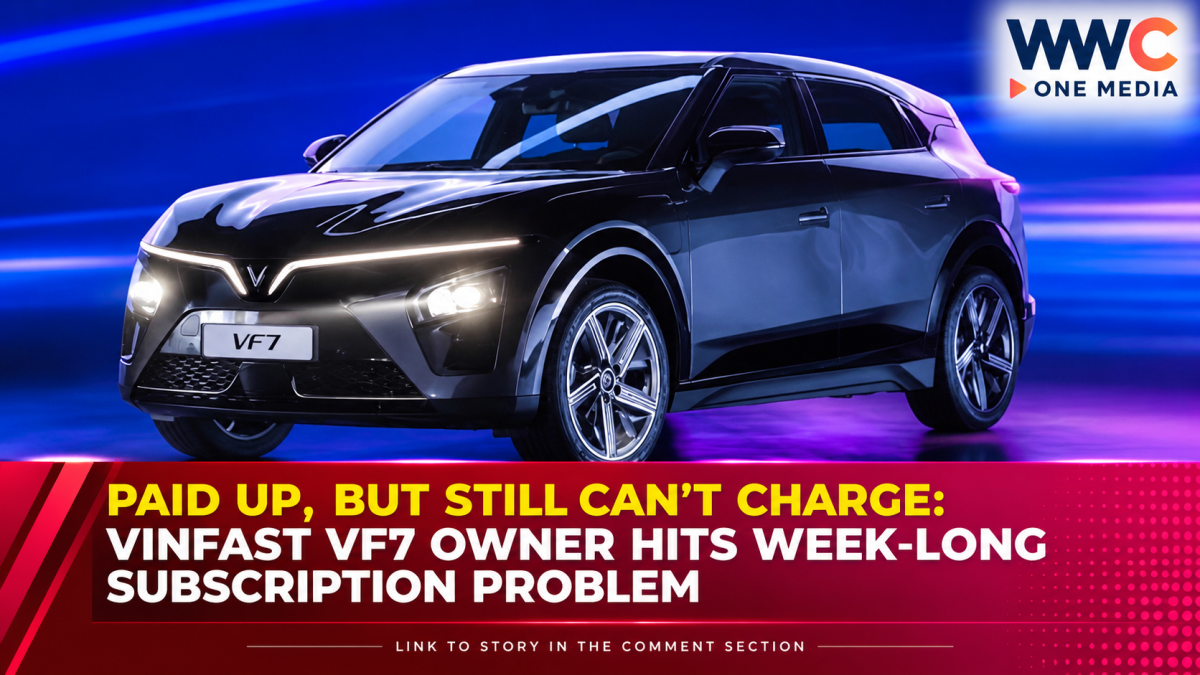
A VinFast VF7 owner says a problem with the electric vehicle’s battery-subscription account left the car unable to charge for at least a week — despite the owner saying payments were made on time.
The complaint has put renewed attention on one of the most distinctive parts of VinFast’s Philippine EV strategy: customers can buy the vehicle at a lower upfront price by subscribing separately to the battery.
For an EV owner, however, a subscription problem is more than a billing inconvenience. If the battery account is not properly activated or recognized, the owner says the vehicle can become effectively unusable.
Owner says VF7 could not charge for a week
In a Facebook post dated September 13, a VinFast VF7 owner using the name Aspen Kurtis said the vehicle had been unable to charge since September 6 because of what the owner described as a subscription issue.
The owner said repeated calls to the dealership had not resolved the problem and claimed payments had been made on time through Maybank.
The owner also said the VinFast application had not been working properly when the vehicle was purchased in May, adding to the frustration over the payment and account issue.
The owner subsequently questioned the purchase, saying that if a subscription problem could leave the vehicle unable to charge for days, a future battery-related problem could potentially create an even longer wait.
Those are the owner’s statements. They do not establish that the VF7 itself had a battery defect or that all VinFast owners are experiencing the same problem.
Another owner reportedly raised a similar concern
The controversy became more significant when another VF7 owner reportedly responded that a separate account had allegedly remained inactive since March despite claimed timely payments.
That owner said proof of payment had repeatedly been sent to a dealer representative and VinFast Philippines but that the account had still not been activated.
The commenter also claimed that official receipts or invoices had not been issued for some payments.
Again, these are individual customer allegations reported by Bilyonaryo, not independently verified findings against VinFast. Bilyonaryo reported that it had sought comment from VinFast Philippines but had not received a response at the time of publication.
Why the subscription matters
VinFast’s battery-subscription model is designed to reduce the initial purchase price of its EVs.
Under the company’s January 2026 Philippine policy, the VF7 Eco was listed at ₱1.43 million with battery subscription compared with ₱1.76 million with the battery included.
The VF7 Plus was listed at ₱1.55 million with the subscription model versus ₱2.38 million with the battery included.
The monthly subscription fees were listed at ₱2,650 for the VF7 Eco and ₱3,350 for the VF7 Plus.
That makes the subscription an important part of the ownership arrangement rather than an optional add-on with little effect on vehicle operation.
VinFast says the subscription includes battery maintenance and repairs and provides battery replacement when capacity falls below 70 percent, subject to the applicable policy.
The trade-off: lower upfront cost, continuing subscription
The model effectively separates the cost of the vehicle from the battery service.
That can make the initial purchase price substantially lower, but it also means owners have an ongoing relationship with the subscription system.
TopGear Philippines reported that VinFast revised its battery-subscription structure for 2026, cutting monthly rates and removing distance limits for most models.
For the VF7, the publication reported the same ₱2,650 and ₱3,350 monthly rates for the Eco and Plus variants respectively, with unlimited travel under the revised structure.
That change was intended to make EV ownership more accessible.
But the latest owner complaint highlights a different question:
What happens when the digital account that links the owner to the subscription does not work as expected?
The VinFast app is part of the ownership ecosystem
VinFast’s official mobile application is designed to handle several vehicle-related functions, including vehicle status, charging status, payment methods and customer support.
The current App Store listing also shows that VinFast has been releasing updates to improve the application, including charging-support requests for users in the Philippines.
The app’s role makes account accuracy particularly important.
A payment may have been made by a customer, but the practical question is whether the payment has been correctly matched to the customer’s account and subscription status.
That distinction is at the heart of the reported complaint.
This is different from a failed battery
It is important not to confuse the reported subscription problem with a mechanical or electrical battery failure.
The information currently available does not establish that the owner’s high-voltage battery was defective.
Instead, the complaint described by Bilyonaryo concerns the subscription/account side of the vehicle’s operation.
That distinction matters because an EV can be mechanically healthy while still encountering a software, account, payment or authorization problem that interferes with access to certain services.
VinFast says its battery program is designed to reduce battery risk
VinFast has promoted the subscription system partly as a way of reducing one of the biggest financial concerns surrounding EV ownership: battery degradation and replacement costs.
Under the company’s Philippine policy, VinFast says it assumes responsibility for battery maintenance and repairs during the subscription period and provides replacement when battery capacity drops below 70 percent.
For customers who instead purchase the vehicle with the battery included, VinFast says its battery warranty can extend to 10 years or 200,000 kilometers, depending on the applicable terms.
So the subscription model is not simply a financing gimmick. It changes how the customer interacts with the battery throughout ownership.
Charging access is becoming a bigger part of VinFast’s Philippine strategy
VinFast has also been expanding its charging ecosystem in the Philippines.
Automotive publication ZigWheels reported that VinFast customers could charge at V-Green stations for free under the company’s then-current promotional program, with the program subsequently extended during 2026.
The company has also been developing its broader EV ecosystem rather than relying solely on home charging.
That makes service-account reliability increasingly important as more functions move into digital platforms.
The bigger challenge for EV brands: after-sales support
The reported VF7 complaint touches on an issue extending beyond one vehicle.
For conventional gasoline cars, a payment problem generally does not prevent the engine from accepting fuel.
For EVs operating under subscription-based ownership models, however, the customer may have separate relationships involving:
- The vehicle
- The battery
- The subscription account
- Charging services
- Mobile applications
- Payment systems
- Dealership support
- Charging-network operators
When those systems work together, the model can offer a lower upfront cost and potentially reduce battery-replacement risk.
When one link fails, the customer’s experience can become considerably more complicated.
The complaint does not establish a wider VinFast failure
There is currently no evidence in the material reviewed that the reported incident represents a systemic failure affecting all Philippine VF7 owners.
The complaint involves individual customers who say their subscription accounts or payments were not properly reflected.
It is also important to distinguish a customer-service complaint from a safety defect.
No evidence in the available reports establishes that the VF7 is unsafe to drive or that its battery system has a widespread defect.
The issue reported here is primarily about subscription activation, payment recognition and customer support.
What VinFast owners and buyers should clarify
For consumers considering a VinFast EV under the battery-subscription model, the episode highlights several practical questions worth asking before signing a contract.
Buyers should understand:
How quickly are subscription payments reflected in the account?
What happens if a payment is made but the system does not recognize it?
What documentation proves that the subscription is active?
What is the procedure for escalating an account problem?
Can the vehicle still be charged if the subscription system is temporarily unavailable?
How quickly can a dealer or VinFast Philippines restore the service?
And perhaps most importantly:
Who is responsible when the payment has been made but the digital system says otherwise?
These questions are particularly relevant for consumers choosing the subscription model precisely because the battery is not included in the vehicle’s upfront purchase price.
A growing EV market means customer support will matter more
The Philippines is seeing a wider range of battery-electric vehicles enter the market, with automakers competing not only on vehicle price but also on charging infrastructure, warranties, financing and ownership models.
VinFast is taking an unusually aggressive approach by combining lower upfront prices with battery subscriptions.
The company has said the policy can reduce the initial investment by up to approximately 20 percent depending on the model.
That strategy could make EVs more accessible to some buyers.
But the reported VF7 experience illustrates the other side of the equation: a lower entry price does not eliminate the need for reliable billing systems and responsive after-sales support.
For EV owners, being unable to charge is not comparable to waiting for a routine dealership appointment.
Charging is fundamental to using the vehicle.
The unanswered question
The reported incident now leaves one major question hanging over the case:
If the owner can demonstrate that the subscription payments were made on time, why did the system still prevent charging — and how quickly can VinFast resolve the underlying account problem?
VinFast Philippines had not publicly responded to the specific allegations in the Bilyonaryo report at the time of publication.
Until the company provides its account of what happened, it would be premature to conclude that the incident reflects a broader technical defect or systemic problem.
But for prospective buyers, the complaint provides a timely reminder that an EV purchase under a battery-subscription model involves more than choosing the car.
It also means trusting the subscription, payment, software and after-sales systems behind it.
And for a vehicle that cannot charge when those systems fail, that distinction can suddenly become very expensive.