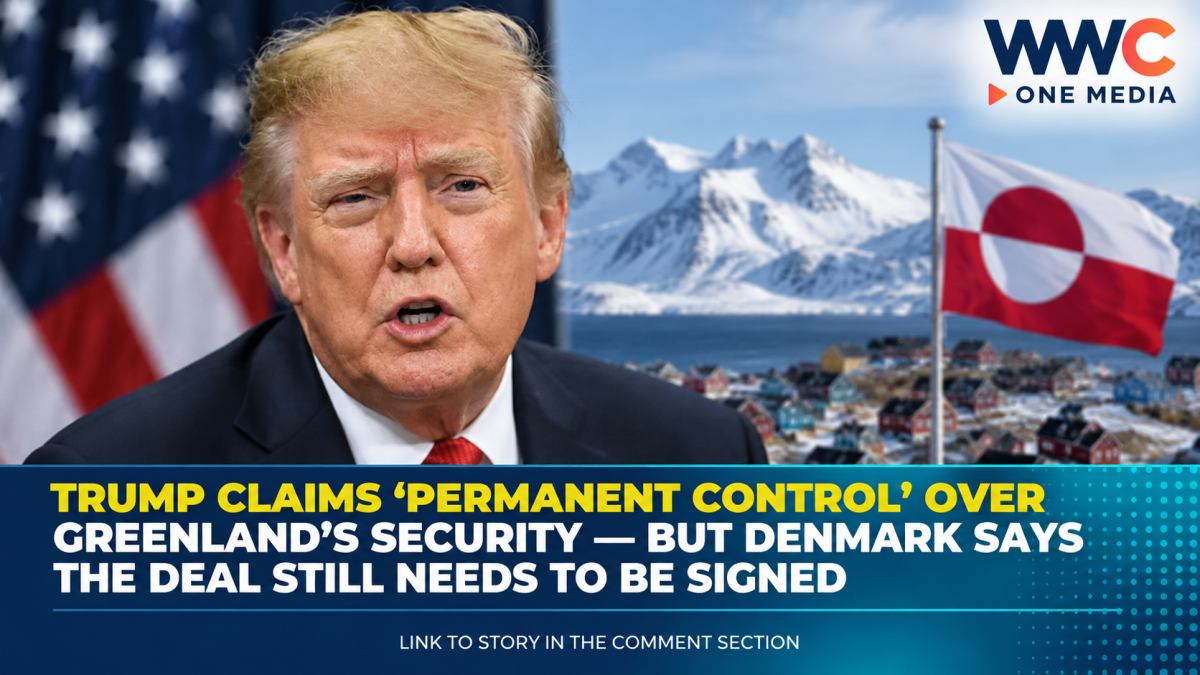
WASHINGTON — President Donald Trump says the United States has reached a sweeping new security agreement with Denmark and Greenland that would give Washington permanent control over Greenland’s security, dramatically expanding the U.S. military role on the strategically important Arctic island.
But the announcement comes with an important qualification: the full agreement has not yet been publicly released, and Danish and Greenlandic officials said they expect the formal document to be signed next week during the United Nations General Assembly in New York.
The emerging arrangement falls well short of Trump’s previous ambition to acquire Greenland outright.
Instead, the deal centers on security, military access and preventing non-NATO adversaries from establishing a strategic foothold on the island.
For Denmark and Greenland, officials have emphasized that the arrangement recognizes Danish sovereignty and Greenlanders’ right to self-determination.
Trump says America will have permanent security control
Trump announced the agreement Friday in a post on Truth Social.
He said representatives of the United States, Denmark and Greenland had worked together to ensure that Washington would have the ability to take whatever measures it considers necessary to protect Greenland and U.S. security.
Trump also said the United States would immediately begin the process of developing a larger military presence on the island.
The president described the arrangement as a major resolution of U.S. security concerns surrounding Greenland.
But the wording of the announcement is broader than the details that have so far been made public.
That gap is significant because the precise legal and operational scope of the agreement remains unclear.
Greenland is not becoming U.S. territory
Despite Trump’s description of “permanent control,” the agreement does not mean Greenland is being transferred to the United States.
Greenland remains an autonomous territory within the Kingdom of Denmark.
Danish Prime Minister Mette Frederiksen said the prospective agreement recognizes the kingdom’s sovereignty and territorial integrity, while also respecting the Greenlandic people’s right to self-determination.
Greenland’s Prime Minister Jens-Frederik Nielsen likewise welcomed the agreement’s recognition of Greenland’s interests and its position in international cooperation.
That makes the latest development fundamentally different from Trump’s earlier calls for the United States to acquire Greenland.
The original U.S. goal was much bigger
Trump has repeatedly argued that Greenland is important to U.S. national security because of its location in the Arctic and its proximity to North America and the North Atlantic.
His administration previously explored ways to increase American control over the island and, at various points, Trump raised the possibility of acquiring Greenland.
Those statements created significant tensions with Denmark, a long-standing U.S. NATO ally.
Trump’s earlier rhetoric even raised concerns in Europe about whether Washington could attempt to use force to take territory belonging to another NATO member.
The emerging agreement represents a very different route: expanded American security access without a transfer of sovereignty.
What the United States would actually gain
According to a U.S. State Department official cited by Reuters and CBS News, the agreement would provide Washington with permanent access, basing and overflight rights in Greenland.
The arrangement would also prevent non-NATO countries from establishing military bases or sending troops to the island.
It would place restrictions on sensitive investments by U.S. adversaries.
The details matter because Greenland already hosts an important U.S. military installation.
The United States operates the Pituffik Space Base, formerly known as Thule Air Base, in northwestern Greenland.
The base supports missile warning, missile defense and space surveillance missions and occupies a strategically important position in the Arctic.
The new agreement could provide a framework for expanding America’s military footprint beyond its existing presence.
China and Russia are at the center of the security debate
The agreement is also closely connected to concerns about China and Russia.
The U.S. has increasingly viewed the Arctic as a strategic competition zone.
Russia maintains extensive military infrastructure across its Arctic territory, while China has sought greater economic and scientific engagement in the region.
The proposed arrangement would prevent non-NATO adversaries from establishing military bases in Greenland.
U.S. officials have also said the agreement creates mechanisms to prevent sensitive investments by countries considered security threats.
That gives the agreement an economic dimension as well as a military one.
Greenland possesses significant mineral resources, including deposits of materials considered strategically important for modern technology and defense.
Golden Dome could be part of the equation
Reuters reported before Trump’s announcement that negotiators had discussed arrangements allowing Greenlandic territory to support the administration’s planned Golden Dome missile-defense system.
Sources told Reuters that discussions also involved limiting Chinese influence on the island.
The precise role Greenland could play in Golden Dome has not been fully disclosed.
But its geographic position makes the island potentially valuable for radar, sensors, missile-warning infrastructure and other elements of a North American missile-defense architecture.
That could make Greenland an increasingly important component of U.S. Arctic defense planning.
The U.S. already had extensive military rights
The new agreement should not be interpreted as America suddenly receiving its first military access to Greenland.
The United States and Denmark have maintained extensive defense arrangements for decades.
A 1951 defense agreement already provides the United States with substantial military access and basing rights in Greenland.
Reuters reported that the existing arrangement gives Washington extensive overflight and basing rights.
The significance of the new deal therefore lies in potentially expanding and making more explicit those rights, particularly in relation to future military infrastructure and strategic investments.
Denmark says the deal is good for NATO
Danish officials have framed the agreement as a security arrangement rather than a concession of sovereignty.
Frederiksen said the agreement would strengthen security in the Arctic and North Atlantic and therefore benefit NATO and Europe.
That framing is important because Denmark is itself a NATO member and Greenland sits at a strategic crossroads between North America and Europe.
A stronger U.S. military presence could therefore be presented as part of broader alliance defense rather than simply an expansion of American territorial influence.
Greenland’s position remains crucial
Greenland has its own government and parliament but remains part of the Kingdom of Denmark.
The island’s population has long had aspirations for greater autonomy and eventual independence.
That makes Greenlandic consent particularly important to any long-term security arrangement.
The Danish and Greenlandic governments said the proposed agreement recognizes Greenland’s interests and right to self-determination.
The fact that the agreement is expected to be formally signed next week also means the current announcement should be viewed as a political and diplomatic breakthrough rather than the final word on every provision.
The full terms remain unclear
Several major questions remain unanswered.
Among them:
- How many additional U.S. military facilities could be established?
- Where would those facilities be located?
- Who would finance their construction?
- What approval would Greenland and Denmark retain over new bases?
- How would sensitive investments be defined?
- What mechanisms would prevent prohibited foreign activity?
- How would the agreement operate if Greenland eventually becomes independent?
A U.S. State Department official told Reuters that the arrangement would continue even if Greenland eventually became an independent country.
That could become one of the most consequential provisions if Greenland’s constitutional status changes in the future.
Greenland’s independence question complicates everything
Greenland’s relationship with Denmark has been evolving for decades.
The island has extensive self-government and controls many domestic affairs, while Denmark retains responsibility for areas including foreign affairs and defense.
The possibility of eventual independence remains part of Greenland’s political landscape.
That means a security agreement designed to last indefinitely would have to account for a potential future in which Greenland is no longer part of the Danish kingdom.
According to U.S. officials cited by Reuters and CBS, the proposed arrangement is designed to continue even under that scenario.
Trump says there will be no cost to the U.S.
Trump has also said the agreement would not cost the United States money.
The Washington Post noted that he did not explain how that would work.
That leaves an important financial question unanswered.
Expanding military infrastructure in Greenland would potentially involve construction, logistics, transportation, personnel and long-term maintenance.
The eventual agreement and subsequent U.S. defense plans would need to clarify how those costs are allocated.
Why Greenland matters so much
Greenland is the world’s largest island and occupies an extraordinary geographic position.
It sits between North America and Europe and near major Arctic shipping and air routes.
Its location also provides a strategic vantage point for monitoring activity across the Arctic and North Atlantic.
As climate change opens more of the Arctic to economic and military activity, the region has become increasingly important to major powers.
That has increased the strategic value of Greenland.
The deal follows months of diplomatic tension
The announcement marks a dramatic change from the atmosphere earlier this year.
Trump’s campaign for greater control over Greenland triggered strong reactions in Denmark and Greenland.
Danish and Greenlandic leaders repeatedly said the island was not for sale.
The possibility of a forced acquisition generated concern among other European governments and NATO allies.
The emerging security arrangement allows all three sides to present the outcome differently:
Washington gets greater military access and strategic assurances.
Denmark retains sovereignty over Greenland.
Greenland’s self-determination is formally recognized.
Whether that balance holds in practice will depend heavily on the agreement’s final terms.
What happens next?
The Danish and Greenlandic governments said they expect the United States, Denmark and Greenland to sign the agreement next week on the sidelines of the United Nations General Assembly in New York.
Until the formal document is released, many of the most important details remain unknown.
Trump has described the arrangement as giving America permanent control over Greenland’s security.
Denmark describes it as a prospective agreement that strengthens Arctic and North Atlantic security while respecting sovereignty.
Greenland has emphasized its interests and role in international cooperation.
Those descriptions overlap — but they are not identical.
The next stage will therefore be watching the actual text of the agreement.
Does “permanent control” mean expanded access and military rights, or something broader? How much authority will Greenland and Denmark retain over future U.S. deployments? And what happens if Greenland eventually becomes independent?
Those questions could determine whether Trump’s Greenland deal becomes a lasting Arctic security framework — or merely the opening chapter of another dispute over who controls one of the world’s most strategically important islands.