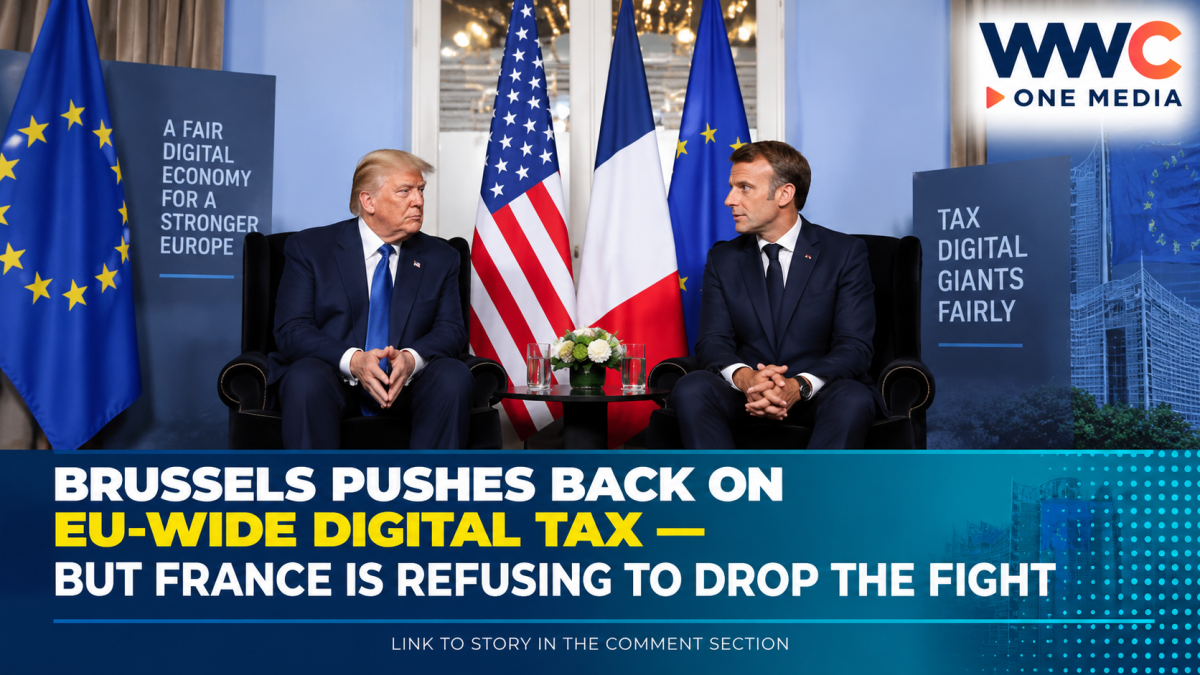
BRUSSELS — Europe’s plan to make major technology companies pay more tax has hit another political roadblock.
EU tax commissioner Wopke Hoekstra has rejected calls for Brussels to immediately introduce an EU-wide digital services tax on technology giants such as Amazon, Google and Meta, arguing that the bloc should first exhaust efforts to reach a global agreement.
The decision comes as France pushes for a European-wide digital levy, saying the measure could generate substantial revenue for the EU and reduce the financial burden on European taxpayers.
But there is a much bigger issue hanging over the debate:
Any EU-wide digital tax could reignite a trade confrontation with the United States.
Europe wants Big Tech to pay more
The dispute centers on a basic problem in the modern tax system.
Traditional corporate taxation generally relies heavily on where a company has a physical presence.
Digital businesses can generate enormous revenues from customers in countries where they have relatively little physical infrastructure.
That has prompted governments around the world to seek new ways of taxing multinational technology companies.
The OECD and G20 spent years developing a multilateral framework intended to address precisely this problem.
But implementation of the agreement has stalled.
The European Parliament’s research service says the OECD/G20 Pillar One agreement reached political consensus in 2021 but has not yet been implemented, increasing pressure for alternative measures.
That stalemate is now putting Brussels under pressure to act.
Hoekstra says the global route should come first
Hoekstra, the European commissioner responsible for taxation, told the Financial Times that the EU should not immediately abandon the international approach.
His position is that Europe should first determine whether the OECD process can still deliver a workable global system.
Only if that route fails should Brussels move toward an EU-level solution.
The logic is straightforward: a global tax framework would reduce the risk of different countries imposing different rules on the same multinational companies.
Hoekstra has described the global approach as the preferred option, while acknowledging that an EU-wide solution could become necessary if international negotiations ultimately fail.
France wants Brussels to move faster
France takes a different view.
Paris has renewed its call for an EU-wide digital services tax, arguing that a common European system could raise revenue while preventing individual countries from facing U.S. retaliation alone.
France is not starting from scratch.
France, Italy, Spain and Austria already have national digital services taxes, according to the Financial Times and other reporting.
Those national measures have already attracted scrutiny from Washington.
France’s argument is that a single EU framework could put the bloc in a stronger position than a collection of individual national taxes.
It could also create a new source of revenue at a time when EU governments are debating how to finance future spending.
The potential revenue is significant — but disputed
European Commission analysis cited by the Financial Times estimates that an EU-wide digital services tax could raise roughly €5 billion a year, depending on how the tax is designed.
That would not transform the EU’s overall finances, but it would represent a meaningful additional revenue stream for the bloc.
The European Parliament has been examining the possibility of using a digital levy as an EU “own resource”, meaning revenue that could help finance the EU budget directly.
However, estimates vary considerably depending on the tax’s structure.
A June European Parliament workshop cited by KPMG examined scenarios involving substantially broader digital taxation and noted that revenue estimates are highly dependent on which services, companies and rates are included.
So the €5 billion figure should be viewed as an estimate rather than a guaranteed annual windfall.
Washington has already issued a major warning
The biggest obstacle may not be inside Europe.
It may be across the Atlantic.
In June, President Donald Trump threatened a 100% tariff on goods from countries that impose digital services taxes on U.S. companies.
Trump said such tariffs could override existing trade agreements.
The warning dramatically increased the potential cost of unilateral European action.
That threat matters because the EU and U.S. have already spent considerable political capital negotiating their broader trade relationship.
A new dispute over digital taxation could therefore spill into unrelated areas such as industrial goods, automobiles, agriculture and technology.
Why the U.S. objects to digital services taxes
Washington has argued that digital services taxes disproportionately affect American technology companies.
The United States has previously launched Section 301 investigations into digital services taxes adopted or considered by several countries.
The U.S. Trade Representative maintains a dedicated Section 301 process concerning digital services taxes.
European governments, meanwhile, argue that the taxes are designed to address a structural problem in international taxation rather than specifically target American companies.
That disagreement is at the heart of the transatlantic dispute.
Europe already has a patchwork of digital taxes
One reason Brussels wants to examine a common approach is the growing patchwork of national systems.
France introduced its digital services tax before the current EU-wide debate.
Italy, Spain and Austria have also adopted national measures.
Other countries have considered similar policies at various points.
The result is a complicated international tax environment in which the same multinational company can face different rules in different jurisdictions.
A unified European approach could theoretically reduce that fragmentation.
But it could also concentrate the political conflict with Washington at the EU level.
The OECD’s Pillar One was supposed to solve the problem
The current debate cannot be understood without Pillar One.
The OECD/G20 framework was designed to update international taxation for an economy in which companies can generate substantial revenues in markets without maintaining traditional physical establishments there.
The proposed system would redistribute some taxing rights toward the jurisdictions where multinational companies generate revenue.
More than 130 jurisdictions participated in the original international agreement.
But implementation has remained incomplete.
The European Parliament says the lack of progress has increased pressure for countries and regional blocs to consider alternative measures.
That is why Hoekstra’s position is particularly important.
He is not arguing that digital companies should never face additional taxation.
He is arguing that Europe should give the multilateral framework more time before moving unilaterally.
The OECD says negotiations are still alive
The OECD has not declared the global process dead.
OECD tax director Manal Corwin said discussions remain ongoing and described countries as having a strong interest in reaching a multilateral solution.
The organization argues that a coordinated approach can reduce fragmentation and create greater certainty for companies and governments.
G7 finance ministers also asked the OECD to report on progress toward a common approach to taxing the digital economy by the end of December.
That creates an important deadline.
Europe now has to decide whether the international process has enough momentum to justify waiting.
Brussels could still act later this year
Hoekstra told the FT that an EU-level decision would likely have to be made around the end of 2026.
That means Friday’s position should not be interpreted as the permanent rejection of a European digital tax.
It is more accurately described as a decision to delay a unilateral EU approach while international negotiations continue.
If the OECD process fails to produce a workable solution, pressure for Brussels to act could increase significantly.
France is already preparing the political ground for that possibility.
The EU’s budget problem adds pressure
The digital tax debate is also tied to a much bigger question:
How will the European Union finance its future priorities?
EU governments are discussing the bloc’s next long-term budget and potential new sources of revenue.
A digital levy is one of several possibilities being considered.
European countries have also discussed other potential EU-level revenue sources, including taxes related to online gambling, cryptocurrency and other activities.
That means the digital tax debate isn’t solely about Google, Amazon or Meta.
It is also about how much financial independence Brussels wants to build into the EU budget.
There is no guarantee consumers would escape the cost
Another unresolved question is who ultimately bears the economic cost of a digital services tax.
Although the tax would be imposed on large digital businesses, companies can respond by changing prices, investment strategies, business structures or the way services are offered.
European Parliament and KPMG analyses have highlighted concerns about potential pass-through of costs to businesses and consumers, as well as possible effects on competitiveness and innovation.
That makes the design of the tax critical.
A levy aimed at the world’s biggest technology companies could have very different consequences depending on whether it is applied to advertising, digital marketplaces, online services or other forms of revenue.
The political calculation is getting harder
Europe therefore faces competing pressures.
On one side:
- France wants an EU-wide digital tax.
- The European Parliament has supported exploring new EU revenue sources.
- The EU needs additional budget resources.
- The OECD process has stalled.
- National digital taxes already exist in several member states.
On the other:
- The U.S. opposes measures it views as discriminatory against American companies.
- Washington has threatened severe tariffs.
- EU officials want to preserve a global tax framework.
- A unilateral European tax could worsen transatlantic trade tensions.
The decision is therefore not simply about taxation.
It is also about trade, sovereignty and Europe’s relationship with the United States.
Big Tech is caught in the middle
For companies such as Google, Amazon and Meta, the uncertainty means Europe’s tax environment could become more complicated.
A coordinated international system could create one set of rules.
A collection of national taxes creates fragmentation.
An EU-wide levy would eliminate some of that fragmentation but potentially trigger a larger confrontation with Washington.
The companies are therefore watching not only Brussels but also Paris, Washington and the OECD.
What happens next?
The immediate answer is: wait and negotiate.
Hoekstra wants the OECD process to be given additional time.
France wants Brussels to prepare an alternative.
The OECD is continuing discussions.
And Washington has already demonstrated that it is willing to use tariffs as leverage.
A decision is expected around the end of the year.
If international negotiations produce a breakthrough, the EU could continue pursuing a global solution.
If they fail, the political argument for a European-wide tax could become substantially stronger.
That leaves Europe facing a potentially explosive choice:
Tax Big Tech together and risk another fight with Washington — or keep waiting for a global deal that has already taken years to materialize?
For now, Brussels is choosing the second path.
But the clock is ticking, France is pushing for action, and the U.S. has already shown what it could do if Europe moves first.
The next few months could determine whether Europe’s digital-tax debate ends in a global compromise — or becomes the next major front in the transatlantic trade war.