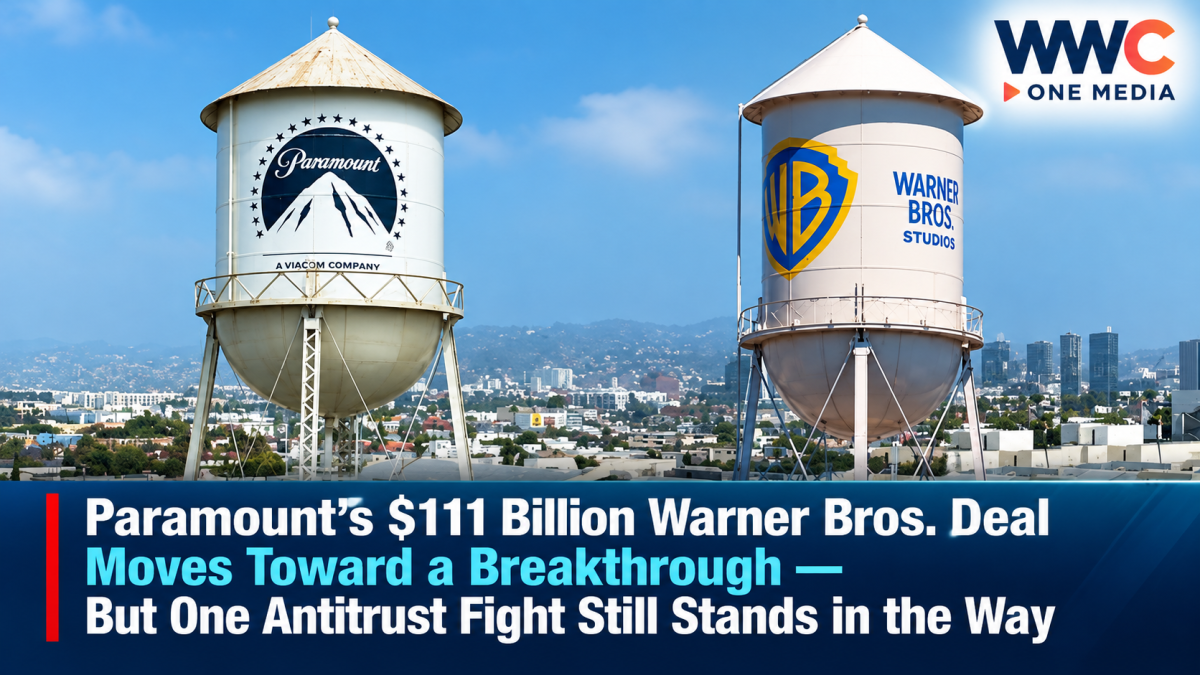
Paramount Skydance and a coalition of U.S. states are moving closer to a possible settlement that could resolve the antitrust lawsuit blocking Paramount’s proposed $111 billion acquisition of Warner Bros. Discovery.
The negotiations, led in part by California Attorney General Rob Bonta, could potentially clear a major obstacle to one of Hollywood’s biggest proposed mergers in decades.
But the deal is not yet cleared.
People familiar with the discussions told the Financial Times that negotiations have progressed rapidly, although the talks could still collapse. Reuters separately reported that Paramount and the states were discussing possible settlement terms, including measures involving CNN and theatrical film releases.
The stakes are enormous: the transaction would bring Paramount Pictures and Warner Bros. Pictures under the same corporate umbrella while combining major television networks, streaming platforms and some of the entertainment industry’s most valuable franchises.
Why the $111 billion deal is in trouble
Paramount Skydance agreed to acquire Warner Bros. Discovery for approximately $110 billion to $111 billion, depending on how the transaction value is calculated.
But in July, California and 11 other states sued to block the transaction under U.S. antitrust law.
The states argue that combining Paramount and Warner Bros. would reduce competition in major areas of the entertainment industry.
Court records describe the proposed transaction as a combination of two of the remaining five major Hollywood film studios, while also bringing together large portfolios of cable television networks and streaming services.
The Writers Guild of America has also challenged the transaction, raising concerns about its potential effects on workers and competition in the entertainment industry.
The litigation effectively prevented Paramount and Warner Bros. Discovery from completing the transaction while the legal challenge proceeds.
California is at the center of the negotiations
California Attorney General Rob Bonta has emerged as the central state official in the settlement discussions.
The coalition of 12 states is led by California, making any agreement involving Bonta potentially important to resolving the broader state challenge.
The Financial Times reported that settlement talks could produce an agreement within weeks, although people familiar with the matter cautioned that negotiations could still fail.
Bonta previously said he was open to settlement discussions if they were conducted in good faith, while maintaining the state’s legal position against the merger.
TheWrap reported that Paramount, Bonta’s office and the Writers Guild of America had also been scheduled for settlement discussions as part of the court process, ahead of a trial currently slated for March.
Paramount is under a serious financial deadline
Time is becoming an important factor for Paramount.
Under the transaction agreement, Paramount faces a $7 million-per-day payment obligation to Warner Bros. Discovery shareholders if the deal remains uncompleted beyond September 30.
Paramount has argued that the prolonged litigation could result in hundreds of millions of dollars in additional costs.
Reuters reported that the company could face roughly $650 million per quarter in such payments if the transaction remains delayed.
That creates a powerful incentive for Paramount to resolve the legal dispute before the financial burden grows substantially.
The Justice Department is no longer blocking the merger
An important piece of context is that the U.S. Department of Justice has already completed its own antitrust investigation.
In June, the DOJ’s Antitrust Division said it had concluded its investigation and determined that the transaction was not likely to harm competition or American consumers in areas including streaming video, linear television and theatrical film production and distribution.
That decision does not automatically eliminate the states’ lawsuit.
The states are pursuing their own antitrust challenge in federal court.
This means the merger can have cleared one major federal regulatory hurdle while still facing litigation brought by state attorneys general.
The FCC has also approved an important part of the transaction
The U.S. Federal Communications Commission recently approved the foreign-investment structure associated with the proposed merger.
Reuters reported that the FCC approved foreign ownership interests involving Middle Eastern sovereign wealth funds, while imposing restrictions intended to prevent those investors from exercising voting control or influencing Paramount’s U.S. operations and content decisions.
The FCC action removes another regulatory issue, but it does not resolve the state antitrust lawsuit.
That leaves the litigation as one of the major remaining obstacles to closing.
What are the states worried about?
The states’ central argument is competition.
The proposed combination would unite two major Hollywood studios and a large collection of television and streaming assets.
The court record describes the potential combined company as controlling:
- Paramount Pictures
- Warner Bros. Pictures
- CBS
- CNN
- HBO
- HBO Max
- Paramount+
- Discovery+
- Numerous cable networks
- Multiple television production studios
The states argue that combining these businesses could reduce competition and give the resulting company greater leverage in film and television markets.
Paramount has disputed the states’ case and argued in court filings that the antitrust claims do not withstand scrutiny. Variety reported that Paramount’s lawyers have challenged the allegations in their legal response.
Paramount has proposed commitments to address concerns
One possible route toward settlement involves commitments governing how the combined company would operate.
Reuters reported that negotiations have included discussions about independent monitoring of CNN and a commitment to maintain a minimum level of theatrical film releases.
Paramount CEO David Ellison has publicly committed to releasing 30 theatrical films a year, a proposal intended in part to address concerns about the future of movie theaters and theatrical distribution.
But California officials have reportedly pushed for stronger measures.
The Financial Times reported that Bonta has resisted relying solely on behavioral commitments and has sought more substantial remedies, potentially including asset sales.
That difference could become one of the most difficult issues in the negotiations.
Why asset sales would be a much bigger deal
There is a major difference between promising to behave differently and actually selling businesses.
A behavioral remedy could require the combined company to follow specific rules after the merger.
A structural remedy, such as selling a television network, studio operation or other asset, would permanently change the composition of the merged company.
For Paramount, that could reduce the strategic value of the acquisition.
For regulators, however, divestitures can address competition concerns more directly because they remove overlapping assets from the combined company.
The negotiations therefore involve more than simply deciding whether Paramount can buy Warner Bros. Discovery.
They also concern what the resulting company would look like if the merger is allowed to proceed.
Paramount has also threatened to move its headquarters
The legal battle has spilled beyond the courtroom.
Paramount executives have threatened to relocate the company’s headquarters out of California if the dispute prevents the transaction from closing.
The Financial Times reported that the relocation threat has increased pressure on California officials as the September 30 financial deadline approaches.
The issue is particularly sensitive because Paramount is deeply connected to California’s entertainment industry and employs thousands of people in the state.
California officials, including Governor Gavin Newsom and Los Angeles Mayor Karen Bass, have pushed for an outcome that protects jobs and keeps Paramount’s operations in the state.
Hollywood could be transformed by the merger
If completed, the acquisition would dramatically reshape the entertainment landscape.
Paramount would gain control of major Warner Bros. franchises, including Harry Potter and DC, as well as Warner’s film and television operations.
It would also gain major cable networks and streaming businesses, including HBO Max.
The resulting company would be positioned as a much larger competitor to entertainment giants such as Netflix and Disney. Reuters reported that the transaction would combine major film, television, streaming and sports assets.
That scale is precisely why the antitrust case has attracted so much attention.
The deal has already cleared numerous jurisdictions
The U.S. state lawsuit is not the only regulatory process surrounding the transaction.
The Financial Times reported that the deal has received regulatory approval in nearly 70 jurisdictions, including the United Kingdom and Mexico.
The U.S. Justice Department has also completed its antitrust investigation without seeking to block the transaction.
The FCC has separately approved the foreign-investment component.
But the state litigation remains significant because a court injunction could prevent Paramount from closing the deal even after other regulators have approved it.
Warner Bros. shareholders have already approved the transaction
Warner Bros. Discovery shareholders previously approved Paramount’s acquisition proposal.
The transaction was structured at approximately $31 per Warner Bros. Discovery share, according to court records.
That approval cleared an important corporate hurdle.
But shareholder approval does not override antitrust law.
The transaction still needs to satisfy the remaining legal requirements before Paramount can fully integrate Warner Bros. Discovery.
The trial is still looming
If the settlement talks fail, the antitrust case is expected to continue toward trial.
The current schedule places the trial in March 2027, according to court and industry reporting.
That creates a difficult timeline for Paramount.
Waiting for a full trial could mean months of additional uncertainty and potentially hundreds of millions of dollars in additional transaction-related payments.
A settlement could accelerate the closing process.
But any agreement would still need to satisfy the relevant legal and court requirements.
What the possible settlement could mean
If Paramount and the states reach an agreement, several things could happen.
The states could agree to withdraw or resolve their legal challenge in exchange for enforceable commitments.
Paramount could accept restrictions involving film releases, CNN oversight or other operations.
The parties could potentially negotiate structural remedies involving asset sales.
Or the negotiations could fail, sending the dispute back toward the scheduled trial.
At this point, none of those outcomes is final.
The Financial Times specifically reported that the talks could still collapse.
Why the next few weeks matter
The combination of legal deadlines and financial penalties has created an unusually tight window.
Paramount wants the transaction completed.
The states want remedies addressing their competition concerns.
Warner Bros. Discovery shareholders are waiting for the acquisition to close.
Hollywood workers and unions are watching the potential impact on employment and production.
And California officials are weighing the implications for one of the state’s most important entertainment companies.
The proposed merger therefore sits at the intersection of antitrust law, Hollywood economics, streaming competition, labor, corporate finance and California’s entertainment industry.
The $111 billion question
For now, Paramount and the states appear to be searching for a compromise that could prevent the legal battle from reaching a full trial.
But a settlement is not guaranteed.
The biggest unresolved question is what concessions Paramount would have to make to satisfy the states without undermining the economic rationale for acquiring Warner Bros. Discovery.
The difference between a simple behavioral agreement and substantial asset sales could determine whether negotiations succeed.
The $111 billion Hollywood merger may be closer to a path forward, but the final shape of the deal could depend on what Paramount is willing to give up to get Warner Bros. Discovery across the finish line.