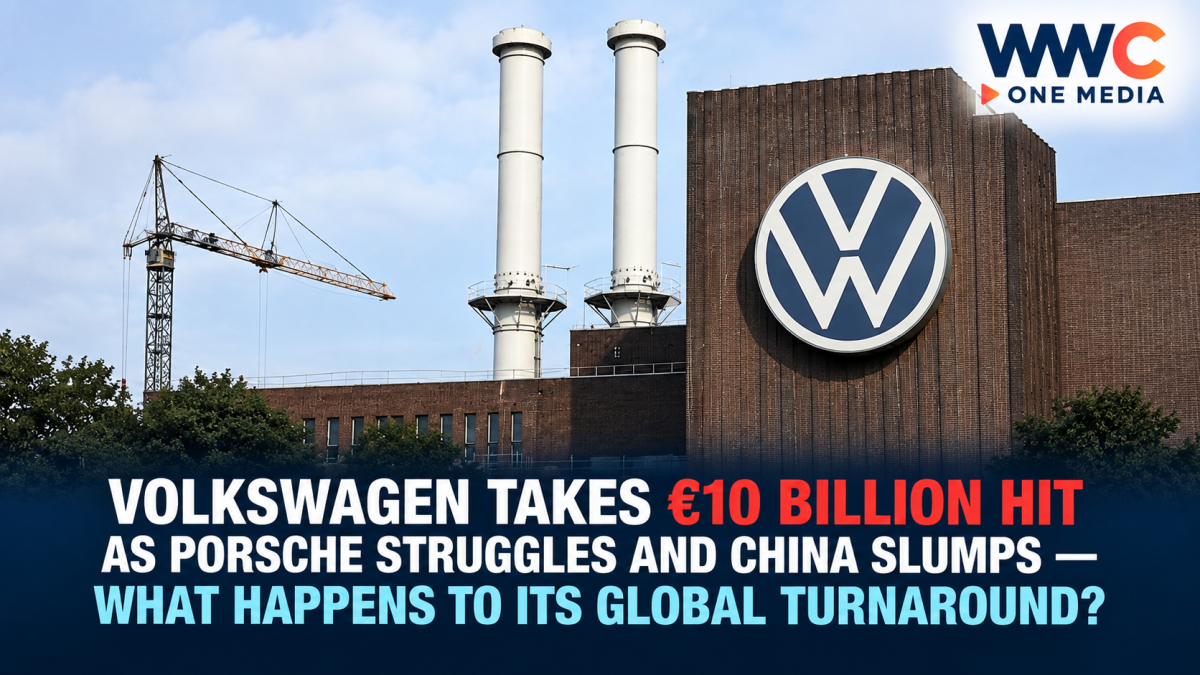
Volkswagen has dramatically cut its 2026 profit outlook after warning that a combination of a major Porsche write-down, worsening conditions in China and rising restructuring costs could produce as much as €10 billion ($11.5 billion) in one-off charges.
The announcement sent Volkswagen shares sharply lower, with the stock falling as much as 7% during Friday trading and ultimately closing down about 5.6%, according to Reuters.
The latest warning adds another layer of pressure to Europe’s largest carmaker, which is already undertaking one of the biggest restructuring programs in its history while facing intensifying competition from Chinese electric-vehicle manufacturers, U.S. tariffs and weak demand in key markets.
Volkswagen slashes its profit-margin forecast
The most immediate shock is the change to Volkswagen’s 2026 profitability guidance.
The company now expects an operating return on sales of no more than 1%, down dramatically from its previous forecast of 4% to 5.5%.
For a company of Volkswagen’s scale, the difference is enormous.
It means that after operating costs, the group expects to retain only around €1 for every €100 of revenue as operating profit, before considering the effects of financing, taxes and other items.
Reuters reported that the downgrade reflects a combination of the Porsche impairment, additional restructuring charges and deterioration in the Chinese market.
The Porsche problem alone accounts for €6 billion
One of the biggest components of the hit is a €6 billion non-cash impairment related to Volkswagen’s stake in Porsche.
Volkswagen owns a controlling stake in Porsche AG, the luxury sports-car maker that has struggled with weakening demand in China and challenges surrounding its electric-vehicle transition.
The impairment does not mean Volkswagen is immediately paying €6 billion in cash.
Rather, it reflects a reduction in the accounting value assigned to the investment and related goodwill.
The financial consequence is nevertheless substantial because the charge reduces reported earnings and reflects the deterioration Volkswagen sees in the business outlook.
The Wall Street Journal reported that the Porsche-related impairment represents the largest component of the roughly $11.5 billion total one-off impact.
China has become one of Volkswagen’s biggest headaches
The Porsche write-down is only part of the problem.
Volkswagen said the market environment had deteriorated further, particularly in China, while demand was shifting more rapidly toward battery-electric vehicles.
China is crucial to Volkswagen.
For decades, the country has been one of the German group’s most important markets and a major source of sales and manufacturing scale.
But the competitive landscape has changed dramatically.
Chinese manufacturers such as BYD and Xiaomi have expanded rapidly, particularly in electric vehicles and increasingly sophisticated technology-focused models.
That has put traditional European manufacturers under pressure.
Volkswagen’s premium brands, including Porsche and Audi, have also been affected by weaker demand for foreign luxury vehicles in China.
The Financial Times reported that China’s overall auto market has declined about 20% in the environment confronting Volkswagen, with no clear consolidation in sight.
Chinese EV makers are changing the competitive equation
The challenge is not simply that Volkswagen is selling fewer cars.
It is also that Chinese competitors are changing what consumers expect from vehicles.
Chinese EV manufacturers have invested heavily in battery technology, software, connectivity and rapid model development.
That has put pressure on established automakers whose traditional advantages were built around engineering, manufacturing scale and established brands.
Volkswagen is therefore attempting to reduce costs while simultaneously accelerating its transition toward electric vehicles.
That combination is proving difficult.
The company has to invest heavily in new technology at the same time that its traditional combustion-engine businesses face pressure.
Porsche is feeling the shift particularly hard
Porsche has been one of the most visible examples of the changing luxury-car market.
The brand has invested heavily in electric vehicles, but its EV strategy has encountered weaker-than-expected demand.
At the same time, China’s luxury market has become more challenging.
Reuters reported that Porsche’s operating margin was only 1.1% last year, highlighting how dramatically profitability has deteriorated.
The impairment announced by Volkswagen therefore reflects more than an accounting adjustment.
It indicates that the parent company has revised down its expectations for the future economic value of the Porsche business.
Restructuring is becoming increasingly expensive
Volkswagen is also paying heavily to restructure its operations.
The company has been negotiating with unions over job reductions, early-retirement programs and changes to its German manufacturing footprint.
The latest outlook includes additional restructuring expenses associated with expanded early-retirement arrangements and the planned sale of the Osnabrück plant.
Volkswagen’s restructuring program is aimed at lowering its cost base and making the group more competitive.
But restructuring itself can be expensive before the savings appear.
Severance packages, early-retirement incentives, plant changes and other workforce measures can generate substantial upfront charges.
Bank of America has estimated that Volkswagen’s restructuring costs could reach around €10 billion, while UBS has estimated up to €7 billion, according to the Financial Times.
Up to 100,000 jobs are tied to the wider restructuring
The scale of Volkswagen’s restructuring has become one of the biggest industrial labor stories in Germany.
Earlier agreements with unions contemplated major workforce reductions, with the broader restructuring potentially affecting around 100,000 positions through attrition, early retirement and other measures.
More recent restructuring plans have also involved another 50,000 job reductions, according to Reuters coverage of the company’s transformation program.
The precise number of jobs ultimately eliminated will depend on how the restructuring is implemented.
But the direction is clear: Volkswagen is attempting to significantly reduce its cost base.
Four German plants are also under pressure
The restructuring extends beyond employee numbers.
Volkswagen has been examining the future of several German production sites as part of its cost-cutting strategy.
The company has reached an agreement concerning the Osnabrück facility, while other German plants have faced uncertainty over their longer-term production futures.
The potential plant changes underscore the scale of the transformation facing the company.
Volkswagen’s German operations have historically been central to its industrial identity and employment base.
Reducing the domestic footprint therefore carries consequences far beyond the balance sheet.
U.S. tariffs add another layer of pressure
Volkswagen is also dealing with the effects of higher U.S. tariffs.
The United States is an important market for Volkswagen and its premium brands.
Higher tariffs can increase the cost of imported vehicles and components, putting additional pressure on margins.
Reuters identified U.S. tariffs, competition from Asian manufacturers and stagnant European demand as factors contributing to Volkswagen’s current difficulties.
The company is therefore being squeezed from several directions simultaneously.
China is becoming more difficult.
Europe remains challenging.
The United States has become more expensive.
And the company must continue investing in electric vehicles and new technologies.
Electric vehicles create both an opportunity and a financial burden
Volkswagen’s warning also highlights the difficult economics of the EV transition.
The company said an accelerated shift in demand toward battery-electric vehicles was contributing to the downgrade.
That does not mean Volkswagen is abandoning electric vehicles.
Quite the opposite.
The group needs to invest heavily in EV platforms, batteries, software and production facilities to remain competitive.
But electric vehicles can have different cost structures and, in some markets, lower margins than established combustion-engine products.
That creates a difficult transition period in which the company must finance the next generation of vehicles while its existing business is under pressure.
Volkswagen had just received some positive restructuring signals
The latest profit warning is particularly striking because Volkswagen’s shares had recently benefited from optimism surrounding its restructuring plans.
The Financial Times reported that Volkswagen stock had risen roughly 9% after the supervisory board approved broad restructuring measures, reflecting investor hopes that the company could execute the changes necessary to restore competitiveness.
Friday’s announcement reversed much of that optimism.
The market reaction suggests investors are now focusing less on the long-term restructuring plan and more heavily on the immediate deterioration in earnings.
This is bigger than Porsche
It would be misleading to describe Volkswagen’s latest problem simply as a Porsche crisis.
Porsche is responsible for the largest individual write-down, but Volkswagen’s profit warning reflects several simultaneous pressures.
They include:
- Weakening Chinese demand
- Competition from Chinese automakers
- Pressure on premium brands
- U.S. tariffs
- European market weakness
- Accelerating EV adoption
- High restructuring costs
- Plant and workforce changes
Together, those forces are putting pressure on Volkswagen’s traditional business model.
The €10 billion figure needs context
The headline figure is striking, but it needs to be understood correctly.
Volkswagen has warned of up to €10 billion in one-off items, not a €10 billion cash payment immediately leaving the company.
A substantial portion involves accounting impairments and restructuring-related charges.
The Porsche impairment is specifically a non-cash accounting adjustment.
The actual cash cost of restructuring will occur over time and depends on the measures ultimately implemented.
That distinction matters when assessing the company’s underlying financial position.
Revenue is also expected to weaken
The profit warning comes alongside pressure on Volkswagen’s sales outlook.
The Wall Street Journal reported that Volkswagen expects revenue of around €315 billion, compared with €321.9 billion in 2025.
That means the company is facing a difficult combination: weaker revenue expectations and significantly lower operating profitability.
For a manufacturer with enormous fixed costs, that combination can be particularly challenging.
The European auto industry’s broader problem
Volkswagen’s difficulties are not unique to one company.
European automakers are facing a structural competitive shift as Chinese manufacturers expand internationally.
The European industry is also navigating tighter emissions requirements, the transition toward EVs, high labor costs and geopolitical uncertainty.
The Financial Times has described the restructuring underway at German automakers as historic, with manufacturers responding to the increasing presence of Chinese competitors.
Volkswagen’s scale makes its problems especially visible, but the underlying competitive pressures extend across the European auto industry.
What happens next?
Volkswagen now faces the difficult task of executing its restructuring while simultaneously rebuilding competitiveness in China and accelerating its electric-vehicle strategy.
The company’s next major scheduled financial milestone is its third-quarter results on October 29, 2026, according to the Wall Street Journal.
Investors will be watching several things closely:
Can Volkswagen stabilize China?
Can Porsche restore profitability?
How quickly can restructuring savings offset the upfront costs?
Can the group improve EV margins?
And perhaps most importantly, can Volkswagen reduce costs without weakening the product development and technology investments it needs to compete with China’s fast-moving automakers?
For now, the numbers show a company under substantial pressure.
Volkswagen’s 2026 operating-margin guidance has fallen from as high as 5.5% to no more than 1%, while the group is preparing for potentially €10 billion in one-off charges.
The Porsche write-down may have triggered the latest alarm.
But the deeper challenge is broader: Volkswagen is trying to rebuild its cost structure, defend its global brands and catch up with a rapidly changing EV market—all while one of its most important markets, China, is becoming substantially harder to win.
The €10 billion hit may be the headline. The real test is whether Volkswagen’s massive restructuring can turn the company around before the competitive gap becomes even harder to close.