A new aviation dispute is emerging between the United States and China just as Beijing and Washington prepare for a high-profile meeting between Chinese President Xi Jinping and U.S. President Donald Trump.
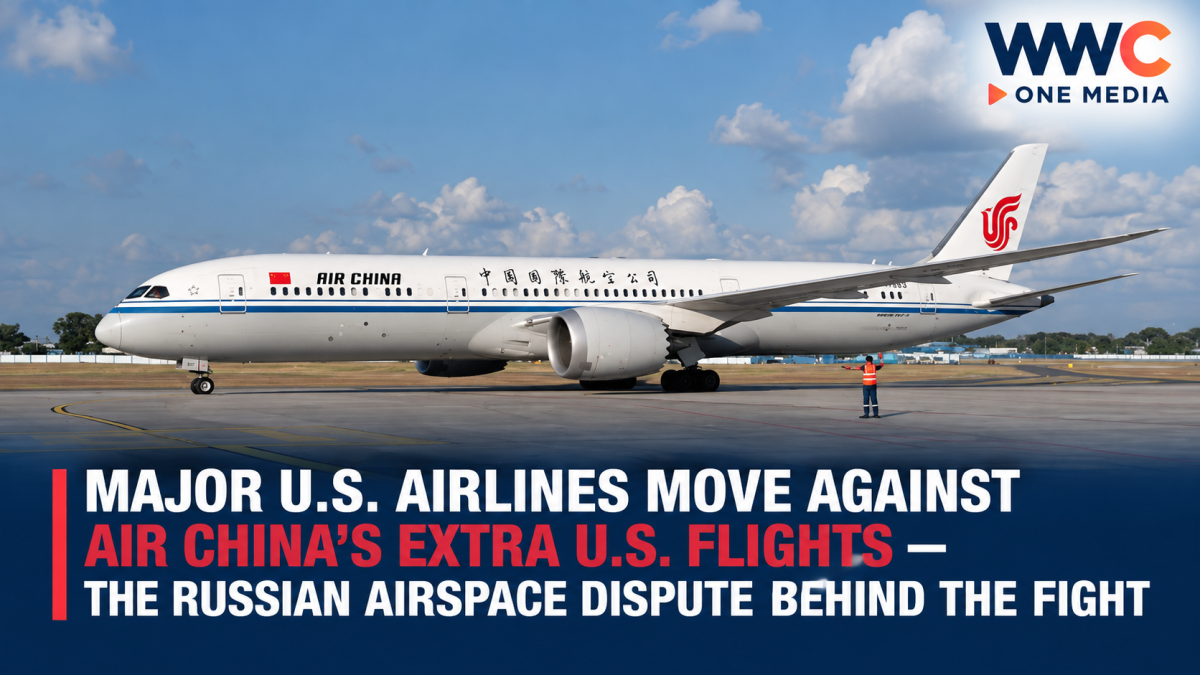
Air China has sought permission to operate two additional flights from Beijing to the United States, including services to New York and Washington, around Xi’s planned visit.
But major U.S. airlines are pushing back.
Airlines for America (A4A), whose members include American Airlines, Delta Air Lines and United Airlines, has formally opposed the request, arguing that the additional operations should be treated as charter flights rather than regular scheduled services.
At the center of the dispute is an unusual aviation imbalance created by the war in Ukraine: Chinese airlines can continue using Russian airspace on some routes to the United States, while U.S. airlines cannot.
That difference can translate into shorter flight times, lower fuel consumption and lower operating costs for Chinese carriers on certain China-U.S. routes.
Air China wants two additional U.S. operations
According to Reuters, Air China requested two additional flights for this week and next week connecting Beijing with New York and Washington.
The timing coincides with Xi’s planned meeting with Trump in the United States.
The additional services would provide more capacity around a major diplomatic event, but U.S. airlines are concerned about how the flights are classified.
A4A argues that if the operations are added to Air China’s regular scheduled service, they could create a precedent for Chinese airlines to seek additional permanent frequencies under the same framework.
The U.S. airline group therefore wants the flights treated as charters, rather than as scheduled additions.
Why American, Delta and United are objecting
The core issue is not simply the number of passengers on two flights.
It is the airspace advantage that U.S. airlines say Chinese carriers currently have.
Following Russia’s invasion of Ukraine in 2022, Russia barred U.S. airlines from using its airspace. The United States had earlier barred Russian aircraft from U.S. airspace.
Chinese airlines were not subjected to the same Russian restriction and have continued to use Russian airspace on some international routes.
That creates a major difference on long-haul flights between the U.S. East Coast and China.
Chinese airlines can use more direct northern routings across Russia, while U.S. carriers must generally fly around Russian airspace.
A4A argues that Chinese airlines consequently have shorter and less costly routings on some China-U.S. services.
The extra distance has a real economic impact
Long-haul airline economics are heavily influenced by fuel burn, aircraft utilization, crew time and payload.
A longer route can mean:
- More fuel consumed
- Longer aircraft operating times
- Higher crew costs
- Potentially reduced payload flexibility
- Less efficient aircraft utilization
- More complicated scheduling
For airlines operating in a highly competitive international market, those differences can materially affect the economics of a route.
This is why U.S. airlines have repeatedly raised the Russian-airspace issue with Washington.
The argument from A4A is that granting Chinese carriers additional scheduled capacity while the underlying airspace imbalance remains unresolved could further widen the competitive gap.
Washington has already tried to address the issue
The dispute is not new.
In October 2025, the U.S. Department of Transportation proposed restricting Chinese airlines from using Russian airspace on routes to and from the United States.
The proposal was based on the department’s assessment that Chinese carriers’ ability to use Russian airspace created competitive disadvantages for U.S. airlines.
The proposal, however, encountered opposition from other U.S. government agencies and was ultimately shelved ahead of trade discussions with Beijing.
That left the underlying airspace imbalance in place.
Why the timing with Xi’s visit matters
The dispute is unfolding against the backdrop of a potentially important U.S.-China diplomatic meeting.
Xi’s planned visit to Washington means there is an obvious logistical reason for additional flights around the event.
But for U.S. airlines, the classification of those flights matters.
If the operations are treated as temporary charters, they would not necessarily establish new scheduled commercial frequencies.
If they are incorporated into regular schedules, A4A fears Chinese carriers could later cite them when seeking additional scheduled operations.
That is why what might appear to be a small scheduling dispute has become part of the broader U.S.-China aviation relationship.
Air China already has a U.S. presence
The dispute is also occurring while Air China already operates scheduled services between China and the United States.
Aviation industry reporting indicates Air China operates services linking Beijing with destinations including New York and Washington, alongside other U.S. routes.
The airline’s ability to use Russian airspace on some of these long-haul routes gives it an operational option that American carriers do not currently have.
That difference has become particularly important for U.S. airlines seeking to restore or expand East Coast service to mainland China.
U.S.-China air travel remains below its pre-pandemic structure
The dispute is taking place in a market that has not fully returned to its earlier configuration.
U.S. and Chinese carriers operate under bilateral aviation arrangements that limit the number of scheduled passenger operations each side can conduct.
At the same time, airlines have faced weaker economics on some routes because of geopolitical tensions, longer routings and changes in international travel patterns.
Aviation Week reported that scheduled U.S.-China capacity for winter 2026–27 was expected to remain below the levels of the market’s earlier peak, with Chinese carriers holding a larger share of available seats in that period.
That imbalance adds another layer to the current dispute.
The fight is about more than two flights
A4A’s objection is essentially about precedent.
If Air China’s additional operations are approved as scheduled services, U.S. airlines fear the decision could make it easier for Chinese carriers to request additional regular flights without first resolving the Russian-airspace issue.
The trade group therefore wants the special flights handled differently from normal scheduled frequencies.
For U.S. airlines, the concern is that capacity decisions and airspace restrictions should be considered together.
For Chinese carriers, continued access to Russian airspace remains an important operational advantage on certain routes.
The issue also affects passengers
For travelers, the airspace dispute has consequences beyond airline competition.
Routes that avoid Russian airspace can take longer and consume more fuel.
That can affect:
- Flight duration
- Aircraft scheduling
- Fuel costs
- Ticket economics
- Available nonstop routes
The longer a flight takes, the more expensive it can be to operate, all else being equal.
Chinese carriers able to use shorter routings can therefore have a different cost structure from American competitors flying the same broad city pairs.
What the U.S. government must decide
The immediate question now sits with the U.S. Department of Transportation.
The department will have to determine how to treat Air China’s requested additional operations.
The current dispute is not a final decision to block Air China’s flights.
Reuters reported that the USDOT and Air China’s legal representative had not immediately commented on the U.S. airlines’ objection.
The outcome could therefore provide an important signal about how Washington intends to manage the aviation relationship with Beijing.
A much larger U.S.-China aviation battle is taking shape
The Air China request comes at a time when aviation has become another arena in the broader U.S.-China economic relationship.
The two countries are negotiating trade, technology and investment issues while airlines continue trying to rebuild international networks.
The Russian-airspace question adds an unusual complication because the two sides’ airlines are technically competing in the same international market while operating under dramatically different geographic conditions.
For American, Delta and United, the issue is about maintaining competitive access.
For Air China, the ability to use available airspace can provide a significant operational advantage.
And for Washington, the decision involves balancing airline competition, bilateral aviation rights, diplomatic considerations and the broader U.S.-China relationship.
The next decision could set the tone for future flights
Air China’s request involves only two additional operations.
But the implications could extend much further.
If Washington allows them as scheduled services, Chinese airlines could potentially seek to build on that precedent.
If the flights are handled as charters, U.S. carriers may view that as a way to accommodate the immediate diplomatic travel demand without expanding regular scheduled rights.
And if Washington revisits the Russian-airspace question itself, the dispute could reopen a much bigger debate over how U.S. and Chinese airlines should compete on long-haul routes.
For now, the battle is over two additional flights. But behind those flights sits a much larger question: can U.S. and Chinese airlines truly compete on equal terms while one side can use Russian airspace and the other cannot?
The Department of Transportation’s handling of Air China’s request could offer the next clue.