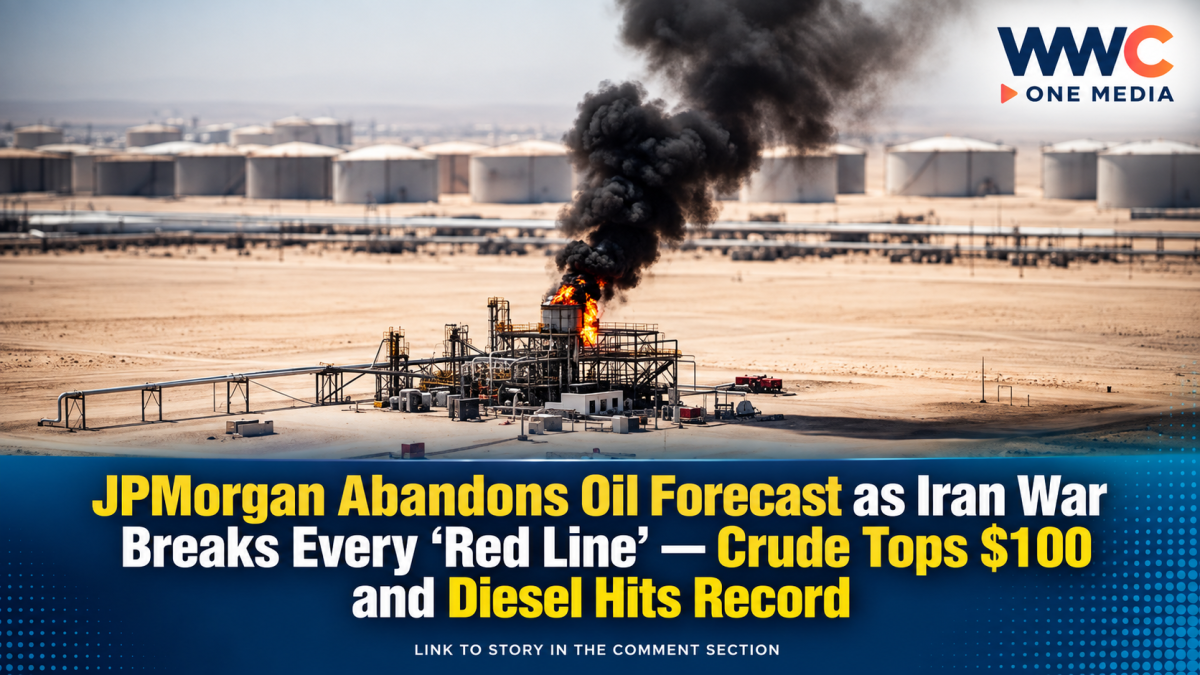
One of Wall Street’s biggest energy forecasting teams has effectively thrown out its previous roadmap for the oil market.
JPMorgan’s commodities analysts say they no longer have a clear baseline scenario for where oil prices are headed, as the U.S.-Israeli conflict with Iran continues to disrupt global energy supplies and undermine assumptions the bank previously made about how the crisis would end.
In a September 17 research note reported by Reuters, JPMorgan’s commodities team said: “We simply don’t know how to model the endgame.” The bank said this was the first time since the conflict began that it lacked a baseline view for the oil market.
The warning comes as Brent crude has moved above $100 a barrel, while U.S. diesel prices reached a record $6.31 per gallon. Gasoline was also around $4.37 per gallon, according to JPMorgan’s assessment cited by Reuters.
The message from one of the world’s most closely watched commodities desks is not that oil must continue rising indefinitely—but that the normal assumptions used to model the market have become increasingly unreliable.
JPMorgan says its previous assumptions have been overtaken by events
At the beginning of the conflict, JPMorgan analysts assumed economic pressure would eventually create incentives for Washington to pursue a resolution.
Those assumptions have now been overtaken by the duration and scale of the conflict, according to the bank’s latest analysis.
Reuters reported that JPMorgan had identified economic thresholds it expected would constrain the U.S. administration. Six months into the conflict, however, those thresholds have been crossed without producing a clear exit strategy.
That has left analysts facing a much wider range of possible outcomes.
Instead of modeling a relatively straightforward path toward de-escalation, the bank is now assessing a market where disruptions to crude production, refining and shipping could persist for an uncertain period.
Brent is above $100—but JPMorgan says its “fair value” is lower
The latest market pricing is also telling.
JPMorgan estimated Brent’s September fair value at roughly $90 per barrel, while the market was trading near $106 when the September 17 analysis was released.
That difference indicates that investors are assigning a significant premium to the possibility of further supply disruption.
JPMorgan estimated that roughly 10 million barrels per day of supply has already been disrupted, while warning that the market is effectively pricing in the possibility of additional losses.
The bank did not say that the additional disruption will necessarily happen.
Rather, the pricing reflects the risk investors are assigning to it.
Why oil has not surged even further
One of the most striking elements of JPMorgan’s analysis is that the oil market has absorbed an extraordinary supply shock without crude prices rising even more dramatically.
The reason is a combination of weaker demand and relatively limited inventory drawdowns.
JPMorgan estimates that global crude and refined-product inventories have fallen by around 555 million barrels since the conflict began—only about one-third of the decline the bank had initially projected.
At the same time, global oil demand has been running roughly 4.4 million barrels per day below year-earlier levels, helping offset some of the supply disruption.
In other words, consumers and businesses have already responded to high energy prices by using less fuel, while inventories have provided an additional cushion.
That has prevented the supply shock from translating into an even larger crude-price explosion.
But the buffer is being consumed
The problem is what happens if the conflict continues.
JPMorgan said significant inventories remain available in major economies including China, Europe, Japan and South Korea, providing some protection against prolonged disruption.
But those inventories are not unlimited.
If Middle East supply disruptions continue for an extended period, the market could become increasingly dependent on demand destruction to remain balanced.
That means higher prices themselves would have to force consumers and businesses to reduce consumption enough to compensate for lost supply.
That is one reason the bank remains concerned even though crude has not reached some of the extreme levels initially feared.
Diesel is becoming an even bigger problem
Crude oil is not the only part of the energy market under pressure.
Diesel has become one of the most significant warning signals.
JPMorgan reported that U.S. diesel prices reached a record $6.31 per gallon, while inventories were at historically low levels.
That matters because diesel is deeply embedded in the real economy.
Trucks use it to transport goods. Ships and industrial equipment depend on petroleum-based fuels. Agriculture, construction, mining and logistics also rely heavily on diesel.
Reuters noted that diesel and heating oil together account for roughly 30% of global oil consumption, or about 29 million barrels per day.
A sustained diesel shortage can therefore spread through the economy even when consumers are not buying diesel directly.
Higher trucking costs can raise the cost of moving food and manufactured goods. Higher shipping and industrial costs can then work their way into consumer prices.
The refining problem may be harder to fix than the crude problem
Another complication is that the current energy shock is increasingly about refining capacity, not simply crude production.
Reuters reported that global refining throughput has been damaged by conflict-related disruptions involving Middle Eastern and Russian facilities.
That creates a crucial distinction.
Crude oil must be processed into products such as diesel, gasoline and jet fuel. If refining capacity is unavailable, additional crude supply alone cannot immediately solve shortages of finished petroleum products.
This is why diesel prices can remain exceptionally high even when crude prices are considerably lower than the implied cost of the refined product.
The Strait of Hormuz remains a critical risk
The geopolitical risk is also tied to one of the world’s most important energy chokepoints: the Strait of Hormuz.
The waterway normally handles a huge share of global oil and LNG shipments.
Although some oil flows have recovered through alternative routes and shipping arrangements, continued military tension creates uncertainty over how much energy can reliably move through the region.
The Associated Press reported September 18 that Iran claimed its Revolutionary Guard had struck the Togo-flagged tanker Trend while it was attempting to transit the Strait of Hormuz. AP said it could not immediately independently confirm the Iranian claim.
That incident illustrates why shipping remains an important component of the oil-price equation.
Red Sea and Saudi routes add another layer of risk
The risk is not confined to Hormuz.
JPMorgan’s analysis also pointed to threats involving the Bab el-Mandeb Strait and attacks affecting Saudi export infrastructure.
Alternative routes have helped keep some oil moving, but each additional disruption reduces the market’s ability to compensate for lost barrels elsewhere.
This creates a fragile balancing act.
As long as enough supply can move through alternative routes and demand remains subdued, prices may remain below the most extreme scenarios.
But if multiple transportation routes or production centers are disrupted simultaneously, the market’s remaining spare capacity and inventories could come under much greater pressure.
JPMorgan’s previous forecast now looks increasingly distant
The latest warning is particularly notable because JPMorgan had previously published a much more conventional oil-price outlook.
In July, JPMorgan Global Research forecast average Brent prices of about $86 per barrel in the third quarter of 2026, $80 in the fourth quarter and $78 at year-end.
That forecast was based on expectations that the market would rebalance through weaker demand and inventory changes.
The bank’s September assessment does not simply represent a routine adjustment to those numbers.
It reflects a fundamental change in the forecasting environment.
The problem is no longer just determining whether supply and demand will balance at $80, $90 or $100.
It is determining what geopolitical conditions will exist when the market attempts to find that balance.
The market is already responding through demand destruction
The current oil shock is also changing behavior.
JPMorgan’s data show that global oil demand has fallen significantly compared with the previous year.
That reduction has helped prevent crude prices from rising in proportion to the supply disruption.
But demand destruction comes with an economic cost.
Businesses may reduce production or transportation. Consumers may cut discretionary travel. Industries may search for alternative energy sources.
Over time, those adjustments can slow economic activity.
Reuters quoted Wood Mackenzie oil-market analyst Alan Gelder as saying higher diesel prices can take longer to filter through the economy and gradually weigh on global growth.
What happens if the conflict continues?
There is no single answer—and that is precisely JPMorgan’s point.
If supply disruptions ease, alternative routes remain open and demand stays weak, oil prices could eventually move lower.
If disruptions persist while inventories continue falling, the market could face greater upward pressure.
And if additional production, refining or shipping infrastructure is damaged, the supply shock could become substantially harder to absorb.
JPMorgan’s latest analysis therefore should not be read as a declaration that oil is guaranteed to surge indefinitely.
It is a warning that the range of possible outcomes has widened dramatically.
The next pressure point could be inflation
The biggest economic concern may ultimately extend beyond the oil market.
Higher diesel prices can affect transportation, agriculture, manufacturing, construction and logistics.
That creates a pathway from an overseas military conflict to higher costs for businesses and households around the world.
JPMorgan’s separate analysis of record diesel prices has highlighted the fuel’s implications for inflation, shipping costs and investment markets.
For central banks, that creates a difficult environment: energy-driven inflation can rise even as higher fuel costs simultaneously weaken economic activity.
For now, the oil market is operating without a clear roadmap
The central message from JPMorgan’s commodities team is unusually blunt.
The bank is not saying it knows where oil will end up.
It is saying that the assumptions it previously used to establish a baseline have been undermined by the prolonged conflict.
Brent is above $100. U.S. diesel has reached a record. Inventories are being depleted, while global demand is already responding to higher prices.
And with shipping routes, refining capacity and Middle Eastern infrastructure all exposed to geopolitical risk, the market has fewer certainties than it did at the start of the conflict.
The question now is no longer simply whether oil can break $100. It already has. The bigger question is how long the global energy system can absorb the shock before shrinking inventories, refining bottlenecks and higher diesel costs begin forcing an even larger economic adjustment.